Pearson+ LogoPearson+ Logo
Ch. 3 - Mendelian Genetics
Klug - Essentials of Genetics 10th Edition
Klug10th EditionEssentials of GeneticsISBN: 9780135588789Not the one you use?Change textbook
Chapter 3, Problem 23e

Two true-breeding pea plants are crossed. One parent is round, terminal, violet, constricted, while the other expresses the contrasting phenotypes of wrinkled, axial, white, full. The four pairs of contrasting traits are controlled by four genes, each located on a separate chromosome. In the F1 generation, only round, axial, violet, and full are expressed. In the F2 generation, all possible combinations of these traits are expressed in ratios consistent with Mendelian inheritance.
If the F1 plant is testcrossed, how many different phenotypes will be produced?

Verified step by step guidance
1
Identify the genotypes of the two true-breeding parent plants based on their phenotypes. Since each trait is controlled by a single gene with two alleles, assign dominant and recessive alleles accordingly. For example, round (R) is dominant over wrinkled (r), terminal (T) over axial (t), violet (V) over white (v), and constricted (C) over full (c).
Determine the genotype of the F1 generation by crossing the two true-breeding parents. Since the parents are homozygous for contrasting traits, the F1 genotype will be heterozygous for all four genes (e.g., Rr Tt Vv Cc).
Understand that a testcross involves crossing the F1 heterozygous plant with a homozygous recessive plant for all traits (rr tt vv cc). This allows us to observe the segregation of alleles in the offspring.
Calculate the number of different phenotypes produced in the testcross offspring. Since each gene segregates independently and the recessive parent contributes only recessive alleles, the phenotype of each offspring depends solely on the allele inherited from the F1 parent for each gene. Each gene can contribute either a dominant or recessive phenotype, resulting in 2 possible phenotypes per gene.
Use the formula for the total number of phenotypic classes in the testcross: \$2^n\(, where \)n\( is the number of genes. Since there are 4 genes, the total number of different phenotypes is \)2^4$.

Key Concepts

Here are the essential concepts you must grasp in order to answer the question correctly.

Mendelian Inheritance and Independent Assortment

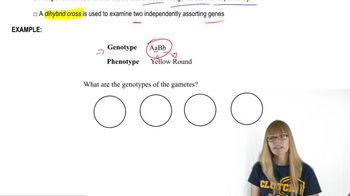
Mendelian inheritance describes how traits are passed from parents to offspring through dominant and recessive alleles. Independent assortment states that genes on different chromosomes segregate independently during gamete formation, leading to various combinations of traits in offspring.
Recommended video:
Guided course
04:58
Gamete Genetics and Independent Assortment

Testcross

A testcross involves crossing an individual with a dominant phenotype but unknown genotype with a homozygous recessive individual. This helps reveal the unknown genotype by analyzing the phenotypes of the offspring, especially useful for determining heterozygosity.

Phenotypic Ratios from Multiple Gene Crosses

When multiple genes assort independently, the number of possible phenotypes in offspring is determined by the combinations of dominant and recessive alleles. For n genes, a testcross typically produces 2^n different phenotypes, reflecting all possible allele combinations.
Recommended video:
Guided course
06:14
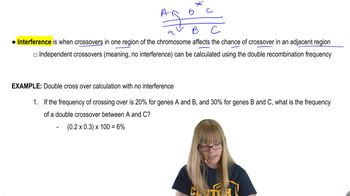
Multiple Cross Overs and Interference