Skip to main content
GOB Chemistry
My Course
Learn
Exam Prep
AI Tutor
Study Guides
Textbook Solutions
Flashcards
Explore
Try the app
My Course
Learn
Exam Prep
AI Tutor
Study Guides
Textbook Solutions
Flashcards
Explore
Try the app
Back
Enzyme Regulation: Allosteric Control definitions
You can tap to flip the card.
Enzyme Regulation
You can tap to flip the card.
👆
Enzyme Regulation
Cellular process using various mechanisms to control when enzymes are active or inactive, ensuring metabolic reactions occur as needed.
Track progress
Control buttons has been changed to "navigation" mode.
1/12
Related flashcards
Related practice
Recommended videos
Enzyme Regulation: Allosteric Control quiz
Enzyme Regulation: Allosteric Control
15 Terms
Enzyme Regulation: Allosteric Control
19. Enzymes
1 problem
Topic
Laura
Enzyme Regulation: Feedback Control
19. Enzymes
1 problem
Topic
Laura
19. Enzymes
9 topics
15 problems
Chapter
Laura
Guided course
1:21
Allosteric Control Example 1
2992
views
1
rank
Guided course
2:57
Allosteric Control Concept 1
2770
views
2
rank
Terms in this set (12)
Hide definitions
Enzyme Regulation
Cellular process using various mechanisms to control when enzymes are active or inactive, ensuring metabolic reactions occur as needed.
Allosteric Control
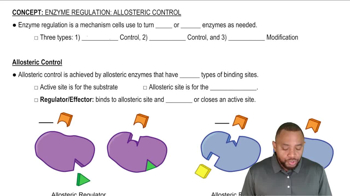
Mechanism where enzyme activity is managed by molecules binding at a site distinct from the active site, altering enzyme function.
Allosteric Enzyme
Protein with both an active site for substrate and a separate site for regulatory molecule attachment, enabling activity modulation.
Active Site
Region on an enzyme where a substrate specifically binds, allowing the chemical reaction to proceed.
Allosteric Site
Distinct region on an enzyme where a regulator binds, influencing the accessibility of the active site.
Regulator
Molecule, also called effector, that attaches to the allosteric site to modify enzyme activity by altering the active site.
Effector
Alternative term for a molecule that binds to the allosteric site, impacting enzyme function positively or negatively.
Positive Allosteric Regulator
Molecule that binds to the allosteric site, making the active site available and increasing the enzyme's reaction rate.
Negative Allosteric Regulator
Molecule that binds to the allosteric site, making the active site unavailable and decreasing the enzyme's reaction rate.
Substrate
Specific molecule that binds to the active site of an enzyme, undergoing a chemical transformation.
Feedback Control
Regulatory mechanism where the end product of a pathway influences enzyme activity earlier in the pathway.
Covalent Modification
Enzyme regulation method involving the addition or removal of chemical groups, altering enzyme activity.
 BackBack
 1:21
1:21