Skip to main content
GOB Chemistry
My Course
Learn
Exam Prep
AI Tutor
Study Guides
Textbook Solutions
Flashcards
Explore
Try the app
My Course
Learn
Exam Prep
AI Tutor
Study Guides
Textbook Solutions
Flashcards
Explore
Try the app
Back
Enzyme Regulation: Allosteric Control quiz
You can tap to flip the card.
What are the three main types of enzyme regulation?
You can tap to flip the card.
👆
What are the three main types of enzyme regulation?
The three main types are allosteric control, feedback control, and covalent modification.
Track progress
Control buttons has been changed to "navigation" mode.
1/15
Related flashcards
Related practice
Recommended videos
Enzyme Regulation: Allosteric Control definitions
Enzyme Regulation: Allosteric Control
12 Terms
Enzyme Regulation: Allosteric Control
19. Enzymes
1 problem
Topic
Laura
Enzyme Regulation: Feedback Control
19. Enzymes
1 problem
Topic
Laura
19. Enzymes
9 topics
15 problems
Chapter
Laura
Guided course
1:21
Allosteric Control Example 1
2992
views
1
rank
Guided course
2:57
Allosteric Control Concept 1
2770
views
2
rank
Terms in this set (15)
Hide definitions
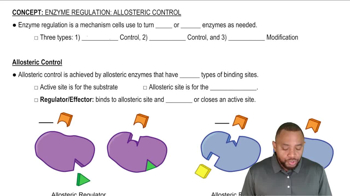
What are the three main types of enzyme regulation?
The three main types are allosteric control, feedback control, and covalent modification.
What is the function of the active site on an enzyme?
The active site is where the substrate attaches to the enzyme.
What is the allosteric site on an enzyme?
The allosteric site is a location on the enzyme where a regulator (effector) binds.
What happens when a positive allosteric regulator binds to an enzyme?
It opens up an active site, increasing the rate of reaction by allowing substrate attachment.
How does a negative allosteric regulator affect enzyme activity?
It closes or hides the active site, decreasing the rate of reaction by preventing substrate attachment.
What is another name for a regulator in allosteric control?
A regulator is also called an effector.
How do allosteric enzymes differ from other enzymes?
Allosteric enzymes have both an active site and an allosteric site for regulator binding.
What is the effect of a regulator binding to the allosteric site?
It can either enhance or inhibit the enzyme's activity by modifying the accessibility of the active site.
What does a positive allosteric regulator do to the rate of reaction?
It increases the rate of reaction.
What does a negative allosteric regulator do to the rate of reaction?
It decreases the rate of reaction.
Where does the substrate bind on an enzyme?
The substrate binds at the active site.
What is the main purpose of enzyme regulation in cells?
It allows cells to turn enzymes on or off as needed.
What happens to the active site when a negative regulator binds to the allosteric site?
The active site becomes unavailable for substrate attachment.
What is the abbreviation commonly used for substrate in enzyme diagrams?
The substrate is commonly abbreviated as 'S'.
How does allosteric control help manage enzyme activity?
It manages enzyme activity by using regulators that bind to the allosteric site to open or close the active site.
 BackBack
 1:21
1:21