Skip to main content
GOB Chemistry
My Course
Learn
Exam Prep
AI Tutor
Study Guides
Textbook Solutions
Flashcards
Explore
Try the app
My Course
Learn
Exam Prep
AI Tutor
Study Guides
Textbook Solutions
Flashcards
Explore
Try the app
Back
Enzyme Regulation: Feedback Control quiz
You can tap to flip the card.
What is a metabolic pathway?
You can tap to flip the card.
👆
What is a metabolic pathway?
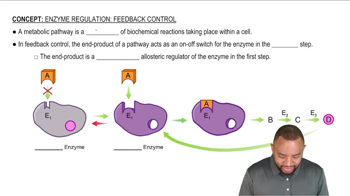
A metabolic pathway is a series of biochemical reactions taking place within a cell.
Track progress
Control buttons has been changed to "navigation" mode.
1/15
Related flashcards
Related practice
Recommended videos
Enzyme Regulation: Feedback Control definitions
Enzyme Regulation: Feedback Control
13 Terms
Enzyme Regulation: Feedback Control
19. Enzymes
1 problem
Topic
Laura
Enzyme Regulation: Covalent Modification
19. Enzymes
2 problems
Topic
Laura
19. Enzymes
9 topics
15 problems
Chapter
Laura
Guided course
2:08
Feedback Control Example 1
2958
views
2
rank
Guided course
2:50
Feedback Control Concept 1
2906
views
2
rank
Terms in this set (15)
Hide definitions
What is a metabolic pathway?
A metabolic pathway is a series of biochemical reactions taking place within a cell.
What role does the end product play in feedback control of a metabolic pathway?
The end product acts as an on/off switch for the enzyme in the first step by serving as a negative allosteric regulator.
Where does the substrate bind on an enzyme?
The substrate binds to the active site of the enzyme.
What is formed when a substrate attaches to an enzyme?
An enzyme-substrate complex is formed.
What happens after the enzyme-substrate complex is formed?
The complex helps create intermediates, eventually leading to the final product.
What is the purpose of the allosteric site on an enzyme?
The allosteric site is where a regulator, such as the end product, can bind to influence enzyme activity.
How does the end product regulate the enzyme when enough product has been made?
The end product binds to the allosteric site, changing the active site so the substrate can no longer bind, making the enzyme inactive.
What is the effect of the end product binding to the allosteric site?
It renders the enzyme inactive and stops further production of the end product.
What happens when the concentration of the end product decreases?
The end product detaches from the allosteric site, allowing the enzyme to become active again.
What is feedback control in enzyme regulation?
Feedback control is a regulatory mechanism where the end product of a pathway inhibits the enzyme at the first step to prevent overproduction.
Why is feedback control important in cells?
It ensures the cell does not overproduce the end product, maintaining balance and efficiency.
What is a negative allosteric regulator?
A negative allosteric regulator is a molecule that binds to an enzyme's allosteric site and decreases its activity.
How does the enzyme become inactive during feedback control?
The enzyme becomes inactive when the end product binds to its allosteric site, altering the active site so the substrate cannot bind.
What restarts the metabolic pathway after it has been stopped by feedback control?
The pathway restarts when the end product detaches from the allosteric site as its concentration decreases.
What is the main goal of enzyme regulation by feedback control?
The main goal is to prevent the unnecessary synthesis of the end product by turning off the pathway when enough product is present.
 BackBack
 2:08
2:08