 Back
BackFiltration and Evaporation definitions
 03:56
03:56
Terms in this set (14)
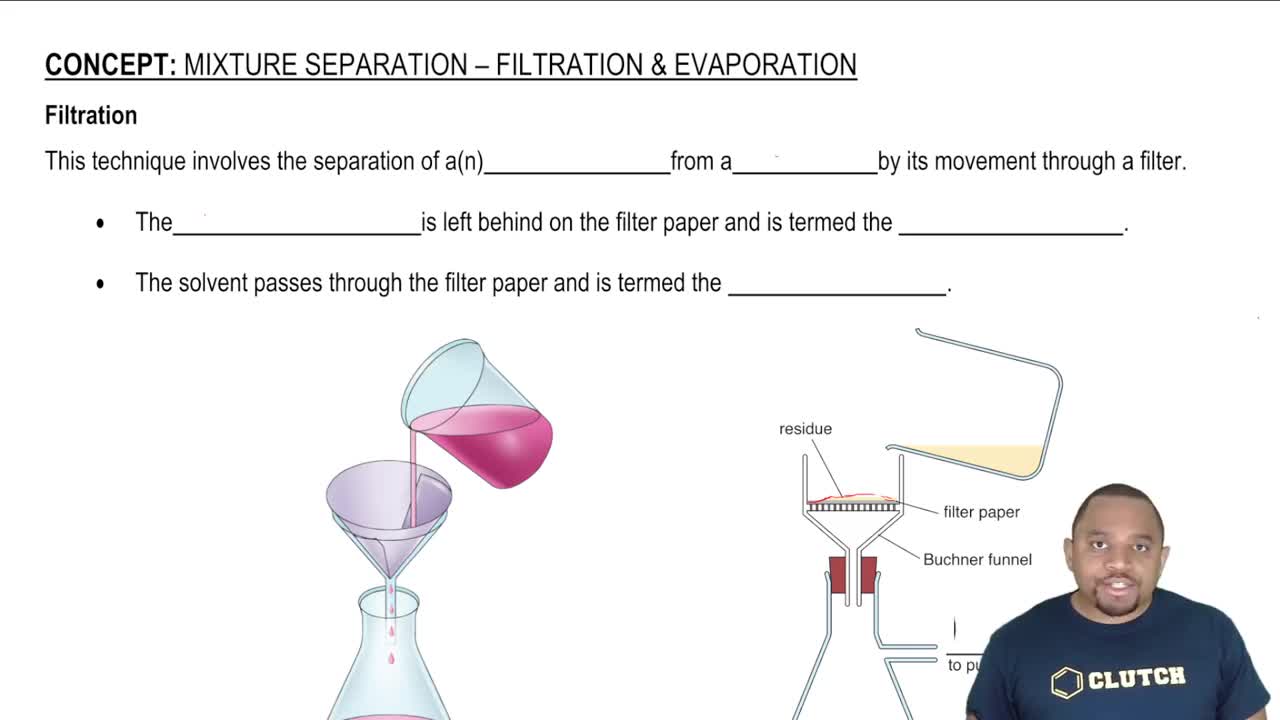
Filtration
Technique for separating an insoluble solid from a liquid using a barrier that retains the solid while allowing the liquid to pass through.
Residue
Material left behind on the barrier after separation, typically the insoluble solid that does not pass through.
Filtrate
Liquid that successfully passes through the barrier during separation, leaving the solid behind.
Filter Paper
Semi-permeable membrane used to trap solids while allowing liquids to pass during separation processes.
Erlenmeyer Flask
Conical laboratory container commonly used to collect liquids during separation techniques.
Funnel
Device used to channel mixtures into containers and support barriers for separation.
Vacuum Pump
Apparatus that creates reduced pressure to accelerate the movement of liquids through barriers.
Buckner Funnel
Specialized device with a flat base, used with reduced pressure to speed up separation of solids from liquids.
Recrystallization
Process where dissolved solids form crystals again, often aided by temperature reduction during separation.
Evaporation
Technique for separating a soluble solid from a liquid by heating until the liquid vaporizes, leaving the solid behind.
Crystallization
Formation of solid particles from a solution as the liquid component is removed, often by heating.
Bunsen Burner
Heat source commonly used in laboratories to vaporize liquids during separation processes.
Evaporation Dish
Heat-resistant container used to hold mixtures during the removal of liquids by heating.
Semi-permeable Membrane
Barrier that allows certain substances, typically liquids, to pass while retaining others, such as solids.