Skip to main content
GOB Chemistry
My Course
Learn
Exam Prep
AI Tutor
Study Guides
Textbook Solutions
Flashcards
Explore
Try the app
My Course
Learn
Exam Prep
AI Tutor
Study Guides
Textbook Solutions
Flashcards
Explore
Try the app
Back
Models of Enzyme Action definitions
You can tap to flip the card.
Enzyme
You can tap to flip the card.
👆
Enzyme
A biological catalyst that interacts with specific molecules to accelerate chemical reactions by lowering activation energy.
Track progress
Control buttons has been changed to "navigation" mode.
1/13
Related flashcards
Related practice
Recommended videos
Models of Enzyme Action quiz
Models of Enzyme Action
15 Terms
Models of Enzyme Action
19. Enzymes
7 problems
Topic
KeyshawnDavis
Factors Affecting Enzyme Activity
19. Enzymes
7 problems
Topic
Laura
19. Enzymes
9 topics
15 problems
Chapter
Laura
Guided course
2:39
Models of Enzyme Action Concept 1
2945
views
1
rank
Guided course
1:26
Models of Enzyme Action Example 1
2850
views
1
rank
Terms in this set (13)
Hide definitions
Enzyme
A biological catalyst that interacts with specific molecules to accelerate chemical reactions by lowering activation energy.
Substrate
A molecule that binds to a specific region of a catalyst, undergoing a transformation during a biochemical reaction.
Active Site
A specialized region on a catalyst where a molecule binds, allowing a chemical transformation to occur.
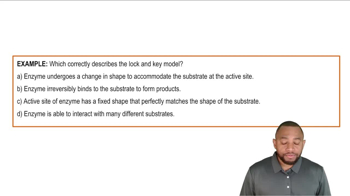
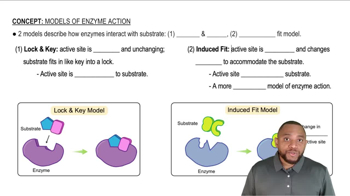
Lock and Key Model
A concept where a catalyst's binding region is rigid, allowing only perfectly matching molecules to interact.
Induced Fit Model
A concept where a catalyst's binding region is flexible, adjusting its shape to accommodate a molecule.
Enzyme-Substrate Complex
A temporary structure formed when a molecule binds to a catalyst's specific region, enabling a reaction.
Specificity
The property of a catalyst to interact only with certain molecules due to precise structural compatibility.
Rigidity
A characteristic of a structure that does not change shape, ensuring only exact matches can interact.
Flexibility
A characteristic of a structure that can alter its shape to better accommodate interacting molecules.
Complementarity
A relationship where two structures fit together due to matching shapes or chemical properties.
Grooves
Structural features on a catalyst's binding region that contribute to the fit and interaction with molecules.
Accommodation
The process by which a structure adapts its shape to allow effective interaction with another molecule.
Dynamic Interaction
A process involving continuous structural adjustments to optimize the fit between interacting molecules.
 BackBack
 2:39
2:39