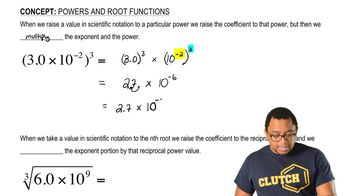
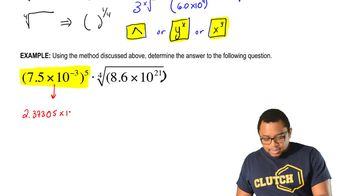
A way to express numbers as a coefficient between 1 and 10 multiplied by a power of 10, simplifying calculations with very large or small values.
Coefficient
The decimal number in scientific notation that must remain between 1 and 10 for proper expression.
Exponent
The integer in scientific notation indicating how many times the coefficient is multiplied or divided by 10.
Power
A mathematical operation where a number is multiplied by itself a specified number of times, affecting both coefficient and exponent in scientific notation.
Root Function
An operation that finds a value which, when raised to a specific power, equals the original number; often expressed as a reciprocal exponent.
Reciprocal Power
A fractional exponent representing the inverse of a root, such as 1/3 for cube root or 1/2 for square root.
Cube Root
A specific root function that determines what number multiplied by itself three times equals the original value.
Square Root
A root function that finds the value which, when multiplied by itself, gives the original number; equivalent to raising to the 1/2 power.
Standard Form
The correct format for scientific notation, requiring the coefficient to be between 1 and 10.
Calculator Function
A specific button or sequence on a calculator used to perform operations like roots or powers, which may vary by model.
Parenthesis
Symbols used in calculator input to group numbers or operations, ensuring correct calculation order.
Caret Button
A calculator key (^) used to indicate exponentiation or raising a number to a power.
YX Button
A calculator key allowing the user to raise a base number to any exponent entered.
Decimal Point
A symbol used to separate the integer part from the fractional part of a number, crucial for adjusting coefficients in scientific notation.
Adjustment
The process of shifting the decimal point and modifying the exponent to maintain the coefficient within the required range in scientific notation.