A covalent bond involves the sharing of valence electrons between atoms to achieve a full outer shell.
What is the octet rule?
The octet rule states that atoms react to achieve 8 valence electrons, resembling the electron configuration of noble gases.
What is the duet rule?
The duet rule applies to hydrogen, which reacts to achieve 2 valence electrons.
List three typical properties of covalent compounds.
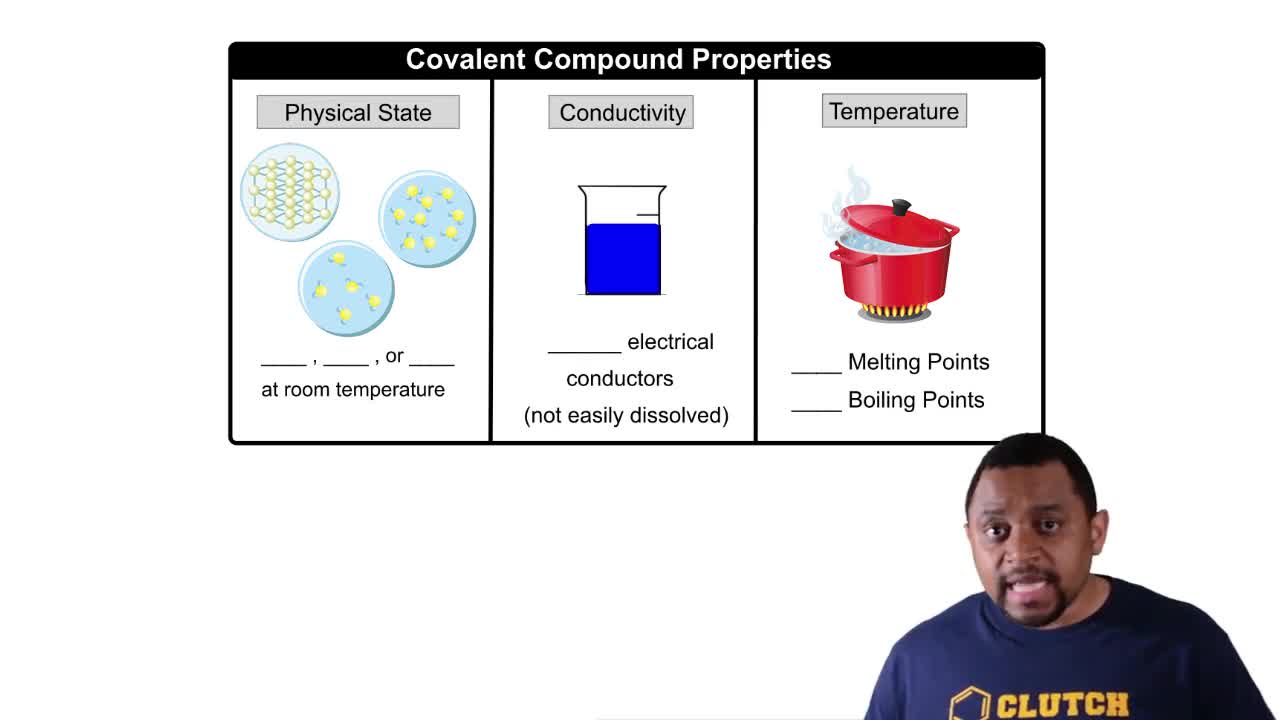
Covalent compounds tend to be gases, liquids, or solids at room temperature, are poor electrical conductors, and have low melting and boiling points.
How are binary molecular compounds named?
Name the first nonmetal normally (no 'mono' prefix if only one atom), then name the second nonmetal with a numerical prefix and change its ending to '-ide'.
What is the electron arrangement of an atom?
The electron arrangement shows the number of electrons in each energy level or shell of an atom.
How do main group metals and nonmetals achieve noble gas configurations?
Metals lose electrons to resemble the noble gas before them; nonmetals gain electrons to resemble the noble gas after them.
How are electrons removed when forming metal cations?
Electrons are removed first from the highest energy level to form cations.
What do Lewis dot symbols represent?
Lewis dot symbols represent the valence electrons of an atom or ion around the element symbol.
What is the rule for placing valence electrons in Lewis dot symbols?
Place one electron on each side of the element symbol clockwise before pairing electrons.
What are molecular models used for?
Molecular models visually represent chemical bonds and atoms using color-coded balls to show element connections.
Define nonbonding electrons and lone pairs.
Nonbonding electrons do not participate in bonding; a lone pair is a pair of nonbonding electrons on an atom.
How many bonds do elements in groups 1A to 4A typically form?
Elements in groups 1A to 4A typically form a number of bonds equal to their group number.
What is the difference between single, double, and triple bonds?
Single bonds share 1 electron pair, double bonds share 2 pairs, and triple bonds share 3 pairs; bond strength and stability increase with more bonds.
How do you draw Lewis dot structures for neutral compounds?
Determine total valence electrons, place the least electronegative atom in the center, connect atoms with single bonds, complete octets, and place remaining electrons on the central atom.
What are resonance structures?
Resonance structures are multiple valid Lewis structures differing only in the placement of electrons, representing the same molecule.
What is VSEPR theory?
Valence Shell Electron Pair Repulsion (VSEPR) theory predicts molecular geometry by minimizing repulsion between electron groups around the central atom.
How is electron geometry determined?
Electron geometry is based on the number of electron groups (bonding and lone pairs) around the central atom.
What is molecular polarity?
Molecular polarity arises from uneven electron sharing due to differences in electronegativity and molecular shape.
How are ionic compounds formed?
Ionic compounds form by the transfer of electrons from metals to nonmetals, creating oppositely charged ions held by electrostatic forces.
What are polyatomic ions?
Polyatomic ions are charged groups of covalently bonded atoms that act as a single ion.
How are acids named?
Binary acids use the prefix 'hydro-' and suffix '-ic'; oxyacids change polyatomic ion endings: '-ate' to '-ic' and '-ite' to '-ous'.
What is the mole concept?
A mole is the amount of substance containing 6.022 x 10^23 particles, linking atomic scale to macroscopic scale.
How is mass percent composition calculated?
Mass percent = (mass of element in 1 mole of compound / molar mass of compound) x 100%.
 Back
Back
 01:04
01:04