 Back
GOB Chemistry: Covalent Bonding, Molecular Polarity, Reactions, and Energy
 01:04

Terms in this set (29)
A covalent bond forms when two atoms share a pair of valence electrons, creating a stable arrangement by satisfying the octet rule or duet for hydrogen.
By the balance between the attraction of positively charged nuclei to shared electrons and the repulsion between the nuclei of the bonded atoms.
A lone pair is a pair of valence electrons on an atom that are not shared with another atom and are represented as two dots in Lewis structures.
Seven elements occur naturally as diatomic molecules, such as H2, N2, and O2, bonded covalently.
Oxygen forms a double bond (two shared pairs), and nitrogen forms a triple bond (three shared pairs) to satisfy the octet rule.
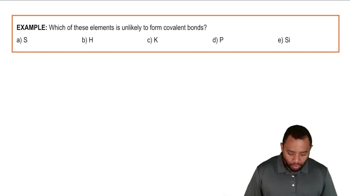
Covalent bonds form between two nonmetals or between a nonmetal and a metalloid, as nonmetals tend to share electrons rather than lose them.
The central atom is the atom bonded to more than one other atom, often carbon, nitrogen, or oxygen in covalent molecules.
Carbon typically forms four covalent bonds because it has four valence electrons and needs four more to complete its octet.
- Count total valence electrons.
- Identify the central atom.
- Connect atoms ensuring octets (duet for H).
- Use multiple bonds if needed.
Boron often forms stable compounds with only six shared electrons, not completing an octet, due to having fewer valence electrons.
VSEPR theory predicts molecular shapes by counting electron groups around a central atom and considering electron pair repulsions.
A molecule with two electron groups is linear with a bond angle of 180°.
A molecule with three electron groups is trigonal planar with bond angles of approximately 120°.
A molecule with four electron groups is tetrahedral with bond angles of approximately 109.5°.
Name the first nonmetal by element name, the second with an -ide ending, and use prefixes to indicate the number of atoms (omit 'mono' for the first element).
Electronegativity is an atom's ability to attract shared electrons; differences in electronegativity cause bonds to be nonpolar, polar covalent, or ionic.
0-0.4: nonpolar covalent; 0.5-1.7: polar covalent; 1.8-3.3: ionic bonds.
London dispersion forces, dipole-dipole forces, and hydrogen bonds.
Temporary dipoles formed by momentary uneven electron distribution induce attractions between nonpolar molecules.
A special dipole-dipole attraction between a hydrogen atom covalently bonded to O, N, or F and a lone pair on another O, N, or F atom.
A process where bonds break, atoms rearrange, and new bonds form to create new substances, often with observable changes.
Combination, decomposition, single replacement, and double replacement reactions.
A reaction involving the transfer of electrons where oxidation is loss of electrons and reduction is gain of electrons.
A mole is \(6.02\times10^{23}\) particles of a substance, used to count atoms or molecules.
Molar mass is the mass of one mole of a substance, expressed in grams per mole (g/mol), numerically equal to atomic or formula mass.
The maximum amount of product predicted from the limiting reactant in a chemical reaction.
Reactant concentration, temperature, and the presence of a catalyst affect reaction rate by influencing collision frequency and activation energy.
The minimum energy required for a chemical reaction to proceed, represented as a hill in an energy diagram.
When a system at equilibrium is disturbed, it shifts to counteract the change and restore equilibrium.