 Back
GOB Chemistry: Ionic and Molecular Compounds, Chemical Reactions
 00:53

Terms in this set (28)
Ionic compounds are chemical substances formed by the combination of metal cations and nonmetal anions held together by electrostatic attraction.
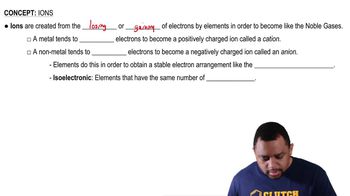
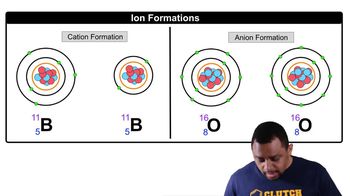
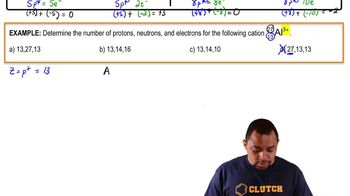
Atoms lose electrons to form cations (positive) and gain electrons to form anions (negative), following the octet rule for stability.
Atoms tend to gain, lose, or share electrons to achieve eight valence electrons, resembling the nearest noble gas configuration.
Group IA loses 1 electron, IIA loses 2, VIA gains 2, VIIA gains 1, and VIIIA are stable with filled shells.
An ionic bond is the electrostatic attraction between oppositely charged ions in a crystal lattice, forming a stable, electrically neutral compound.
Crystalline solids, high melting/boiling points, conduct electricity when molten or dissolved, brittle, and variable water solubility.
Write the cation first, then the anion; use subscripts to balance charges; use parentheses for polyatomic ions with subscripts; do not include charges.
Use the metal name followed by a Roman numeral indicating the ion's charge, e.g., iron(II) ion for Fe2+.
Ions composed of two or more atoms covalently bonded that act as a single charged unit, e.g., sulfate (SO4\(^{2-}\)).
Acids provide H+ ions in water; bases provide OH- ions. Strong acids/bases fully dissociate; weak partially dissociate.
Molecular compounds share electrons between nonmetals via covalent bonds; ionic compounds consist of ions from metals and nonmetals.
A bond formed by sharing one or more pairs of electrons between atoms to achieve stable electron configurations.
Single bonds share one pair, double bonds share two pairs, and triple bonds share three pairs of electrons between atoms.
A covalent bond where both shared electrons come from the same atom, usually from a lone pair donated to an empty orbital.
Predicting molecular shapes based on repulsions between electron pairs around a central atom to minimize repulsion.
Linear (180°), trigonal planar (120°), and tetrahedral (109.5°).
By the difference in electronegativity between two atoms; small difference = nonpolar, moderate = polar covalent, large = ionic.
A molecule is polar if it has a net dipole moment from asymmetrical bond dipoles and lone pairs.
Ionic: ions, metals + nonmetals, high melting points, conduct electricity when molten. Molecular: molecules, nonmetals only, low melting points, do not conduct electricity.
Matter is neither created nor destroyed; atoms are conserved, so equations must be balanced with equal atoms on both sides.
Numbers placed before formulas to balance the number of atoms in a chemical equation without changing subscripts.
Precipitation, acid–base neutralization, and oxidation–reduction (redox) reactions.
A reaction where two aqueous solutions form an insoluble solid (precipitate).
H+ ions from an acid react with OH- ions from a base to form water and a salt.
Oxidation is loss of electrons; reduction is gain of electrons.
Reducing agent loses electrons and is oxidized; oxidizing agent gains electrons and is reduced.
Numbers assigned to atoms to track electron transfer and determine oxidation or reduction in reactions.
Elements in elemental form = 0; monatomic ion = charge; oxygen usually -2; hydrogen +1; sum equals molecule charge or zero.