Skip to main content
GOB Chemistry
My Course
Learn
Exam Prep
AI Tutor
Study Guides
Textbook Solutions
Flashcards
Explore
Try the app
My Course
Learn
Exam Prep
AI Tutor
Study Guides
Textbook Solutions
Flashcards
Explore
Try the app
Back
GOB Chemistry: Ions and Ionic Compounds
You can tap to flip the card.
What is an ion?
You can tap to flip the card.
👆
What is an ion?
An ion is an atom carrying a charge, either positive (cation) or negative (anion), formed by gaining or losing electrons.
Track progress
Control buttons has been changed to "navigation" mode.
1/24
Recommended videos
Guided course
00:53
Ions (Simplified) Concept 1
5734
views
96
rank
Guided course
01:59
Ions (Simplified) Concept 2
5174
views
52
rank
Guided course
02:22
Ions (Simplified) Example 1
9090
views
116
rank
Terms in this set (24)
Hide definitions
What is an ion?
An ion is an atom carrying a charge, either positive (cation) or negative (anion), formed by gaining or losing electrons.
What is a cation?
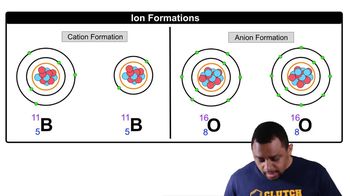
A cation is a positively charged ion formed when an atom loses electrons.
What is an anion?
An anion is a negatively charged ion formed when an atom gains electrons.
What is the Octet Rule?
Atoms tend to gain or lose electrons to have 8 valence electrons, achieving the stable electron configuration of a noble gas.
Which elements are exceptions to the Octet Rule and why?
H, He, Li, and Be are exceptions because their full shell consists of only 2 electrons (1s2 configuration).
What charge do group 7 elements typically form and why?
Group 7 elements have 7 valence electrons and typically gain 1 electron to form ions with a charge of -1.
What charge do group 6 elements typically form?
Group 6 elements have 6 valence electrons and typically gain 2 electrons to form ions with a charge of -2.
What charge do group 5 elements typically form?
Group 5 elements have 5 valence electrons and typically gain 3 electrons to form ions with a charge of -3.
What charge do group 1 elements typically form and why?
Group 1 elements have 1 valence electron and typically lose 1 electron to form ions with a charge of +1.
What charge do group 2 elements typically form?
Group 2 elements have 2 valence electrons and typically lose 2 electrons to form ions with a charge of +2.
Why do group 4 elements usually not form ions?
Group 4 elements have 4 valence electrons and would need to gain or lose 4 electrons, which is energetically unfavorable.
How do transition metal ions differ from main group ions?
Transition metals can form multiple ion charges and do not follow a simple pattern like main group elements.
What charge does silver (Ag) typically form?
Silver typically forms a +1 ion.
What charge does zinc (Zn) typically form?
Zinc typically forms a +2 ion.
Give examples of multiple charges formed by iron (Fe).
Iron can form Fe+1, Fe+2, and Fe+3 ions depending on conditions.
What are polyatomic ions?
Polyatomic ions are clusters of atoms bonded together that carry an overall charge.
How should polyatomic ions be treated when forming ionic compounds?
Polyatomic ions are treated like single ions with a charge when forming ionic compounds.
Name the hydronium ion and its charge.
Hydronium ion is H3O+ with a charge of +1.
Name the ammonium ion and its charge.
Ammonium ion is NH4+ with a charge of +1.
What is the formula and charge of the sulfate ion?
Sulfate ion is SO42- with a charge of -2.
What is the formula and charge of the nitrate ion?
Nitrate ion is NO3- with a charge of -1.
What is the formula and charge of the phosphate ion?
Phosphate ion is PO43- with a charge of -3.
What is the formula and charge of the hydroxide ion?
Hydroxide ion is OH- with a charge of -1.
What is the formula and charge of the carbonate ion?
Carbonate ion is CO32- with a charge of -2.
 BackBack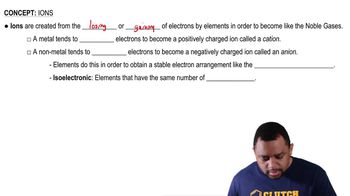
 00:53
00:53