 Back
GOB Chemistry: Lipids, Amino Acids, Proteins, and Enzymes
 3:36

Terms in this set (22)
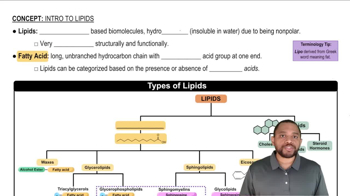
Lipids include fatty acids, waxes, triacylglycerols (oils and fats), phospholipids, and steroids.
Fatty acids are classified as saturated, monounsaturated, or polyunsaturated based on the number of double bonds.
Triacylglycerols are composed of three fatty acids esterified to a glycerol backbone.
Triacylglycerols undergo hydrogenation, hydrolysis, and saponification.
Hydrogenation adds hydrogen to unsaturated bonds, converting oils to fats and increasing saturation.
Hydrolysis breaks triacylglycerols into glycerol and free fatty acids using water and enzymes or acid/base.
Saponification is the base-catalyzed hydrolysis of triacylglycerols producing glycerol and soap (salts of fatty acids).
Phospholipids have two fatty acids, a glycerol backbone, and a phosphate group, making them amphipathic.
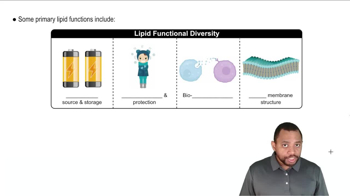
Steroids have a four-ring structure and are used as hormones and membrane components.
Phospholipids form bilayers in membranes, controlling transport of substances across the membrane.
Amino acids are classified as polar or non-polar based on side chain properties.
Amino acids are classified as acidic or basic depending on the charge of their side chains at physiological pH.
The primary structure is the linear sequence of amino acids in a polypeptide chain.
Secondary structures include alpha helices and beta sheets stabilized by hydrogen bonds.
Tertiary structure is the 3D folding of a single polypeptide; quaternary is the assembly of multiple polypeptides.
Forces include hydrogen bonds, ionic bonds, hydrophobic interactions, and disulfide bridges.
Denaturation disrupts protein structure by heat, pH changes, chemicals, or mechanical forces, affecting function.
Enzymes are classified by the type of reaction they catalyze, such as oxidoreductases, transferases, hydrolases, etc.
The enzyme's active site has a specific shape that fits the substrate exactly like a key in a lock.
The enzyme changes shape upon substrate binding to better fit and catalyze the reaction.
Enzyme activity is affected by temperature, pH, substrate concentration, and inhibitors.
Inhibitors can be competitive (bind active site) or non-competitive (bind elsewhere).