 Back
GOB Chemistry: Polyatomic Ions
 01:16

Terms in this set (20)
A polyatomic ion is a charged species composed of two or more atoms covalently bonded that act as a single ion.
The nitrate ion, \(\mathrm{NO_3^-}\), is a common polyatomic ion.
The sulfate ion, \(\mathrm{SO_4^{2-}}\), has a charge of 2-.
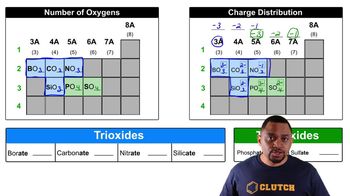
Polyatomic ions are named based on their composition and charge, often ending with -ate or -ite to indicate oxygen content.
-ate ions have more oxygen atoms than -ite ions of the same element.
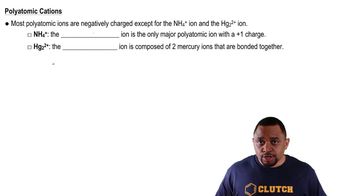
The ammonium ion has the formula \(\mathrm{NH_4^+}\) and a charge of 1+.
The carbonate ion, \(\mathrm{CO_3^{2-}}\), contains carbon and oxygen with a 2- charge.
Use parentheses around the polyatomic ion if more than one is needed, then add the subscript outside, e.g., \(\mathrm{Ca(NO_3)_2}\).
The hydroxide ion, \(\mathrm{OH^-}\), has a charge of 1-.
This is the phosphate ion with a charge of 3-.
Chlorate (\(\mathrm{ClO_3^-}\)) has more oxygen atoms than chlorite (\(\mathrm{ClO_2^-}\)).
The nitrate ion is commonly found in nitric acid.
Balance total positive and negative charges by adjusting the number of ions, using parentheses for polyatomic ions if needed.
The acetate ion has the formula \(\mathrm{C_2H_3O_2^-}\) or \(\mathrm{CH_3COO^-}\).
This is the sulfite ion, which has fewer oxygen atoms than sulfate.
The cyanide ion, \(\mathrm{CN^-}\), has a charge of 1-.
They are essential in naming compounds, understanding reactions, and predicting properties of ionic substances.
The permanganate ion has the formula \(\mathrm{MnO_4^-}\).
This is the dichromate ion with a charge of 2-.
The phosphate ion is \(\mathrm{PO_4^{3-}}\) with a charge of 3-.