 Back
GOB Chemistry: Protein Structure and Function
 2:18

Terms in this set (20)
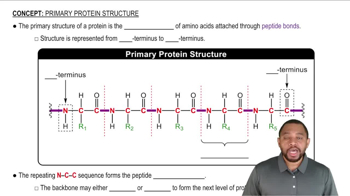
Primary: amino acid sequence.
Secondary: local folding into α-helices or β-sheets.
Tertiary: 3D structure of a single polypeptide.
Quaternary: assembly of multiple polypeptide chains.
Globular proteins are water soluble with hydrophilic residues on the surface.
Fibrous proteins form insoluble fibers or sheets with tightly packed hydrophobic residues.
Proteins requiring non-protein components for function: glycoproteins, lipoproteins, metalloproteins, phosphoproteins, hemoproteins, and nucleoproteins.
Hemoglobin has a quaternary structure composed of four polypeptide chains (2 α and 2 β chains).
Myoglobin is a tertiary structure globular protein found in muscles that stores oxygen.
Myoglobin: muscles.
Hemoglobin: red blood cells.
Collagen: connective tissues like bones, skin, and tendons.
A mutation replaces glutamate (hydrophilic) with valine (hydrophobic) at residue 6 of the β chain, causing hemoglobin aggregation and sickled red blood cells.
Electrophoresis separates proteins based on their charge and sometimes size by applying an electric field through a gel matrix.
Osteogenesis imperfecta (brittle bone disease) and scurvy (vitamin C deficiency affecting collagen hydroxylation).
Disulfide bonds (S-S) between cysteine residues stabilize α-keratin packing in hair.
Proteins and complexes that assist in folding other proteins and prevent aggregation of misfolded proteins.
Prions induce normally folded proteins to misfold into β-sheet rich structures, propagating infectious misfolded proteins.
Protein degradation is the breakdown of proteins into amino acids, occurring mainly in lysosomes and proteasomes.
The peptide bond between amino acids is cleaved during proteolysis.
Hydrolysis breaks peptide bonds, resulting in the breakdown of the protein into individual amino acids.
Denaturation is caused by heat, mechanical agitation, detergents, organic solvents, pH changes, and high salt concentrations disrupting non-covalent interactions.
Protein denaturation is primarily a physical process disrupting structure without breaking peptide bonds.
Vitamin C is required for hydroxylation of proline residues, stabilizing collagen triple helix formation.
The hydrophobic valine at position 6 fits into a hydrophobic pocket on another hemoglobin molecule, causing aggregation into fibrous strands.
Myoglobin has a higher oxygen affinity at low oxygen concentrations, facilitating oxygen storage in muscles, while hemoglobin releases oxygen in tissues.