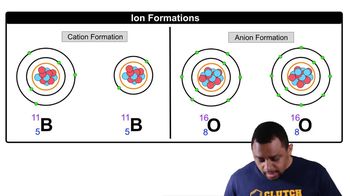
An ionic compound is formed when a metal reacts with a nonmetal by transferring electrons, resulting in positively charged cations and negatively charged anions held together by electrostatic attraction.
How do sodium and chlorine form sodium chloride?
Sodium transfers one electron to chlorine, forming Na+ and Cl- ions that attract each other to form NaCl.
What happens when ionic compounds dissolve in water?
Ionic compounds dissociate into their individual ions, which become surrounded by water molecules, allowing the solution to conduct electricity.
What does the notation (s) and (aq) mean in ionic equations?
(s) indicates a solid ionic compound, while (aq) means the ions are dissolved in water (aqueous solution).
What is the key characteristic of the ionic bond?
Ionic bonds are electrostatic attractions between oppositely charged ions formed by electron transfer.
How do you determine the formula of an ionic compound?
Balance the total positive and negative charges by finding the lowest ratio of cations to anions that results in a neutral compound.
What is the formula for a compound formed between Na+ and O2-?
Na2O, because two Na+ ions balance the charge of one O2- ion.
How do you write the formula for Mg2+ and Cl- compound?
MgCl2, since one Mg2+ ion balances two Cl- ions.
What is the method to find the ratio of ions in a compound?
Cross the charges of the ions and use them as subscripts for the opposite ion, then reduce to the lowest whole number ratio.
How do you write formulas with polyatomic ions?
Use parentheses around the polyatomic ion if more than one is needed, then place the subscript outside the parentheses.
What is the formula for magnesium sulfate?
MgSO4, because Mg2+ and SO42- charges balance 1:1.
How do you write the formula for barium phosphate?
Ba3(PO4)2, using parentheses to show two phosphate ions balance three Ba2+ ions.
How can you determine the charge of an unknown ion in a compound?
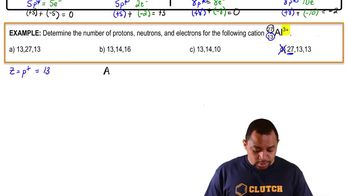
Use the known charge of the other ion and the requirement that the total charge of the compound is zero to calculate the unknown charge.
What is the charge of Ag in AgNO3?
Ag has a +1 charge because NO3- has a -1 charge and the compound is neutral.
What is the charge of Fe in Fe2O3?
Fe has a +3 charge because three O2- ions contribute -6 total charge, balanced by two Fe ions with +6 total charge.
What is the charge of the polyatomic ion in K3C6H5O7?
The polyatomic ion C6H5O73- has a -3 charge to balance three K+ ions.
Why do ionic compounds conduct electricity when dissolved?
Because the ions separate and move freely in solution, allowing electric current to flow.
What happens to ionic compounds when water evaporates from their solution?
The ions recombine to form the solid ionic compound again.
What is an electrolyte?
A solution containing dissolved ions that can conduct electricity.
Why must the overall charge of an ionic compound be zero?
Because the total positive charge from cations must balance the total negative charge from anions for the compound to be stable.
 Back
Back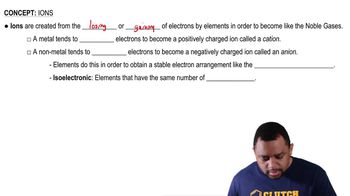
 00:53
00:53