 Back
Lec 14GOB Chemistry: Nucleic Acid Function and Translation
 1:44

Terms in this set (21)
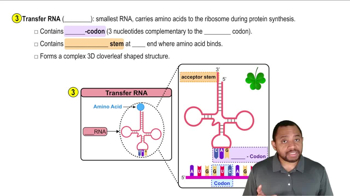
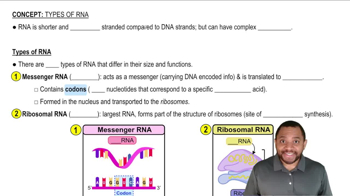
tRNA acts as an adapter that carries amino acids to the ribosome and matches its anticodon with the mRNA codon to translate RNA sequence into a protein sequence.
The amino acid is covalently linked to the 3' OH of the tRNA via an ester bond, catalyzed by aminoacyl-tRNA synthetase, using energy from pyrophosphate (PPi) hydrolysis.
The genetic code is a triplet code where each group of 3 mRNA bases (codon) specifies one amino acid; it is degenerate and non-random.
A codon is a 3-base sequence on mRNA; an anticodon is the complementary 3-base sequence on tRNA that pairs with the codon during translation.
The third base of the codon (first of anticodon) allows flexible pairing, enabling fewer tRNAs to recognize multiple codons due to less stringent base pairing.
There are 64 codons total: 61 code for amino acids and 3 are stop codons signaling termination of translation.
The ribosome has the A site (aminoacyl-tRNA), P site (peptidyl-tRNA), and E site (exit site for deacylated tRNA).
The large ribosomal subunit catalyzes peptide bond formation between amino acids attached to tRNAs in the P and A sites.
mRNA is read 5' to 3', and the protein is synthesized from the N-terminus to the C-terminus.
Two GTP molecules (phosphoanhydrides) are hydrolyzed per elongation cycle: one for tRNA selection and one for translocation.
Translation terminates when a stop codon enters the A site; release factors bind and hydrolyze the bond between the polypeptide and tRNA.
A point mutation is a single base change that can be silent, missense, or nonsense, potentially altering the amino acid sequence or protein function.
An insertion or deletion not in multiples of three bases shifts the reading frame, altering all downstream amino acids.
An SNP is a point mutation that is the most common genetic variation in humans; it can be silent, disease-causing, or protective.
DNA polymerase, DNA template, two primers, and dNTPs are required for PCR amplification.
PCR cycles through denaturation, primer annealing, and extension, doubling DNA amount each cycle (2^n amplification).
Restriction enzymes cut DNA at specific sequences creating sticky ends that allow insertion of DNA fragments into plasmids.
DNA is negatively charged and migrates toward the positive electrode; DNA-specific dyes allow visualization of separated fragments.
RT-PCR converts viral RNA into cDNA using reverse transcriptase, then amplifies the DNA to detect viral genetic material.
Ct is the number of cycles needed to detect DNA; a lower Ct means higher initial viral load in the sample.
PCR tests detect viral genetic material; antigen tests detect viral proteins and are faster but less sensitive.