 Back
lecture 9
 2:18

Terms in this set (20)
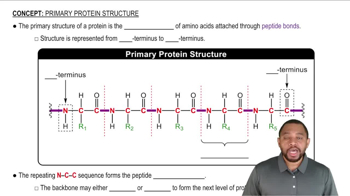
Primary: amino acid sequence
Secondary: α-helix and β-sheet structures
Tertiary: 3D folding of a single polypeptide
Quaternary: assembly of multiple polypeptide chains
Globular proteins are water soluble with hydrophilic residues on the surface; fibrous proteins are insoluble, form fibers or sheets, and have tightly packed hydrophobic residues.
Proteins requiring non-protein components for function: glycoproteins, lipoproteins, metalloproteins, phosphoproteins, hemoproteins, nucleoproteins.
Hemoglobin has a quaternary structure with 4 polypeptide chains; myoglobin has a tertiary structure with a single polypeptide chain.
Myoglobin: muscle tissue
Hemoglobin: red blood cells
Collagen: connective tissues like skin, bones, and teeth
Mutation of glutamate to valine at residue 6 in β-globin creates a hydrophobic patch causing hemoglobin aggregation and sickled red blood cells.
By charge and size, allowing analysis of protein variants like normal and sickle cell hemoglobin.
Osteogenesis imperfecta (brittle bone disease) and scurvy (vitamin C deficiency affecting collagen synthesis).
Disulfide bonds (S-S) between cysteine residues stabilize α-keratin packing.
Proteins and complexes that assist other proteins in folding correctly and prevent aggregation.
Misfolded prions induce normal prions to change shape, causing transmissible spongiform encephalopathies.
Breakdown of proteins by hydrolysis of peptide bonds; occurs in lysosomes and proteasomes.
The peptide bond between amino acids is cleaved during proteolysis.
Heat, mechanical agitation, detergents, organic solvents, pH changes, and high salt concentrations disrupt non-covalent interactions.
Stores oxygen and facilitates oxygen diffusion in muscle cells.
Oxygen binding causes conformational changes in hemoglobin's quaternary structure, enhancing oxygen transport.
Myoglobin binds oxygen more tightly to store it in muscles, especially at low pO2 like in capillaries.
Glycine, every third residue, allows tight packing of the three collagen strands.
Vitamin C is required to hydroxylate proline residues, stabilizing collagen's triple helix.
A self-degradative process removing misfolded proteins and damaged organelles to maintain cellular health.