 Back
Acid-Base Equilibria: Core Concepts and Calculations
Study Guide - Smart Notes
 Tailored notes based on your materials, expanded with key definitions, examples, and context.
Acid-Base Equilibria
Introduction to Acid-Base Equilibria
Acid-base equilibria are fundamental to understanding chemical reactions in aqueous solutions. This topic covers the identification of acids and bases, the equilibrium condition in acid-base reactions, and the quantitative relationships involving pH, pOH, and ion concentrations.
Identification of Equilibrium Condition in Acid-Base Reactions
Recognizing Acids and Bases
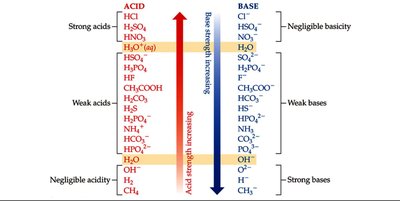
Acids are substances that donate protons (H+), while bases accept protons.
To analyze an acid-base reaction, identify the acid and base on both sides of the equation and determine which is stronger.
The equilibrium favors the transfer of protons from the stronger acid to the weaker acid (or from the stronger base to the weaker base).
Example: For the reaction , the equilibrium lies to the right because HNO3 is a strong acid.
Autoionization of Water
Definition and Equilibrium Constant
Autoionization (autoprotolysis) of water is the process where two water molecules react to form hydronium and hydroxide ions:
The equilibrium constant for this reaction is:
In dilute solutions, the concentration of water is nearly constant, so we define the ion-product constant for water:
at 25°C
In pure water, M
The pH Scale
Definition and Calculation
pH is defined as the negative logarithm (base 10) of the hydronium ion concentration:
For pure water at 25°C, (neutral).
Acidic solutions: ; Basic solutions: .
Example: If , then M.
pOH Scale and Relationship to pH
Definition and Interconversion
pOH is defined as the negative logarithm of the hydroxide ion concentration:
At 25°C, .
To find from , use .
Example: For a solution with M, , and .
Relationships Between [H+], [OH-], and pH
Summary Table at 25°C
pH | [H+] | [OH-] |
|---|---|---|
<7.00 (Acidic) | >1.0 × 10⁻⁷ | <1.0 × 10⁻⁷ |
7.00 (Neutral) | 1.0 × 10⁻⁷ | 1.0 × 10⁻⁷ |
>7.00 (Basic) | <1.0 × 10⁻⁷ | >1.0 × 10⁻⁷ |
Measuring pH
Methods
pH meters provide accurate, electronic measurements of pH.
Acid-base indicators change color depending on the pH, but are less precise.

Strong Acids and Strong Bases
Properties and Examples
Strong acids completely ionize in aqueous solution: .
Examples: HCl, HI, H2SO4, HNO3
Strong bases completely dissociate: .
Examples: NaOH, KOH, Ca(OH)2
pH for strong acids:
pH for strong bases:
Weak Acids and Weak Bases
Ionization and Equilibrium Constants
Weak acids only partially ionize in solution. The extent is given by the acid dissociation constant ():
The higher the , the stronger the acid.
Percent ionization quantifies acid strength:
Percent Ionization =
Relationship between and pH (Henderson-Hasselbalch equation):
Weak bases accept protons and are described by the base dissociation constant ():
For conjugate acid-base pairs:

Polyprotic Acids
Multiple Ionizations
Polyprotic acids can donate more than one proton, with each ionization step having its own value.
First ionization is always stronger than subsequent ones ().
For example, carbonic acid ():
First ionization: ,
Second ionization: ,
When , the pH is determined mainly by the first dissociation.
Comparison of Acid Strengths
Trends in the Periodic Table
For binary acids (HA): Acidity increases with increasing electronegativity across a period and with decreasing bond strength down a group.
For oxyacids (Y–OH): Acidity increases with the electronegativity of the central atom Y.
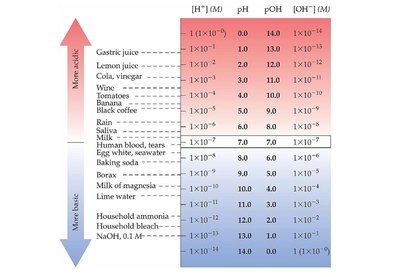
Summary Table: pH, pOH, [H+], and [OH-] of Common Substances
Substance | [H+] (M) | pH | pOH | [OH-] (M) |
|---|---|---|---|---|
Gastric juice | 1×10⁻¹ | 1.0 | 13.0 | 1×10-13 |
Lemon juice | 1×10⁻² | 2.0 | 12.0 | 1×10-12 |
Cola, vinegar | 1×10⁻³ | 3.0 | 11.0 | 1×10-11 |
Wine | 1×10⁻⁴ | 4.0 | 10.0 | 1×10⁻¹⁰ |
Tomatoes | 1×10-4.5 | 4.5 | 9.5 | 1×10-9.5 |
Baking soda | 1×10⁻⁹ | 9.0 | 5.0 | 1×10⁻⁵ |
Household ammonia | 1×10-11 | 11.0 | 3.0 | 1×10⁻³ |
NaOH, 0.1 M | 1×10-13 | 13.0 | 1.0 | 1×10⁻¹ |

Examples of Weak Acids and Their Ka Values
Acid | Structural Formula | Conjugate Base | Ka |
|---|---|---|---|
Chlorous (HClO2) | H–O–Cl=O | ClO2- | 1.0 × 10⁻² |
Hydrofluoric (HF) | H–F | F- | 6.8 × 10⁻⁴ |
Nitrous (HNO2) | H–O–N=O | NO2- | 4.5 × 10⁻⁴ |
Benzoic (C6H5COOH) | See structure | C6H5COO- | 6.3 × 10⁻⁵ |
Acetic (CH3COOH) | H–O–C(=O)–CH3 | CH3COO- | 1.8 × 10⁻⁵ |
Hypochlorous (HOCl) | H–O–Cl | OCl- | 3.0 × 10⁻⁸ |
Hydrocyanic (HCN) | H–C≡N | CN- | 4.9 × 10⁻¹⁰ |
Phenol (HOC6H5) | See structure | C6H5O- | 1.3 × 10⁻¹⁰ |
Summary
Acid-base equilibria involve the transfer of protons and are governed by equilibrium constants (, , ).
pH and pOH provide a convenient way to express the acidity or basicity of a solution.
Strong acids and bases ionize completely, while weak acids and bases only partially ionize.
Polyprotic acids have multiple ionization steps, each with its own .
Acid strength trends can be predicted based on periodic properties and molecular structure.
