 Back
Acid-Base Equilibria: Study Notes for GOB Chemistry
Study Guide - Smart Notes
 Tailored notes based on your materials, expanded with key definitions, examples, and context.
Acid-Base Equilibria
Introduction to Acid-Base Equilibria
Acid-base equilibria are fundamental to understanding chemical reactions in aqueous solutions. This topic covers the identification of acids and bases, equilibrium conditions, the autoionization of water, pH and pOH scales, and the properties of strong and weak acids and bases.
Identification of Equilibrium Condition in Acid-Base Reactions
- Acids are substances that donate protons (H+), while bases accept protons. - The equilibrium in an acid-base reaction depends on the relative strengths of the acids and bases involved. - The transfer of protons favors the formation of the weaker acid and base. - Example: For the reaction , equilibrium lies towards the formation of the weaker acid/base pair. 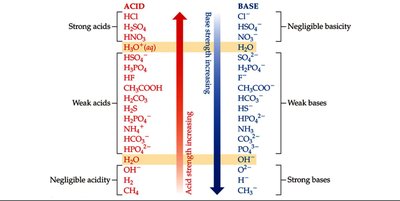
Autoionization of Water
Water can undergo autoionization (auto-protolysis), producing hydronium and hydroxide ions: - The equilibrium constant for this reaction is: - In dilute solutions, is nearly constant, so: - At 25°C, ; thus, M in pure water.
pH Scale
The pH scale quantifies the acidity or basicity of a solution: - Definition: (often written as ) - Pure water is neutral (), with equal concentrations of and . - Example: A solution with has M. 
pOH Scale and Relationship to pH
- pOH is defined as . - The relationship between pH and pOH is: at 25°C. -
Concentration Relationships and pH Conditions
The concentrations of and vary with pH:
Condition | pH | [H+] | [OH-] |
|---|---|---|---|
Acidic | <7.00 | >1.0 × 10⁻⁷ | <1.0 × 10⁻⁷ |
Neutral | 7.00 | 1.0 × 10⁻⁷ | 1.0 × 10⁻⁷ |
Basic | >7.00 | <1.0 × 10⁻⁷ | >1.0 × 10⁻⁷ |
Measuring pH
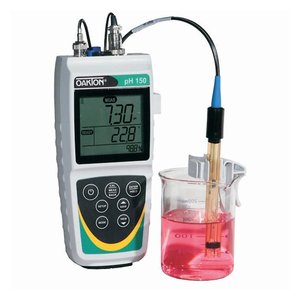
- pH can be measured using a pH meter for precise readings. - Acid-base indicators provide color-based, less precise measurements. 
Strong Acids and Strong Bases
- Strong acids completely ionize in water; for monoprotic acids, . - Examples: HCl, HI, H2SO4, HNO3 - Strong bases completely dissociate; . - Examples: NaOH, KOH, Ca(OH)2 - pH calculation for strong acids: - pH calculation for strong bases:
Weak Acids
- Most acids are weak acids, only partially ionizing in water. - The extent of ionization is described by the acid dissociation constant (): - The higher the $K_a$, the stronger the acid. 
Percent Ionization
- Percent ionization measures acid strength:
Relationship Between Ka and pH
- The relationship between and pH is given by: - - All concentrations are determined at equilibrium.
Polyprotic Acids
- Polyprotic acids can donate more than one proton. - Each proton removal has its own value (, , etc.). - The first proton is generally removed more easily than subsequent ones. - For weak diprotic acids (e.g., carbonic acid):
Weak Bases
- Weak bases accept protons and follow similar equilibrium processes as weak acids. - - The relationship for pOH: -
Conjugate Acid-Base Pairs
- Each weak acid or base has a conjugate base or acid. - For a conjugate pair:
Comparison of Acid Strengths
- Binary acids: Acidity increases with electronegativity within a period (left to right). - Within a group, acidity increases as bond strength decreases. - Oxyacids: Acidity is affected by the electronegativity of the atom bonded to oxygen.
Summary Table: Acidic and Basic Solutions
Substance | [H+] | pH | pOH | [OH-] |
|---|---|---|---|---|
Gastric juice | 1 × 10⁻¹ | 1.0 | 13.0 | 1 × 10-13 |
Lemon juice | 1 × 10⁻² | 2.0 | 12.0 | 1 × 10-12 |
Cola, vinegar | 1 × 10⁻³ | 3.0 | 11.0 | 1 × 10-11 |
Human blood, tears, egg white, seawater | 1 × 10⁻⁷ | 7.0 | 7.0 | 1 × 10⁻⁷ |
Household ammonia | 1 × 10-11 | 11.0 | 3.0 | 1 × 10⁻³ |
NaOH, 0.1 M | 1 × 10-13 | 13.0 | 1.0 | 1 × 10⁻¹ |
Examples of Weak Acids and Their Ka Values
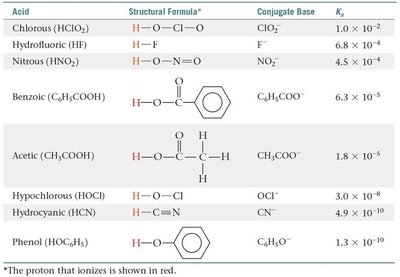
Acid | Structural Formula | Conjugate Base | Ka |
|---|---|---|---|
Chlorous (HClO2) | H–O–Cl=O | ClO2- | 1.0 × 10⁻² |
Hydrofluoric (HF) | H–F | F- | 6.8 × 10⁻⁴ |
Nitrous (HNO2) | H–O–N=O | NO2- | 4.5 × 10⁻⁴ |
Benzoic (C6H5COOH) | See image | C6H5COO- | 6.3 × 10⁻⁵ |
Acetic (CH3COOH) | H–O–C=O | CH3COO- | 1.8 × 10⁻⁵ |
Hypochlorous (HOCl) | H–O–Cl | OCl- | 3.0 × 10⁻⁸ |
Hydrocyanic (HCN) | H–C≡N | CN- | 4.9 × 10⁻¹⁰ |
Phenol (HOC6H5) | See image | C6H5O- | 1.3 × 10⁻¹⁰ |
Summary
Acid-base equilibria are central to understanding chemical reactions in aqueous solutions. Key concepts include the identification of acids and bases, equilibrium conditions, the autoionization of water, pH and pOH scales, and the properties of strong and weak acids and bases. The relationships between , , and are essential for calculating pH and understanding acid-base strength. Polyprotic acids and weak bases follow similar equilibrium principles, with their own dissociation constants. Conjugate acid-base pairs and the comparison of acid strengths are important for predicting reaction direction and equilibrium position.
