 Back
BackAcids and Bases: Bronsted-Lowry Theory and Properties
Study Guide - Smart Notes
 Tailored notes based on your materials, expanded with key definitions, examples, and context.
Acids and Bases: Bronsted-Lowry Theory and Properties
Introduction to Acids and Bases
Acids and bases are fundamental concepts in chemistry, crucial for understanding chemical reactions, biological processes, and industrial applications. This section introduces their definitions, properties, and naming conventions, focusing on the Bronsted-Lowry theory.
What are Acids?
Acids are substances that produce hydrogen ions (H+) when dissolved in water. The release of hydrogen ions gives acids their characteristic sour taste, ability to turn blue litmus paper red, and corrosive properties. Historically, acids were defined as compounds that generate H+ ions in aqueous solution.
Examples: Vinegar (acetic acid), lemon juice (citric acid)
Properties: Sour taste, react with metals, change indicators
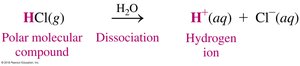
Naming Acids: Simple Anions
Acids containing hydrogen and a simple nonmetal anion are named using the prefix "hydro" and the suffix "ic acid" instead of "ide." For example:
HCl (aq): Hydrochloric acid
HBr (aq): Hydrobromic acid
Naming Acids: Polyatomic Ions
Acids containing hydrogen and an oxygen-containing polyatomic ion are named based on the ion's suffix:
"ate" ending → "ic acid" (e.g., HNO3 → nitric acid)
"ite" ending → "ous acid" (e.g., HNO2 → nitrous acid)
What is a Base?
Bases are ionic compounds that dissociate into cations and hydroxide ions (OH-) when dissolved in water. Most bases are formed from Group 1 and Group 2 metals. Bases have a bitter taste, slippery feel, turn litmus paper blue, and phenolphthalein indicator pink.
Examples: NaOH, KOH, LiOH, Ca(OH)2
Properties: Bitter taste, slippery feel, change indicators

Naming Bases
Bases are named by stating the metal followed by "hydroxide." For example:
LiOH: Lithium hydroxide
NaOH: Sodium hydroxide
Bronsted-Lowry Acids and Bases
The Bronsted-Lowry theory expands the definition of acids and bases. A Bronsted-Lowry acid is a substance that donates an H+ ion, while a Bronsted-Lowry base is a substance that accepts an H+ ion. In aqueous solutions, free hydrogen ions do not exist; instead, they combine with water to form the hydronium ion (H3O+).
Acid: H+ donor
Base: H+ acceptor
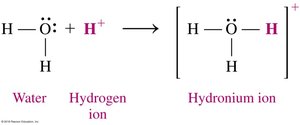
Bronsted-Lowry Acid-Base Reactions
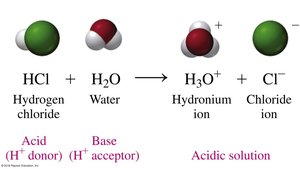
In a typical Bronsted-Lowry acid-base reaction, the acid donates a proton to the base. For example, when hydrogen chloride (HCl) reacts with water:
HCl donates H+ (acid)
H2O accepts H+ (base)
Products: H3O+ (hydronium ion) and Cl- (chloride ion)
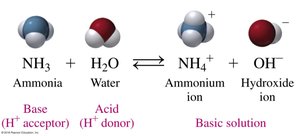
Another example involves ammonia (NH3) and water:
NH3 accepts H+ (base)
H2O donates H+ (acid)
Products: NH4+ (ammonium ion) and OH- (hydroxide ion)
Conjugate Acid-Base Pairs
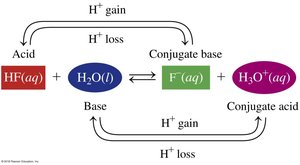
Every acid-base reaction involves two conjugate acid-base pairs. A conjugate acid is formed when a base gains an H+, and a conjugate base is formed when an acid loses an H+. The transfer of H+ occurs in both forward and reverse reactions.
Example: HF + H2O → F- + H3O+
HF (acid) → F- (conjugate base)
H2O (base) → H3O+ (conjugate acid)
Strength of Acids
The strength of an acid is determined by the extent to which it dissociates in water to produce H3O+ ions. Strong acids dissociate completely, while weak acids only partially dissociate.
Strong acids: HCl, HBr, HNO3, H2SO4
Weak acids: HNO2, H2CO3
Equation for strong acid dissociation:
Strength of Bases
The strength of a base is determined by the amount of OH- ions produced in solution. Strong bases dissociate completely, while weak bases are poor acceptors of H+ and produce few ions.
Strong bases: NaOH, KOH, Ca(OH)2
Weak bases: NH3, Cu(OH)2
Equation for strong base dissociation:
Summary Table: Strong and Weak Acids and Bases
Type | Strong | Weak |
|---|---|---|
Acids | HCl, HBr, HNO3, H2SO4 | HNO2, H2CO3 |
Bases | NaOH, KOH, Ca(OH)2 | NH3, Cu(OH)2 |
Key Equations
Acid dissociation:
Base dissociation:
Additional info:
These notes cover the essential concepts from Chapter 10 (sections 10.1–10.3) of GOB Chemistry, focusing on acids, bases, their naming, Bronsted-Lowry theory, conjugate pairs, and the strength of acids and bases. All images included directly reinforce the chemical concepts discussed.
