Back
BackAcids and Bases: Properties, Reactions, and Applications 9
Study Guide - Smart Notes
 Tailored notes based on your materials, expanded with key definitions, examples, and context.
Acids and Bases
Introduction to Acids and Bases
Acids and bases are fundamental classes of compounds in chemistry, with distinct properties and behaviors. Their definitions have evolved to better describe their behavior in aqueous solutions.
Arrhenius Definition: An acid produces H+ ions in water, while a base produces OH− ions.
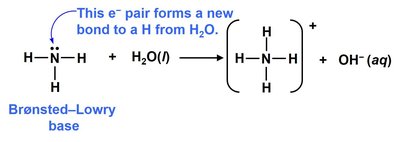
Brønsted–Lowry Definition: An acid is a proton (H+) donor, and a base is a proton acceptor.
In water, H+ does not exist freely but forms the hydronium ion (H3O+).
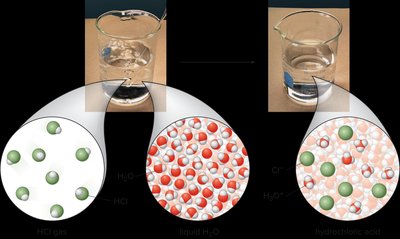
Brønsted–Lowry Acids and Bases
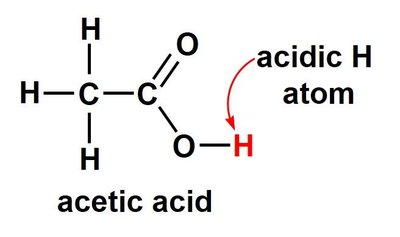
Brønsted–Lowry acids must contain a hydrogen atom that can be donated as a proton. Bases must have a lone pair of electrons to accept a proton.
Common Acids: HCl (hydrochloric acid), H2SO4 (sulfuric acid), HNO3 (nitric acid).
Common Bases: NH3 (ammonia), H2O (water), NaOH (sodium hydroxide).
Monoprotic acids have one acidic proton (e.g., HCl), diprotic acids have two (e.g., H2SO4), and triprotic acids have three (e.g., H3PO4).
Acid and Base Nomenclature
The names of acids are derived from the anions they form in water:
Anions ending in -ide: Add prefix hydro- and change to -ic acid (e.g., Cl− → hydrochloric acid).
Anions ending in -ate: Change to -ic acid (e.g., SO42− → sulfuric acid).
Anions ending in -ite: Change to -ous acid (e.g., SO32− → sulfurous acid).
Acid–Base Reactions
Brønsted–Lowry Acid–Base Reactions
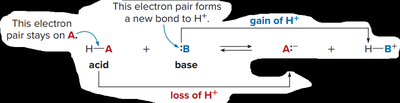
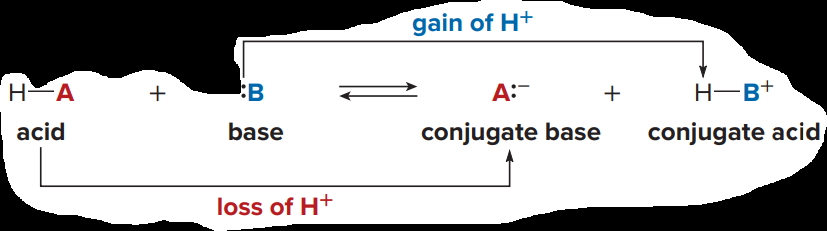
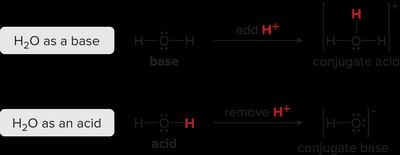
When an acid reacts with a base, a proton is transferred. The acid loses a proton to become its conjugate base, and the base gains a proton to become its conjugate acid.
Conjugate acid–base pair: Two species that differ by one proton.
Amphoteric compounds: Substances like water that can act as either an acid or a base.
Acid and Base Strength
Strong and Weak Acids/Bases
The strength of an acid or base depends on its degree of dissociation in water.
Strong acids/bases: Completely dissociate in water (e.g., HCl, NaOH).
Weak acids/bases: Partially dissociate in water (e.g., CH3COOH, NH3).

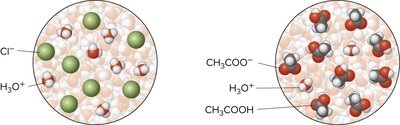

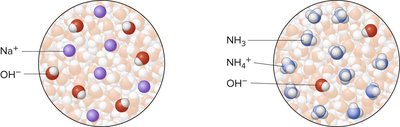
Relative Strengths of Acids and Bases
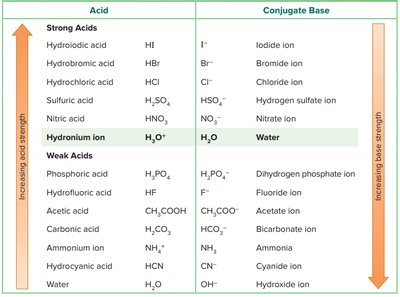
A strong acid forms a weak conjugate base, and a strong base forms a weak conjugate acid. The relative strengths can be summarized in a table.
Acid | Conjugate Base |
|---|---|
Hydroiodic acid (HI) | Iodide ion (I−) |
Hydrobromic acid (HBr) | Bromide ion (Br−) |
Hydrochloric acid (HCl) | Chloride ion (Cl−) |
Sulfuric acid (H2SO4) | Hydrogen sulfate ion (HSO4−) |
Nitric acid (HNO3) | Nitrate ion (NO3−) |
Hydronium ion (H3O+) | Water (H2O) |
Phosphoric acid (H3PO4) | Dihydrogen phosphate ion (H2PO4−) |
Acetic acid (CH3COOH) | Acetate ion (CH3COO−) |
Water (H2O) | Hydroxide ion (OH−) |
Predicting the Direction of Acid–Base Equilibrium
In an acid–base reaction, the stronger acid and stronger base react to form the weaker acid and weaker base. The equilibrium favors the side with the weaker acid and base.


Equilibrium and Acid Dissociation Constants
Acid Dissociation Constant (Ka)
The acid dissociation constant, Ka, quantifies the strength of a weak acid in water:
The larger the Ka, the stronger the acid.
Equilibrium favors the formation of the weaker acid (smaller Ka).
Acid | Ka |
|---|---|
Hydrogen sulfate ion (HSO4−) | 1.2 × 10⁻² |
Phosphoric acid (H3PO4) | 7.5 × 10⁻³ |
Hydrofluoric acid (HF) | 6.31 × 10⁻⁴ |
Acetic acid (CH3COOH) | 1.75 × 10⁻⁵ |
Carbonic acid (H2CO3) | 4.3 × 10⁻⁷ |
Dissociation of Water and the pH Scale
Dissociation of Water
Water can act as both an acid and a base, leading to the following equilibrium:
The ion-product constant for water is:
at 25°C
In neutral solutions: [H3O+] = [OH−] = 1.0 × 10⁻⁷ M
Acidic solutions: [H3O+] > [OH−]
Basic solutions: [H3O+] < [OH−]
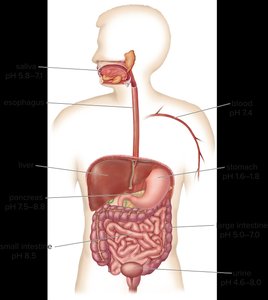
The pH Scale
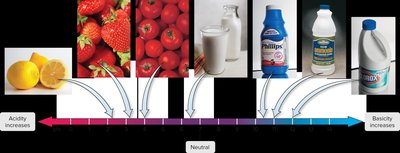
The pH of a solution is a measure of its acidity or basicity:
Acidic: pH < 7
Neutral: pH = 7
Basic: pH > 7
Acid–Base Reactions and Applications
Neutralization Reactions
A neutralization reaction occurs when an acid reacts with a base to produce a salt and water:
Net ionic equation:
Reactions with Bicarbonate and Carbonate Bases
Bicarbonate (HCO3−) reacts with acid to form carbonic acid, which decomposes to CO2 and H2O.
Carbonate (CO32−) reacts with two protons to form carbonic acid, then CO2 and H2O.
Acidity and Basicity of Salt Solutions
The pH of a salt solution depends on the strengths of the acid and base from which it is derived:
Cation Derived from | Anion Derived from | Solution pH | Examples |
|---|---|---|---|
Strong base | Strong acid | Neutral (7) | NaCl, KBr |
Strong base | Weak acid | Basic (>7) | NaHCO3, KCN |
Weak base | Strong acid | Acidic (<7) | NH4Cl |
Titration
Determining Concentration by Titration
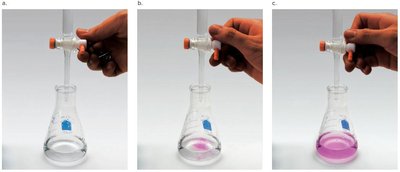
Titration is used to determine the concentration of an acid or base by reacting it with a solution of known concentration until neutralization is achieved (the endpoint).
At the endpoint: moles of acid = moles of base
Calculation involves volume and molarity relationships.

Buffers
Buffer Solutions
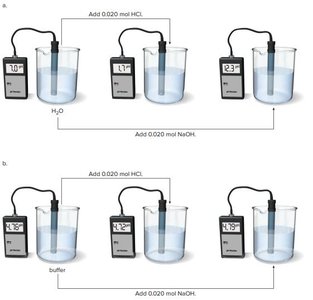
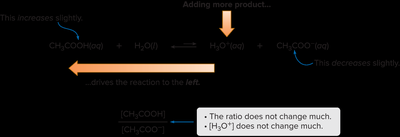
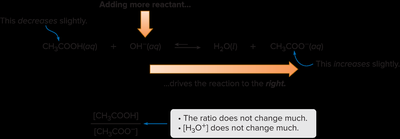
A buffer is a solution that resists changes in pH when small amounts of acid or base are added. Most buffers consist of a weak acid and its conjugate base (or a weak base and its conjugate acid).
Added base reacts with the weak acid; added acid reacts with the conjugate base.
Calculating Buffer pH
The pH of a buffer is determined by the concentrations of the weak acid and its conjugate base:
Common buffers: Acetic acid/acetate, bicarbonate/carbonate, phosphate systems.
Acid Rain and Buffers in the Environment
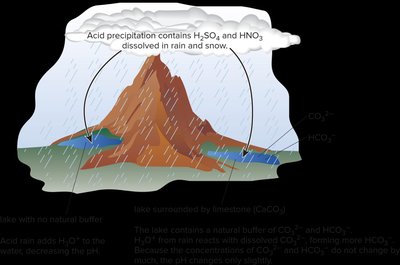
Acid rain can lower the pH of lakes, but lakes with natural buffers (like carbonate ions) resist pH changes.
Buffers in the Human Body
Blood Buffer System
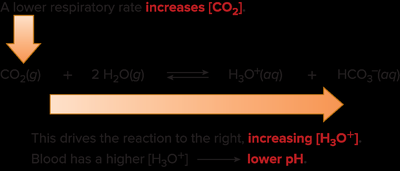
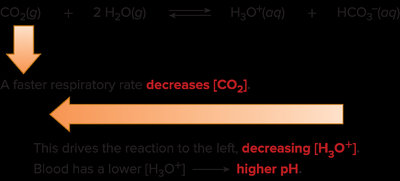
Normal blood pH is tightly regulated between 7.35 and 7.45, primarily by the carbonic acid/bicarbonate buffer system:
Respiratory acidosis: Failure to eliminate enough CO2 increases [H3O+], lowering pH.
Respiratory alkalosis: Hyperventilation decreases CO2, raising pH.