 Back
BackAcids and Bases: Properties, Reactions, and Calculations
Study Guide - Smart Notes
 Tailored notes based on your materials, expanded with key definitions, examples, and context.
Chapter 11: Acids and Bases
11.1 Acids and Bases: Arrhenius and Brønsted–Lowry Definitions
Acids and bases are fundamental chemical species with distinct properties and behaviors in aqueous solutions. Their definitions have evolved to explain a wide range of chemical reactions.
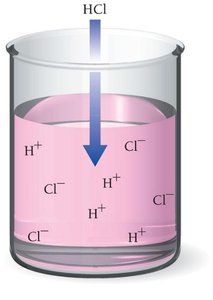
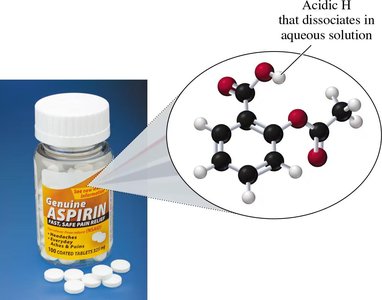
Arrhenius Acid: Produces hydrogen ions (H+) when dissolved in water. Example: HCl dissociates to form H+ and Cl− ions.
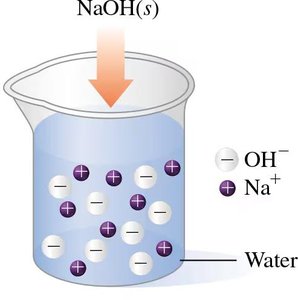
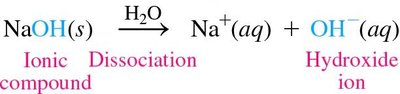
Arrhenius Base: Produces hydroxide ions (OH−) in water. Example: NaOH dissociates to form Na+ and OH− ions.
Brønsted–Lowry Acid: Proton (H+) donor.
Brønsted–Lowry Base: Proton (H+) acceptor.
Electrolytes: Both acids and bases conduct electricity in solution due to ion formation.
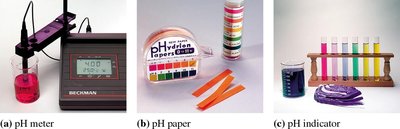
Indicators: Acids turn blue litmus paper red; bases turn red litmus paper blue. Phenolphthalein is colorless in acids and pink in bases.

Properties of Acids and Bases
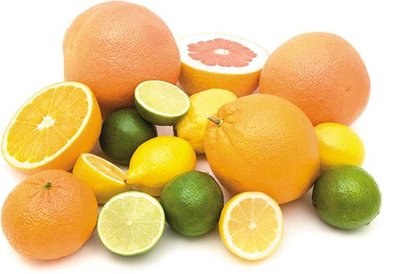
Acids: Sour taste, may sting, react with metals, turn litmus red.
Bases: Bitter or chalky taste, slippery feel, turn litmus blue.
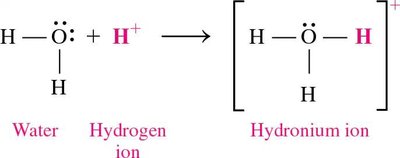
Hydronium Ion Formation
Free H+ ions are highly reactive and bond with water to form the hydronium ion (H3O+). Chemists use H+(aq) and H3O+ interchangeably.
Naming Acids and Bases
Acids with H+ and a nonmetal anion: hydro– + root + –ic acid (e.g., HCl: hydrochloric acid).
Acids with H+ and a polyatomic ion: If ion ends in –ate: root + –ic acid (e.g., HNO3: nitric acid); if –ite: root + –ous acid (e.g., HNO2: nitrous acid).
Bases: Metal name + hydroxide (e.g., NaOH: sodium hydroxide).
11.2 Brønsted–Lowry Acids and Bases
The Brønsted–Lowry definition expands the concept of acids and bases to include more substances, focusing on proton transfer.
Acid: H+ donor
Base: H+ acceptor
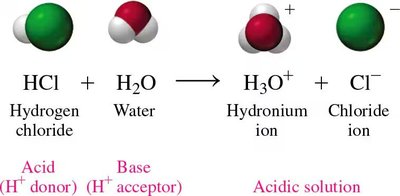
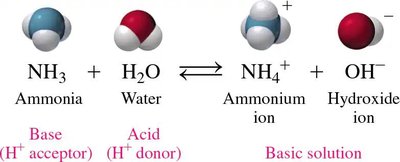
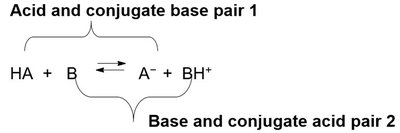
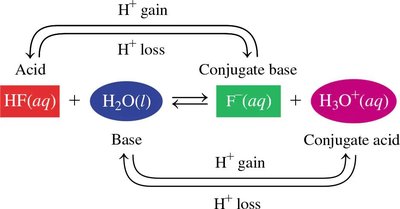
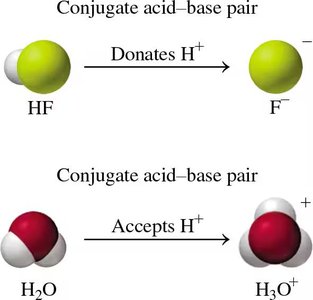
Conjugate Acid–Base Pairs
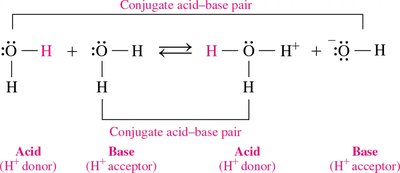
In every acid–base reaction, two conjugate acid–base pairs exist, related by the gain or loss of a proton.
Amphoteric Substances
Substances like water that can act as both acids and bases are called amphoteric or amphiprotic.
11.3 Strengths of Acids and Bases
The strength of an acid or base depends on its degree of dissociation in water.
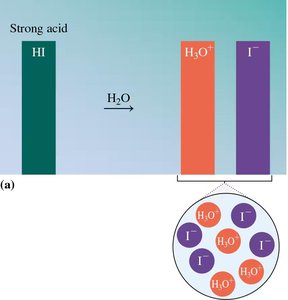
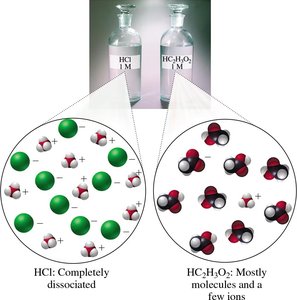
Strong acids: Completely dissociate in water (e.g., HCl, HI).
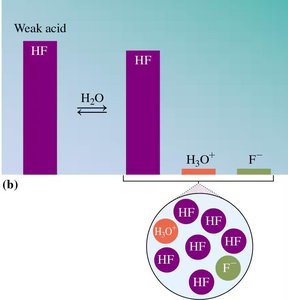
Weak acids: Partially dissociate, producing few ions (e.g., HF, HC2H3O2).
Strong bases: Group 1A and 2A metal hydroxides, fully dissociate (e.g., NaOH, KOH).
Weak bases: Poor acceptors of H+, produce few ions (e.g., NH3).




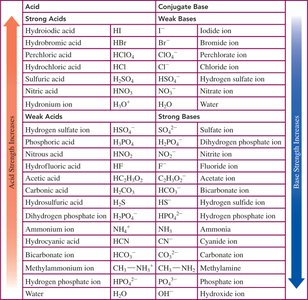
Direction of Acid–Base Reactions
The direction of an acid–base reaction depends on the relative strengths of acids and bases. The reaction favors the formation of the weaker acid and base.

11.4 Dissociation of Weak Acids and Bases
Weak acids and bases establish equilibrium between the undissociated and dissociated forms in solution. The extent of dissociation is described by equilibrium constants.
Acid dissociation constant (Ka):
Base dissociation constant (Kb):
Small Ka or Kb values indicate weak acids or bases.
11.5 Dissociation of Water and the Ion Product Constant (Kw)
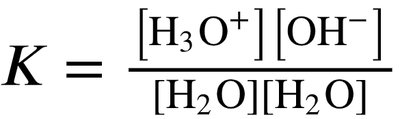
Water self-ionizes to a small extent, producing equal concentrations of H3O+ and OH− in pure water at 25°C.
at 25°C
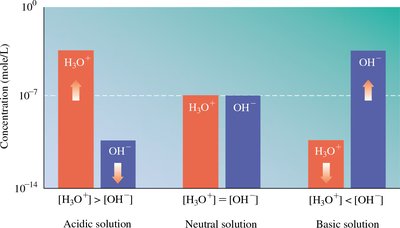
Neutral solution: [H3O+] = [OH−] = M
Acidic solution: [H3O+] > [OH−]
Basic solution: [OH−] > [H3O+]

11.6 The pH Scale
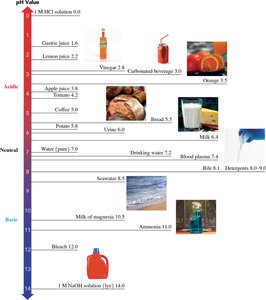
The pH scale quantifies the acidity or basicity of a solution. It is based on the concentration of hydronium ions.
pH = –log[H3O+]
pH < 7: Acidic; pH = 7: Neutral; pH > 7: Basic
Each pH unit represents a tenfold change in [H3O+]
![Calculation of [H3O+] from [OH-]](https://static.studychannel.pearsonprd.tech/study_guide_files/gob/sub_images/a91106c3_image_34.png)
11.7 Reactions of Acids and Bases
Acids and bases react in neutralization reactions to produce salt and water. Titration is a laboratory technique used to determine the concentration of an acid or base.
General equation: Acid + Base → Salt + Water
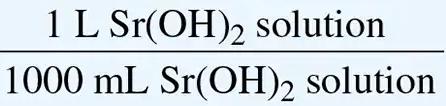
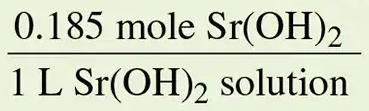
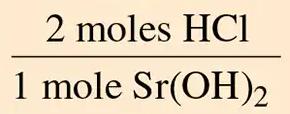
Titration: Uses a solution of known concentration to determine the unknown concentration of another solution, often using an indicator to detect the endpoint.





11.8 Buffers
Buffers are solutions that resist changes in pH when small amounts of acid or base are added. They are essential in biological systems, such as blood, to maintain a stable pH.
Composed of a weak acid and its conjugate base (or a weak base and its conjugate acid).
Example: Acetic acid (HC2H3O2) and sodium acetate (NaC2H3O2).
Blood buffers include carbonate, phosphate, and protein systems.
Characteristic | Strong Acids | Weak Acids | Strong Bases | Weak Bases |
|---|---|---|---|---|
Equilibrium Position | Toward products | Toward reactants | Toward products | Toward reactants |
Dissociation | 100% | Small percent | 100% | Small percent |
Conjugate Strength | Weak base | Strong base | Weak acid | Strong acid |
Additional info: Buffers are crucial in physiological systems to prevent harmful pH fluctuations. The carbonate buffer system in blood helps maintain a pH near 7.4, essential for proper cellular function.
