 Back
BackAcids, Bases, and Buffers: Principles and Applications
Study Guide - Smart Notes
 Tailored notes based on your materials, expanded with key definitions, examples, and context.
Acids and Bases
Arrhenius Definition
The Arrhenius definition is one of the earliest ways to classify acids and bases. According to Arrhenius:
Acid: Contains a hydrogen atom and dissolves in water to form a hydrogen ion, H+.
Base: Contains hydroxide and dissolves in water to form OH−.
Example: HCl (hydrochloric acid) dissolves in water to produce H+ and Cl−; NaOH (sodium hydroxide) dissolves to produce Na+ and OH−.
Brønsted–Lowry Definition
The Brønsted–Lowry definition is more widely used in modern chemistry:
Brønsted–Lowry acid: Proton (H+) donor.
Brønsted–Lowry base: Proton (H+) acceptor.
For example, when HCl is dissolved in water, it donates a proton to H2O, forming H3O+ and Cl−.

Brønsted–Lowry Acids
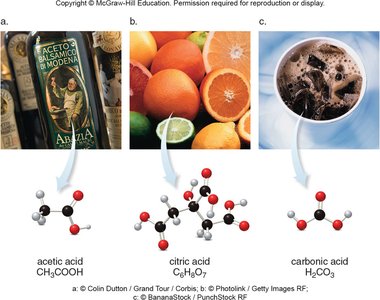
Brønsted–Lowry acids must contain a hydrogen atom. Common examples include:
HCl (hydrochloric acid)
HBr (hydrobromic acid)
CH3COOH (acetic acid)
H2SO4 (sulfuric acid)
HNO3 (nitric acid)

Brønsted–Lowry Bases
A Brønsted–Lowry base is a proton acceptor and must contain a lone pair of electrons to form a bond with a proton. Examples include:
NH3 (ammonia)
NaOH (sodium hydroxide)
KOH (potassium hydroxide)
Mg(OH)2 (magnesium hydroxide)
Ca(OH)2 (calcium hydroxide)
H2O (water)

Proton Transfer and Conjugate Pairs
Proton Transfer Reactions
When a Brønsted–Lowry acid reacts with a Brønsted–Lowry base, a proton is transferred:
The acid loses a proton (H+).
The base gains a proton (H+).


Conjugate Acid–Base Pairs
After proton transfer:
The product formed by loss of a proton from an acid is its conjugate base.
The product formed by gain of a proton by a base is its conjugate acid.
Example: HBr and Br− are a conjugate acid–base pair; H2O and H3O+ are another pair.
Charge Changes in Proton Transfer
Gaining a proton increases charge by +1.
Losing a proton decreases charge by –1.
Acid and Base Strength
Strong vs. Weak Acids
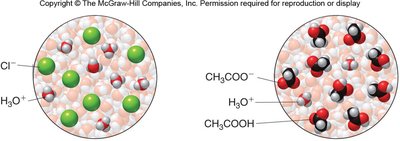
Acid strength is determined by the degree of dissociation in water:
Strong acids: Dissociate completely in water. Examples: HI, HBr, HCl, H2SO4, HNO3.
Weak acids: Dissociate only partially. Examples: H3PO4, HF, H2CO3, HCN.
Strong vs. Weak Bases
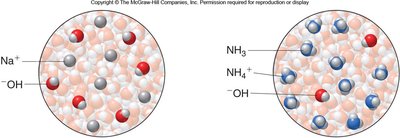
Strong bases: Dissociate completely in water. Examples: NaOH, KOH.
Weak bases: Dissociate only partially. Examples: NH3, C5H5N, C2H5NH2.
Relationship Between Acid/Base Strength and Conjugates
A strong acid forms a weak conjugate base.
A strong base forms a weak conjugate acid.
Dissociation of Water and the pH Scale
Dissociation of Water
Water can dissociate into H3O+ and OH− ions, establishing equilibrium.
The pH Scale
The pH scale is used to express the acidity or basicity of a solution:
pH = –log [H3O+]
Acidic solution: pH < 7
Basic solution: pH > 7
Neutral solution: pH = 7
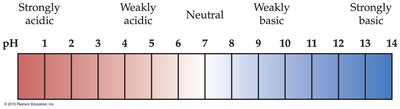
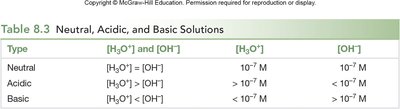
Table: Neutral, Acidic, and Basic Solutions
Type | [H3O+] and [OH−] | [H3O+] | [OH−] |
|---|---|---|---|
Neutral | [H3O+] = [OH−] | 10–7 M | 10–7 M |
Acidic | [H3O+] > [OH−] | > 10–7 M | < 10–7 M |
Basic | [H3O+] < [OH−] | < 10–7 M | > 10–7 M |
Calculating pH
To calculate pH from [H3O+]:
Example: If [H3O+] = 1.0 × 10⁻⁵ M, then pH = –log(1.0 × 10⁻⁵) = 5.00.
Acid–Base Reactions
Neutralization Reactions
A neutralization reaction occurs when an acid reacts with a hydroxide base to produce a salt and water:
General equation: HA(aq) + MOH(aq) → H2O(l) + MA(aq)
The acid donates a proton to the base, forming water, and the remaining ions form a salt.
Drawing Balanced Equations
To write a balanced equation for a neutralization reaction:
Identify the acid and base.
Draw H2O as one product.
Combine the remaining ions to form the salt.
Le Châtelier’s Principle
Le Châtelier’s principle states that when a system at equilibrium is disturbed, the rates of the forward and reverse reactions change to relieve the stress and reestablish equilibrium.
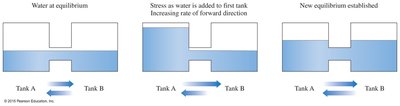
Carbonate and Bicarbonate Reactions
When carbonate (CO32–) or bicarbonate (HCO3–) bases react with acids, water and carbon dioxide are produced:
HCO3– + H3O+ → H2O + CO2
CO32– + H3O+ → H2O + CO2
Buffers
General Characteristics of Buffers
A buffer is a solution whose pH changes very little when acid or base is added. Most buffers are composed of:
A weak acid
The salt of its conjugate base
Buffers resist changes in pH because:
Added base reacts with the weak acid.
Added acid reacts with the conjugate base.
Buffer Equilibria
For the acetic acid buffer:
CH3COOH(aq) + H2O(l) ⇌ H3O+(aq) + CH3COO–(aq)
If acid is added, the excess reacts with the conjugate base, driving the reaction to the left. If base is added, it reacts with the weak acid, driving the reaction to the right.
Buffers in the Human Body
Blood Buffer System
Normal blood pH is between 7.35 and 7.45. The principal buffer in blood is the carbonic acid/bicarbonate system:
CO2(g) + H2O(l) ⇌ H2CO3(aq) ⇌ H3O+(aq) + HCO3–(aq)
CO2 is produced by metabolism and its concentration affects blood pH.
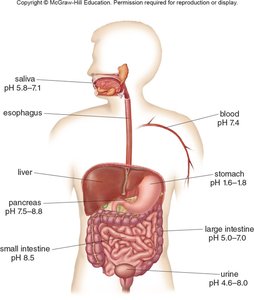
Respiratory Acidosis and Alkalosis
Respiratory acidosis: Occurs when the body fails to eliminate enough CO2, increasing [H3O+] and lowering pH.
Respiratory alkalosis: Caused by hyperventilation, decreasing [H3O+] and raising pH.
Example: Blood pH changes in response to CO2 levels.
Summary Table: Common Acids and Bases
Acid | Formula | Base | Formula |
|---|---|---|---|
Hydrochloric acid | HCl | Sodium hydroxide | NaOH |
Acetic acid | CH3COOH | Ammonia | NH3 |
Sulfuric acid | H2SO4 | Potassium hydroxide | KOH |
Additional info: The notes cover all major aspects of acids, bases, buffers, and their relevance to human physiology, including pH regulation and acid–base reactions.
