 Back
BackAcids, Bases, and Equilibrium: Reactions and Titrations
Study Guide - Smart Notes
 Tailored notes based on your materials, expanded with key definitions, examples, and context.
Acids and Bases: Reactions and Equilibrium
Introduction to Acid–Base Chemistry
This section explores the fundamental reactions of acids and bases, including their interactions with metals, carbonates, and hydroxides, as well as the principles and calculations involved in acid–base titrations. These concepts are essential for understanding chemical equilibrium and applications in biological and laboratory contexts.
Reactions of Acids
General Properties and Types of Reactions
Acids react with certain metals, bases, and carbonate or bicarbonate ions.
These reactions typically produce a salt (an ionic compound without H+ as the cation or OH− as the anion), water, and sometimes gases such as hydrogen or carbon dioxide.
Acids and Metals
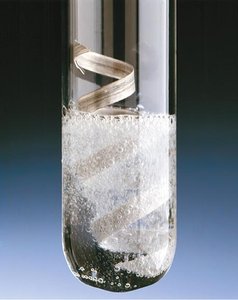
Acids react with active metals (e.g., K, Na, Ca, Mg, Al, Zn, Fe, Sn) to produce hydrogen gas and a salt of the metal.
General equation:
Example:
Acids with Carbonates and Bicarbonates
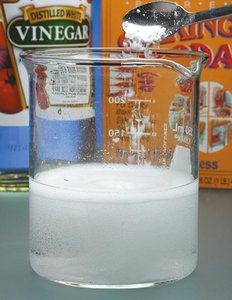
Acids react with carbonates (CO32−) and bicarbonates (HCO3−) to produce carbon dioxide gas, a salt, and water.
General equations:
Example:
Neutralization Reactions
Acids and Hydroxides
When an acid reacts with a base (hydroxide), the products are a salt and water. This is called a neutralization reaction.
General equation:
Example:
The net ionic equation for strong acid–strong base neutralization is:
Balancing Neutralization Reactions
To balance neutralization reactions, ensure the number of H+ ions from the acid equals the number of OH− ions from the base. The salt is formed from the remaining ions.
Example:
Example:
Acid–Base Titration
Principles of Titration
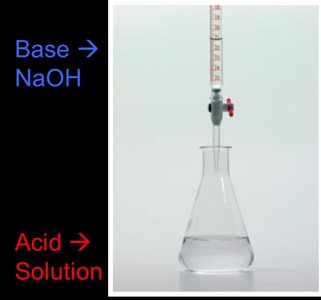
Titration is a laboratory technique used to determine the concentration (molarity) of an acid or base by reacting it with a solution of known concentration. An indicator, such as phenolphthalein, is used to detect the endpoint, where the amount of acid equals the amount of base.
At the endpoint: moles of base = moles of acid
The volume and concentration of the titrant (solution of known concentration) are used to calculate the unknown molarity.
Titration Calculations
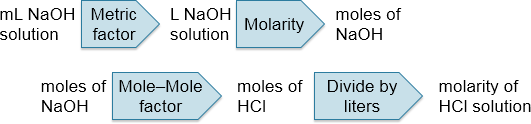
To calculate the molarity of an unknown acid solution:
Write the balanced neutralization equation.
Convert the volume of titrant (base) to liters.
Calculate moles of titrant using its molarity.
Use the mole ratio from the balanced equation to find moles of acid.
Divide moles of acid by the volume of acid (in liters) to find molarity.
Example Calculation:
Given: 18.5 mL of 0.225 M NaOH neutralizes 0.0100 L HCl
Balanced equation:
Calculation:
Convert 18.5 mL NaOH to L: L
Moles NaOH: mol
Mole ratio (1:1): mol HCl
Molarity HCl: M
Chemistry Link to Health: Antacids
Neutralization of Stomach Acid
Antacids are substances used to neutralize excess stomach acid (HCl). Common antacids contain aluminum hydroxide, magnesium hydroxide, calcium carbonate, or sodium bicarbonate. These compounds react with stomach acid to relieve symptoms of heartburn and indigestion.
Antacid | Base(s) |
|---|---|
Amphojel | Al(OH)3 |
Milk of magnesia | Mg(OH)2 |
Mylanta, Maalox, Di-Gel, Gelusil, Riopan | Mg(OH)2, Al(OH)3 |
Bisodol, Rolaids | CaCO3, Mg(OH)2 |
Titralac, Tums, Pepto-Bismol | CaCO3 |
Alka-Seltzer | NaHCO3, KHCO3 |
Example: Magnesium hydroxide in "milk of magnesia" neutralizes stomach acid according to:
Additional info: Antacids are formulated to minimize side effects and avoid excessive neutralization, which could disrupt normal digestive processes.
