 Back
BackAcids, Bases, pH, and Titration Study Guide for GOB College Chemistry
Study Guide - Smart Notes
 Tailored notes based on your materials, expanded with key definitions, examples, and context.
Q1. Define the following: Arrhenius Acid, Arrhenius Base, Brønsted–Lowry Acid, Brønsted–Lowry Base.
Background
Topic: Acid-Base Theories
This question tests your understanding of the fundamental definitions of acids and bases according to two major theories: Arrhenius and Brønsted–Lowry.
Key Terms:
Arrhenius Acid: Substance that increases the concentration of H+ ions in water.
Arrhenius Base: Substance that increases the concentration of OH- ions in water.
Brønsted–Lowry Acid: Proton (H+) donor.
Brønsted–Lowry Base: Proton (H+) acceptor.
Step-by-Step Guidance
Recall the Arrhenius definition: Acids produce H+ in aqueous solution, bases produce OH-.
Recall the Brønsted–Lowry definition: Acids donate protons, bases accept protons.
Think about examples for each definition (e.g., HCl for Arrhenius acid, NH3 for Brønsted–Lowry base).
Try solving on your own before revealing the answer!
Q2. When a hydrogen atom loses an electron, it becomes a: ____________.
Background
Topic: Atomic Structure
This question tests your understanding of what happens to a hydrogen atom when it loses its only electron.
Key Terms:
Hydrogen atom: 1 proton, 1 electron.
Ion: Atom or molecule with a net charge.
Step-by-Step Guidance
Consider the composition of a hydrogen atom (1 proton, 1 electron).
When the electron is lost, only the proton remains.
Think about what this particle is called in chemistry.
Try solving on your own before revealing the answer!
Q3. Water naturally forms: ____________ and ____________ ions.
Background
Topic: Autoionization of Water
This question tests your knowledge of the ions produced when water undergoes autoionization.
Key Terms:
Autoionization: Water molecules react to form ions.
Hydronium ion () and hydroxide ion ().
Step-by-Step Guidance
Recall the autoionization equation: .
Identify the two ions formed.
Try solving on your own before revealing the answer!
Q4. Write products of acid or base dissociation and balance the equation as needed:
H2SO4 → ___________________________
HCl → _____________________________
H3PO4 → _________________________________
CH3COOH → _____________________________
Background
Topic: Acid/Base Dissociation
This question tests your ability to write dissociation equations for common acids and bases.
Key Terms and Formulas:
Dissociation: Splitting of a compound into ions in solution.
Balance the equation to show correct stoichiometry.
Step-by-Step Guidance
Write the formula for each acid or base.
Determine the ions produced upon dissociation (e.g., H+, SO42-).
Balance the equation to ensure charge and atom balance.
Try solving on your own before revealing the answer!
Q5. Know properties of acids and bases.
Background
Topic: Properties of Acids and Bases
This question tests your knowledge of the physical and chemical properties that distinguish acids from bases.
Key Terms:
Acids: Sour taste, react with metals, turn litmus red.
Bases: Bitter taste, slippery feel, turn litmus blue.
Step-by-Step Guidance
List common properties of acids (taste, reaction with metals, effect on indicators).
List common properties of bases (taste, feel, effect on indicators).
Think about examples for each property.
Try solving on your own before revealing the answer!
Q6. Translate the name of a substance into its molecular formula.
HNO3 → ______________________________
NH3 → _______________________________
HF → ________________________________
H2CO3 → _____________________________
Ca(OH)2 → ___________________________
H3PO4 → _____________________________
HBr → _______________________________
CH3COOH → __________________________
Fe(OH)3 → ____________________________
HCl → _______________________________
Background
Topic: Chemical Nomenclature
This question tests your ability to convert between compound names and molecular formulas.
Key Terms:
Molecular formula: Representation of the elements and their ratios in a compound.
Acids and bases: Know common names and formulas.
Step-by-Step Guidance
Recall the name and formula for each compound.
Write the correct formula for each name.
Check for polyatomic ions and correct subscripts.
Try solving on your own before revealing the answer!
Q7. Practice: complete the following equations
Autoionization of water: H2O + H2O →
Carbonic acid mixed with water (donates 1 proton) →
Hydroiodic acid mixed with water →
Full dissociation of potassium hydroxide →
Partial dissociation of lead (II) hydroxide →
Formation of acetic acid →
Formation of ammonium when ammonia is mixed in water →
Background
Topic: Chemical Reactions and Dissociation
This question tests your ability to write and balance equations for acid/base reactions and dissociation.
Key Terms:
Dissociation: Separation into ions.
Formation: Combination to form a compound.
Step-by-Step Guidance
Write the reactants and products for each reaction.
Balance the equation for atoms and charge.
Identify if the dissociation is full (strong) or partial (weak).
Try solving on your own before revealing the answer!
Q8. The pH scale measures ____________________________. Neutral pH = ____ Acidic range = ________ to ________ Basic range = ________ to ________
Background
Topic: pH Scale
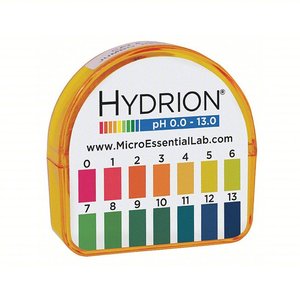
This question tests your understanding of what the pH scale measures and the ranges for acidic, neutral, and basic solutions.
Key Terms and Formulas:
pH: Measure of hydrogen ion concentration.
Neutral pH: 7
Acidic: Less than 7
Basic: Greater than 7
Step-by-Step Guidance
Recall what pH measures (hydrogen ion concentration).
Identify the value for neutral pH.
State the ranges for acidic and basic solutions.
Try solving on your own before revealing the answer!
Q9. pH Calculations
[H+] = 1.0 × 10⁻³ M → pH = ____________
pH = 4.0 → [H+] = ______________________
[OH-] = 1.0 × 10⁻⁵ M → pOH = ____________ → pH = ____________
Background
Topic: pH and pOH Calculations
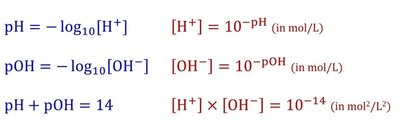
This question tests your ability to use logarithmic relationships to calculate pH, pOH, and ion concentrations.
Key Formulas:
Step-by-Step Guidance
For each calculation, identify the known value (concentration or pH/pOH).
Use the appropriate formula to set up the calculation.
For pH from [H+], use .
For [H+] from pH, use .
For pOH from [OH-], use .
For pH from pOH, use .
Try solving on your own before revealing the answer!
Q10. Find the pH of a solution containing 0.04M hydrocyanic acid. Is HCN a strong or a weak acid?
Background
Topic: Weak Acid pH Calculation
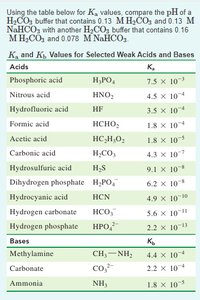
This question tests your ability to calculate the pH of a weak acid solution and classify the acid's strength.
Key Terms and Formulas:
Weak acid: Does not fully dissociate.
Ka: Acid dissociation constant.
ICE table: Used to calculate equilibrium concentrations.
Step-by-Step Guidance
Identify the initial concentration of HCN (0.04 M).
Find the Ka value for HCN from the table.
Set up an ICE table to determine [H+] at equilibrium.
Use the Ka expression: .
Solve for [H+] and then use .
Try solving on your own before revealing the answer!
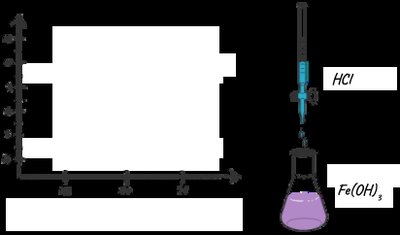
Q11. Plot the titration curve for Fe(OH)3 + HCl and label all its parts. Assume 1 equivalence point.
Background
Topic: Titration Curves
This question tests your ability to interpret and label a titration curve for a weak base and strong acid reaction.
Key Terms:
Titration: Gradual addition of one solution to another to determine concentration.
Equivalence point: Point where stoichiometric amounts of acid and base have reacted.
Buffer region: Area before equivalence point where pH changes slowly.
Step-by-Step Guidance
Draw axes: pH (y-axis) vs. volume of titrant (x-axis).
Mark the starting pH (weak base).
Show the gradual decrease in pH as HCl is added.
Identify and label the equivalence point.
Label buffer region and after equivalence point.
Try solving on your own before revealing the answer!
