 Back
Aldehydes and Ketones: Structure, Properties, and Nomenclature
Study Guide - Smart Notes
 Tailored notes based on your materials, expanded with key definitions, examples, and context.
Chapter 15: Aldehydes and Ketones
15.1 The Carbonyl Group
The carbonyl group is a fundamental functional group in organic chemistry, consisting of a carbon atom double-bonded to an oxygen atom. This group is central to the chemistry of aldehydes and ketones, imparting unique reactivity and polarity to these compounds.
Definition: The carbonyl group is represented as C=O.
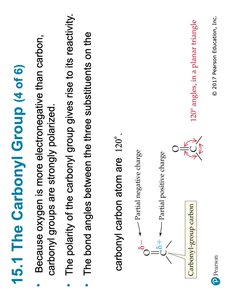
Polarity: Oxygen is more electronegative than carbon, making the carbonyl group strongly polarized.
Shape: The bond angles between the three substituents on the carbonyl carbon are approximately 120°, forming a planar triangle.
Classification: Carbonyl compounds are classified based on what is bonded to the carbonyl carbon.
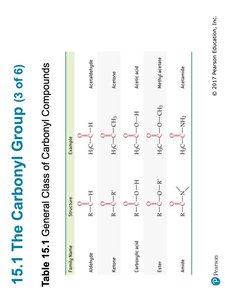
Aldehydes and ketones share similar properties due to their carbonyl groups, but differ in their structure:
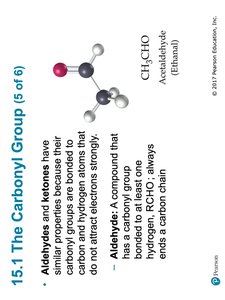
Aldehyde: A compound with at least one hydrogen bonded to the carbonyl group (RCHO). The carbonyl group always ends a carbon chain.
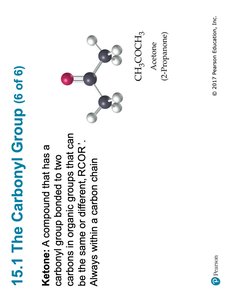
Ketone: A compound with the carbonyl group bonded to two carbon atoms (RCOR'). The carbonyl group is always within a carbon chain.
15.2 Naming Simple Aldehydes and Ketones
Aldehydes and ketones are named using both common and systematic (IUPAC) nomenclature. Understanding their naming conventions is essential for identifying and drawing their structures.
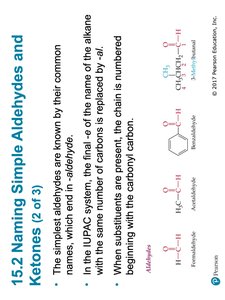
Aldehydes: The simplest aldehydes are named with the suffix -aldehyde. In IUPAC, the final -e of the alkane is replaced by -al. The chain is numbered starting from the carbonyl carbon.
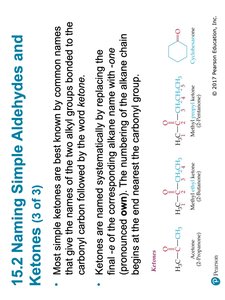
Ketones: Ketones are named by replacing the -e of the alkane with -one. The chain is numbered so the carbonyl carbon gets the lowest possible number. Common names use the names of the two alkyl groups attached to the carbonyl carbon, followed by "ketone".
Worked Example: Naming a ketone
Given structure:
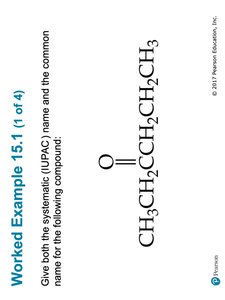
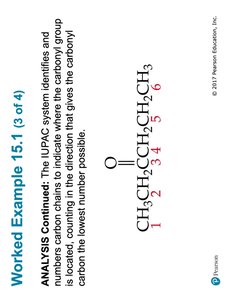
Analysis: The compound is a ketone with an ethyl group and a propyl group attached to the carbonyl carbon.
IUPAC name: 3-hexanone
Common name: ethyl propyl ketone
15.3 Properties of Aldehydes and Ketones
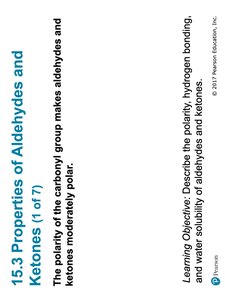
The carbonyl group imparts moderate polarity to aldehydes and ketones, affecting their physical properties such as boiling point and solubility.
Boiling Points: Aldehydes and ketones boil at higher temperatures than alkanes of similar molecular weight, but lower than alcohols.
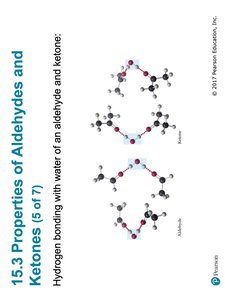
Hydrogen Bonding: Individual aldehyde and ketone molecules do not hydrogen bond with each other, but can accept hydrogen bonds from water.
Solubility: Aldehydes and ketones with fewer than five or six carbon atoms are soluble in water due to their ability to accept hydrogen bonds. They are also soluble in common organic solvents.
Polarity: The presence of the carbonyl group makes these compounds polar.
Summary Table: Properties of Aldehydes and Ketones
Property | Aldehydes & Ketones |
|---|---|
Polarity | Moderately polar due to carbonyl group |
Boiling Point | Higher than alkanes, lower than alcohols |
Hydrogen Bonding | Cannot hydrogen bond with each other, but can accept from water |
Solubility | Water-soluble if small; soluble in organic solvents |
Physical State | Typically liquids |
Toxicity | Ketones generally less toxic than simple aldehydes |
Many aldehydes and ketones have distinctive odors and are less toxic than simple aldehydes.
15.4 Some Common Aldehydes and Ketones
Many aromas and flavors derive from naturally occurring aldehydes and ketones. These compounds are important in both biological and industrial contexts.
Some naturally occurring aldehydes and ketones have distinctive odors.
Formaldehyde (HCHO): At room temperature, formaldehyde is a colorless gas with a pungent, suffocating odor. It is toxic but useful in industry.
Low concentrations in air can cause irritation and asthma attacks; skin contact can produce dermatitis.
Formaldehyde is formed during incomplete combustion of hydrocarbons and is partly responsible for smog irritation.
It is a breakdown product of methyl alcohol and is toxic, causing kidney damage, coma, and sometimes death.
Formaldehyde is commonly sold as a 37% aqueous solution called formalin, used for disinfecting and sterilizing equipment.
On standing, formaldehyde polymerizes into a solid known as paraformaldehyde.
Example: Naturally occurring aldehydes and ketones with distinctive odors
Additional info: The notes cover the structure, nomenclature, properties, and some common examples of aldehydes and ketones, which are central to GOB Chemistry Chapter 15. The content is suitable for exam preparation and provides a concise, structured overview of the topic.
