 Back
BackAmines, Amides, Amino Acids, Proteins, and Enzymes: Structured Study Notes
Study Guide - Smart Notes
 Tailored notes based on your materials, expanded with key definitions, examples, and context.
Amines and Amides
Heterocyclic Amines
Heterocyclic amines are cyclic organic compounds containing nitrogen atoms within the ring structure. These rings may consist of five or six atoms, with one or two nitrogen atoms present.
Pyrrolidine: Five-membered ring with four carbon atoms and one nitrogen atom, all single bonds.
Pyrrole: Five-membered ring with one nitrogen atom and two double bonds.
Imidazole: Five-membered ring with two nitrogen atoms.
Piperidine: Six-membered ring with one nitrogen atom; found in black pepper.
Purine and Pyrimidine: Found in DNA and RNA; purine combines a six-membered pyrimidine and a five-membered imidazole ring.
Alkaloids
Alkaloids are physiologically active compounds produced by plants that contain heterocyclic amines. They are used in anesthetics, antidepressants, and stimulants, and many are habit-forming.
Neurotransmitters
A neurotransmitter is a chemical compound that transmits impulses from a nerve cell to a target cell (another nerve cell, muscle cell, or gland cell). Neurotransmitters contain nitrogen atoms as amines and alkylammonium ions, and are synthesized from amino acids obtained from the diet.
Important neurotransmitters: acetylcholine, dopamine, norepinephrine, epinephrine, serotonin, histamine, glutamate, GABA.
Histamine causes allergic reactions and stimulates acid production in the stomach.
Antihistamines block histamine receptors to stop allergic reactions.
Amides
Amides are derivatives of carboxylic acids where a nitrogen group (—NH2) replaces the hydroxyl (—OH) group. Amides do not exhibit the basic properties of amines and are generally water soluble if they have fewer than six carbons.
Amino Acids and Proteins
Proteins: Structure and Function
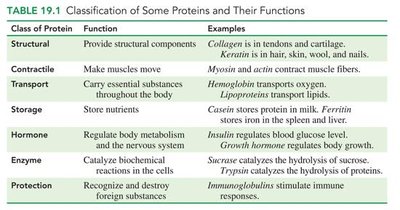
Proteins are polymers made from 20 different amino acids. Their characteristics and functions depend on the sequence of amino acids. Proteins serve as structural components, enzymes, and transporters, and are involved in oxygen transport (hemoglobin, myoglobin).
Structural: Collagen, keratin
Contractile: Myosin, actin
Transport: Hemoglobin, lipoproteins
Storage: Casein, ferritin
Hormone: Insulin, growth hormone
Enzyme: Sucrase, trypsin
Protection: Immunoglobulins
Amino Acid Structure
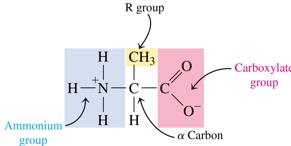
Amino acids are the building blocks of proteins. Each amino acid has a central α carbon bonded to:
An ammonium group (—NH3+)
A carboxylate group (—COO−)
A hydrogen atom
An R group (side chain)
Zwitterion
At physiological pH, amino acids exist as zwitterions, with both positive (ammonium) and negative (carboxylate) charges, resulting in an overall neutral molecule. The pH at which this occurs is called the isoelectric point (pI).
Classification of Amino Acids
Amino acids are classified based on their R groups:
Nonpolar (hydrophobic): Hydrogen, alkyl, or aromatic R groups
Polar (hydrophilic): R groups interact with water
Polar neutral: Hydroxyl (—OH), thiol (—SH), or amide (—CONH2) R group
Polar acidic: Carboxylic acid (—COOH) R group
Polar basic: Amine (—NH2) R group
Essential Amino Acids
Of the 20 amino acids, 11 can be synthesized by the body, while 9 are essential amino acids that must be obtained from the diet.
Peptide Bonds and Protein Structure
A peptide bond is an amide bond formed between the —COO− group of one amino acid and the —NH3+ group of another. Peptides are chains of amino acids:
Dipeptide: 2 amino acids
Tripeptide: 3 amino acids
Tetrapeptide: 4 amino acids
Pentapeptide: 5 amino acids
Polypeptide: More than 5 amino acids
Protein: Polypeptide with 50+ amino acids and biological activity
Primary Structure
The primary structure of a protein is the sequence of amino acids held together by peptide bonds from the N-terminus to the C-terminus.
Secondary Structure
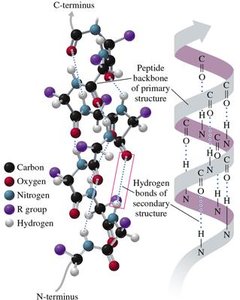
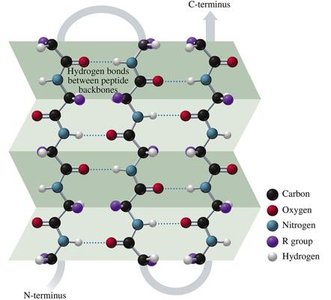
The secondary structure describes the arrangement of the polypeptide backbone stabilized by hydrogen bonds.
Alpha (α) helix: Hydrogen bonds form between C=O and N-H groups, creating a helical shape.
Beta (β) pleated sheet: Hydrogen bonds form between C=O and N-H groups in adjacent sections, resulting in a zig-zag sheet.
Tertiary Structure
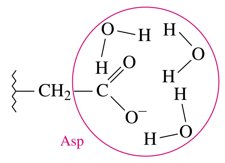
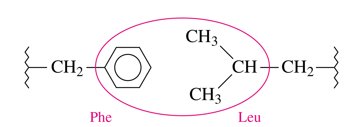
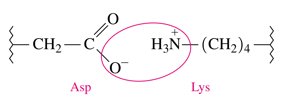
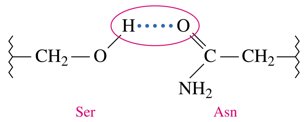
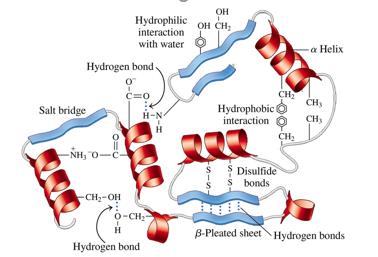
The tertiary structure is the overall three-dimensional shape of a protein, stabilized by interactions between R groups:
Hydrophilic interactions: Polar residues interact with water, pulling them to the protein's surface.
Hydrophobic interactions: Nonpolar residues cluster in the protein's interior.
Salt bridges: Ionic attractions between acidic and basic residues.
Hydrogen bonds: Between polar residues.
Disulfide bonds: Covalent bonds between cysteine residues.
Quaternary Structure
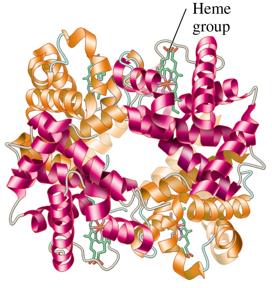
Proteins with two or more polypeptide chains have a quaternary structure. Hemoglobin, for example, consists of four subunits (two orange, two red chains).
Protein Hydrolysis and Denaturation
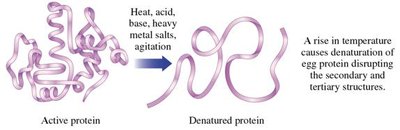
Denaturation occurs when the interactions stabilizing secondary, tertiary, or quaternary structures are disrupted, destroying the protein's shape and biological activity. Causes include heat, acid, base, heavy metal salts, and agitation.
Enzymes and Vitamins
Enzyme Structure and Function
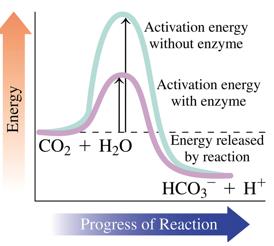
Enzymes are globular proteins that increase the rate of chemical reactions by lowering the activation energy. They have a unique three-dimensional shape with an active site where substrates bind.
Enzyme-substrate (ES) complex forms, providing an alternative pathway with lower activation energy.
Amino acid R groups in the active site catalyze the reaction, forming an enzyme-product (EP) complex.
Models of Enzyme Action
Lock-and-key model: Rigid substrate binds to rigid enzyme, like a key fitting a lock.
Induced-fit model: Active site adapts to the substrate's shape, lowering activation energy.
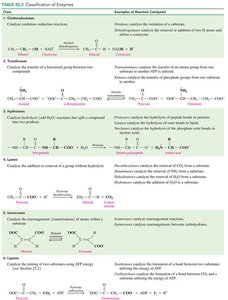
Classification of Enzymes
Enzymes are classified into six types based on the reactions they catalyze:
Oxidoreductases: Catalyze oxidation-reduction reactions
Transferases: Transfer functional groups between compounds
Hydrolases: Catalyze hydrolysis (add H2O) to split molecules
Lyases: Add or remove groups without hydrolysis
Isomerases: Rearrangement (isomerization) of atoms within a substrate
Ligases: Join two substrates using ATP energy
Factors Affecting Enzyme Activity
Optimum temperature: Most active at 37°C in humans
Low temperature: Little activity
High temperature (>50°C): Denaturation occurs, activity lost
Optimum pH: Usually 7.4, but varies by organ
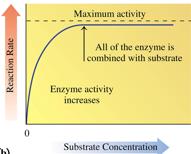
Enzyme and Substrate Concentration
Increasing enzyme concentration (constant substrate): Increases reaction rate
Increasing substrate concentration (constant enzyme): Increases reaction rate until enzyme is saturated, then activity plateaus
Summary Table: Protein Functions
Class of Protein | Function | Examples |
|---|---|---|
Structural | Provide structural components | Collagen (tendons, cartilage), Keratin (hair, skin, wool, nails) |
Contractile | Make muscles move | Myosin, Actin |
Transport | Carry substances throughout body | Hemoglobin, Lipoproteins |
Storage | Store nutrients | Casein (milk), Ferritin (spleen, liver) |
Hormone | Regulate metabolism and nervous system | Insulin, Growth hormone |
Enzyme | Catalyze biochemical reactions | Sucrase, Trypsin |
Protection | Recognize and destroy foreign substances | Immunoglobulins |
Key Equations
Peptide bond formation:
Enzyme-catalyzed reaction:
Additional info:
Protein denaturation is irreversible in most cases, especially when caused by heat or strong chemicals.
Enzyme activity is crucial for metabolic pathways and is regulated by inhibitors, activators, and environmental conditions.
