 Back
BackAmines and Amides
Study Guide - Smart Notes
 Tailored notes based on your materials, expanded with key definitions, examples, and context.
Amines
Definition and Structure
Amines are organic compounds derived from ammonia (NH3) in which one or more hydrogen atoms are replaced by alkyl or aromatic groups. The nitrogen atom in amines is bonded to one or more carbon-containing groups, giving rise to a variety of structures and properties.
Key Point: Amines contain a nitrogen atom attached to alkyl or aromatic rings.
Example: Methylamine, aniline.
Classification of Amines
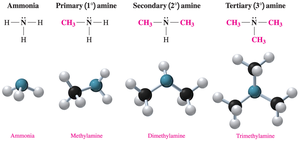
Amines are classified based on the number of carbon groups attached to the nitrogen atom:
Primary (1°) amine: One carbon group bonded to the nitrogen.
Secondary (2°) amine: Two carbon groups bonded to the nitrogen.
Tertiary (3°) amine: Three carbon groups bonded to the nitrogen.
Naming Amines
Simple amines are named as alkylamines. The names of the alkyl groups bonded to the nitrogen atom are listed in alphabetical order, followed by "amine." Prefixes are used to indicate duplicate alkyl substituents.
Example: Ethylamine, Dimethylamine, Ethyldimethylamine.
Aromatic Amines
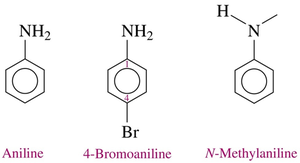
Aromatic amines are based on the benzene ring. The simplest aromatic amine is aniline. Alkyl groups attached to the nitrogen are named with the prefix "N-" followed by the alkyl name. Aniline is widely used in the manufacture of dyes.
Example: N-methylaniline, 4-bromoaniline.
Line-Angle Formulas of Amines
Line-angle formulas are used to represent the shapes of amine molecules, showing the arrangement of alkyl groups bonded to the nitrogen atom. 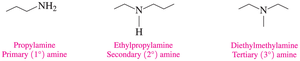
Solubility of Amines: Hydrogen Bonds
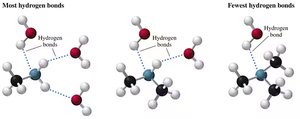
Amines can form hydrogen bonds with water, affecting their solubility. Primary and secondary amines form more hydrogen bonds than tertiary amines, making them more soluble in water.
Key Point: The number of hydrogen bonds decreases from primary to tertiary amines.
Amines as Bases in Water
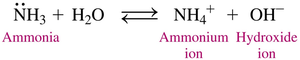
Amines act as Brønsted-Lowry bases in water. The lone pair of electrons on the nitrogen atom accepts a proton (H+) from water, forming an ammonium ion and a hydroxide ion.
Equation:
Equation:

Neutralization of Amines
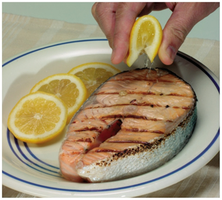
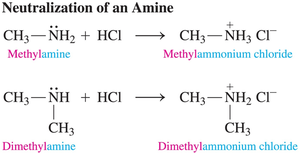
Amines react with acids in a neutralization reaction to form amine salts. This process is used to neutralize odors (such as fishy smells) and to prepare amines for use in medications.
Example: The amines in fish react with citric acid in lemon juice to neutralize the odor.
Formation and Properties of Amine Salts
Amine salts are named by combining the alkylammonium ion name with the name of the negative ion.
Properties: Amine salts are solids at room temperature, odorless, soluble in water and body fluids, and are often used as active ingredients in medications.
Example: Ephedrine (decongestant), diphenhydramine (Benadryl).
Alkaloids: Amines in Plants
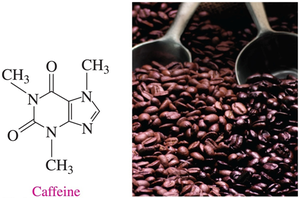
Alkaloids are naturally occurring amines produced by plants. They are used as anesthetics, stimulants, and painkillers.
Example: Morphine (poppy plant), nicotine (stimulant), caffeine (stimulant).
Amides
Definition and Structure
Amides are derivatives of carboxylic acids in which a nitrogen group (-NH2) replaces the hydroxyl group (-OH) of the acid. Amides are important in biological systems and pharmaceuticals.
Example: Acetaminophen (Tylenol), urea (protein metabolism).
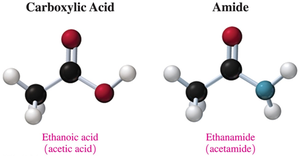
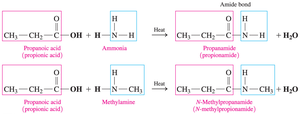
Preparation of Amides: Amidation
Amides are formed by reacting a carboxylic acid with ammonia, a primary amine, or a secondary amine, in the presence of heat.
Equation:
Equation:
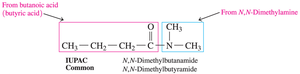
Naming Amides
The IUPAC name for an amide is formed by dropping the "oic acid" or "ic acid" suffix from the carboxylic acid and adding "amide." Alkyl groups attached to the nitrogen are named with the prefix "N-" followed by the alkyl name.
Example: Butanamide, N-methylbutanamide.
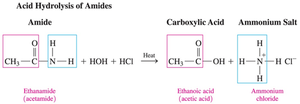
Hydrolysis of Amides
Amides can be hydrolyzed by acids or bases:
Acid hydrolysis: Produces a carboxylic acid and an ammonium salt.
Equation:
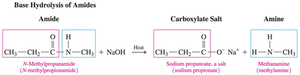
Base hydrolysis: Produces the salt of a carboxylic acid and an amine or ammonia.
Equation:
Summary Table: Classification of Amines
Type | Structure | Example |
|---|---|---|
Primary (1°) | R-NH2 | Methylamine |
Secondary (2°) | R-NH-R' | Dimethylamine |
Tertiary (3°) | R-N(R')-R'' | Trimethylamine |
Summary Table: Properties of Amine Salts
Property | Description |
|---|---|
Physical State | Solid at room temperature |
Odor | Odorless |
Solubility | Soluble in water and body fluids |
Use | Active ingredients in medications |
Summary Table: Hydrolysis of Amides
Type | Reactants | Products |
|---|---|---|
Acid Hydrolysis | Amide + H2O + HCl | Carboxylic acid + Ammonium salt |
Base Hydrolysis | Amide + NaOH | Carboxylate salt + Amine |
Additional info: Alkaloids are a diverse group of naturally occurring amines with significant pharmacological effects. Amides are key functional groups in proteins and pharmaceuticals.
