 Back
BackAmino Acid and Protein Structure Study Guide
Study Guide - Smart Notes
 Tailored notes based on your materials, expanded with key definitions, examples, and context.
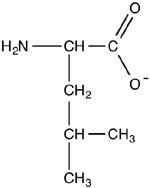
Q10. What is the structure of the amino acid leucine at pH 12?
Background
Topic: Amino Acid Structure and Ionization
This question tests your understanding of how amino acids change their structure depending on the pH of their environment, specifically focusing on leucine at a basic pH (pH 12).
Key Terms and Formulas:
Amino Acid: Organic molecules containing both an amino group (–NH2) and a carboxyl group (–COOH).
Zwitterion: A form of an amino acid where both the amino group is protonated (–NH3+) and the carboxyl group is deprotonated (–COO–), typically at neutral pH.
pI (Isoelectric Point): The pH at which the amino acid has no net charge.
Ionization: At high pH, the amino group loses a proton and becomes –NH2; the carboxyl group is already deprotonated as –COO–.
Step-by-Step Guidance
Recall the general structure of leucine: it has an amino group, a carboxyl group, and a side chain (isobutyl group).
At pH 12 (which is much higher than the pI), the environment is basic. The amino group will lose a proton and become –NH2, while the carboxyl group will remain deprotonated as –COO–.
Compare the provided structures to identify which one shows leucine with a deprotonated amino group (–NH2) and a deprotonated carboxyl group (–COO–).
Look for the structure that matches these features. Pay attention to the charges and the side chain.
Try solving on your own before revealing the answer!
Final Answer: Structure C
At pH 12, leucine's amino group is deprotonated (–NH2) and its carboxyl group is deprotonated (–COO–), which matches structure C.
This reflects the basic environment where both groups lose protons.
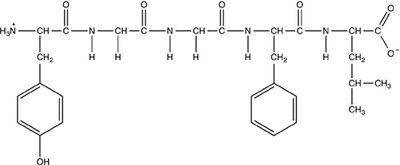
Q14. How many chirality centers are in leu-enkephalin (structure shown)?
Background
Topic: Chirality in Peptides
This question tests your ability to identify chiral centers (carbon atoms with four different groups attached) in a peptide structure, specifically leu-enkephalin.
Key Terms and Formulas:
Chirality Center: A carbon atom bonded to four different groups.
Peptide: A chain of amino acids linked by peptide bonds.
Leu-enkephalin: A pentapeptide with several amino acid residues, each potentially containing a chiral center at the alpha carbon.
Step-by-Step Guidance
Examine the structure of leu-enkephalin and identify each amino acid residue.
For each residue, locate the alpha carbon (the central carbon attached to the amino group, carboxyl group, side chain, and hydrogen).
Determine if each alpha carbon is a chirality center by checking if it is attached to four different groups.
Count the total number of chirality centers in the entire peptide.
Try solving on your own before revealing the answer!
Final Answer: 3 chirality centers
Each amino acid residue (except glycine) typically has a chiral alpha carbon. In leu-enkephalin, there are three such centers.
