 Back
Aromatic Rings and Hydrocarbon Nomenclature: Structure, Naming, and Functional Groups
Study Guide - Smart Notes
 Tailored notes based on your materials, expanded with key definitions, examples, and context.
Aromatic Rings
Structure and Representation
Aromatic rings, most commonly exemplified by benzene, are characterized by a cyclic structure with alternating double bonds, which are often depicted as resonance structures. The actual electronic structure is a delocalized pi system, giving aromatic compounds unique stability.
Benzene is the prototypical aromatic ring, consisting of six carbon atoms in a hexagonal ring, each bonded to a hydrogen atom.
Resonance structures are used to illustrate the delocalization of electrons in aromatic rings.
Hydrogens are often omitted in skeletal formulas for clarity.
Aromaticity is a property resulting from the delocalized electrons, leading to chemical stability.
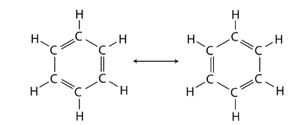
Additional info: The resonance structures show alternating double bonds, but the true structure is a hybrid with equal bond lengths.
Nomenclature of Aromatic Rings with Functional Groups
The naming of aromatic compounds follows IUPAC rules, with 'benzene' as the backbone. Functional groups attached to the ring are named as prefixes, and their positions are indicated by numbers. Some aromatic compounds have common names that are widely used.
For a single substituent, numbering is not required.
Common names include phenol (benzenol), toluene (methylbenzene), and aniline (aminobenzene).
Alkyl groups are named by replacing the '-ane' ending with '-yl' and used as prefixes (e.g., methylbenzene).
For multiple substituents, use the lowest possible numbers and prefixes like di-, tri-, etc.
Multiple Functional Groups on Chains and Rings
Chains and Rings with Multiple Functional Groups
When a molecule contains more than one functional group, the positions and quantity must be specified. If the same group appears multiple times, prefixes such as di-, tri-, etc., are used. The numbering of the carbon chain or ring starts from the end that gives the substituents the lowest possible numbers.
For identical groups, indicate their positions and use appropriate prefixes.
If substituents are double or triple bonds, the chain is named as an alkene or alkyne, respectively.
For rings, numbering starts at the substituent with the highest priority.
Branched Chains (Side Chains)
Naming Branched Hydrocarbons
Branched hydrocarbons are named by identifying the longest continuous carbon chain as the backbone. Side chains (alkyl groups) are named as prefixes, and their positions are indicated by numbers. Multiple side chains are listed alphabetically, ignoring their numerical prefixes when determining order.
The backbone is the longest chain; all other chains are treated as substituents.
Number the chain to give the substituents the lowest possible numbers.
List substituents alphabetically, not by their position numbers.
Use prefixes (di-, tri-, etc.) for multiple identical substituents.
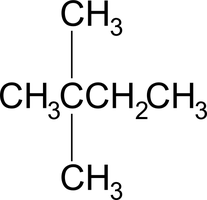
Example: The structure shown is a branched hydrocarbon; the longest chain and side chains must be identified for proper naming.
Identifying the Longest Chain
To name a branched hydrocarbon, first identify the longest continuous chain. This determines the base name of the compound. Side chains are then named and their positions specified.
Count the number of carbons in the longest chain.
Assign numbers to the chain to minimize the numbers assigned to substituents.
Side chains are named as alkyl groups (e.g., methyl, ethyl).
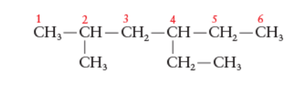
Example: The image shows a hydrocarbon with the longest chain numbered and side chains identified.
Complex Branched Hydrocarbons
For more complex branched hydrocarbons, the same principles apply: identify the longest chain, number it, and name all substituents. Multiple substituents on the same carbon are both called out.
Assign the lowest possible numbers to substituents.
Multiple substituents on the same carbon are indicated by their positions and prefixes.
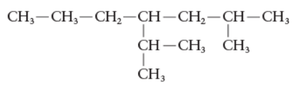
Example: The image shows a complex hydrocarbon with multiple branches.
Multiple Functional Groups on Aromatic Rings
Naming Aromatic Rings with Multiple Substituents
When aromatic rings have more than one substituent, the positions are numbered to give the lowest possible numbers. Common names are often used for certain compounds, which can simplify naming. Substituents are listed alphabetically, and prefixes are used for multiple identical groups.
Number the ring to assign the lowest numbers to substituents.
Use prefixes (di-, tri-, etc.) for multiple identical groups.
Common names may indicate the position of a substituent (e.g., 'phenol' for hydroxybenzene).
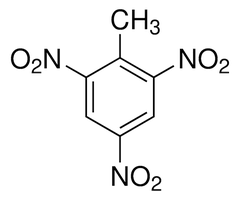
Example: The image shows an aromatic ring with three nitro groups and a methyl group. Possible names include 2,3,5-trinitrotoluene or trinitrotoluene (TNT).
Alternative Names for Aromatic Compounds
Some aromatic compounds have more than one acceptable name, depending on the substituents and their positions. Both IUPAC and common names may be used.
Alternative names may arise from different conventions or historical usage.
Always check for common names in addition to IUPAC names.
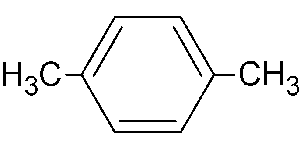
Example: The image shows an aromatic ring with two methyl groups. This compound can be named as 1,3-dimethylbenzene (IUPAC) or m-xylene (common name).
Summary Table: Nomenclature Rules for Aromatic and Branched Hydrocarbons
Feature | Rule | Example |
|---|---|---|
Single substituent on aromatic ring | No numbering required | Toluene (methylbenzene) |
Multiple substituents (same group) | Use prefixes (di-, tri-, etc.) and number positions | 1,3-dibromobenzene |
Branched chains | Longest chain is backbone; side chains as prefixes | 2,4-diethylpentane |
Multiple functional groups (different) | List alphabetically, number for lowest positions | 3-nitroaniline |
Common names | Used for certain aromatic compounds | Phenol, aniline, xylene |
Additional info: This table summarizes key rules for naming aromatic and branched hydrocarbons, including both IUPAC and common conventions.
