 Back
Atomic Structure and Periodic Trends: Mini-Textbook Study Notes for GOB Chemistry
Study Guide - Smart Notes
 Tailored notes based on your materials, expanded with key definitions, examples, and context.
Atomic Structure and Electromagnetic Radiation
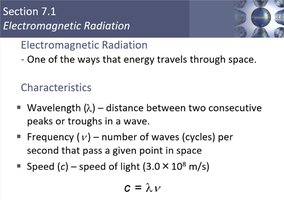
Electromagnetic Radiation
Electromagnetic radiation is a fundamental way that energy travels through space, and is essential for understanding atomic structure and chemical behavior.
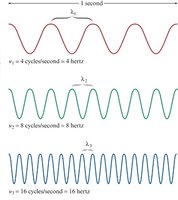
Wavelength (\lambda): The distance between two consecutive peaks or troughs in a wave.
Frequency (\nu): The number of wave cycles passing a given point per second, measured in Hertz (Hz).
Speed (c): The speed of light in a vacuum, approximately m/s.
Relationship:
Key Equations and Constants
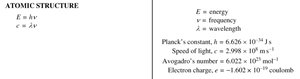
Energy of a photon:
Speed of light:
Planck's constant: J·s
Avogadro's number: mol-1
Electron charge: coulombs
Units and Conversions
Understanding units is crucial for calculations involving electromagnetic radiation.
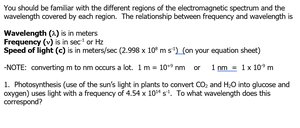
Wavelength: Often measured in meters (m) or nanometers (nm).
Frequency: Measured in s-1 or Hz.
Sample Calculations and Applications
Photosynthesis: Light with a frequency of s-1 is used. To find wavelength:
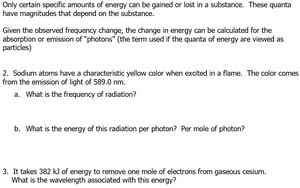
Sodium emission: Light of 589.0 nm is emitted. Calculate frequency and energy per photon.
Energy removal: 382 kJ is required to remove one mole of electrons from cesium. Find the associated wavelength.
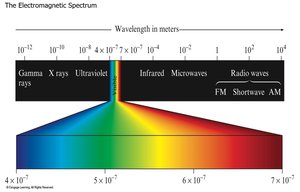
The Electromagnetic Spectrum
Regions of the Spectrum
The electromagnetic spectrum includes a range of wavelengths, from gamma rays to radio waves. Each region has distinct properties and applications.
Gamma rays: Shortest wavelength, highest energy.
X-rays, Ultraviolet: Used in medical imaging and sterilization.
Visible light: The range detectable by human eyes.
Infrared, Microwaves, Radio waves: Used in communication and heating.
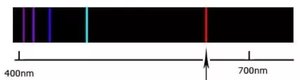
Atomic Spectra and Energy Levels
Line and Continuous Spectra
Atoms emit light at specific wavelengths, producing line spectra. This is evidence for quantized energy levels within atoms.
Continuous spectrum: Contains all wavelengths.
Line spectrum: Contains only specific wavelengths characteristic of the element.
Hydrogen: Shows a line spectrum, indicating quantized energy levels.
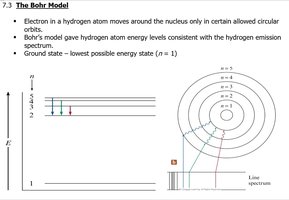
The Bohr Model
The Bohr model describes electrons in hydrogen as moving in specific allowed circular orbits, each with a quantized energy.
Ground state: Lowest possible energy state ().
Energy levels: Electrons can transition between levels, emitting or absorbing photons.
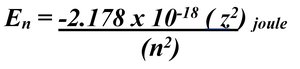
Energy of Electron in Bohr Model
Formula: joule
Z: Atomic number
n: Principal quantum number
Quantum Mechanical Model
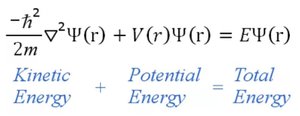
Schrödinger Equation
The quantum mechanical model uses wave functions to describe the probability of finding an electron in a particular region around the nucleus.
Wave function (\Psi): Mathematical description of electron's position.
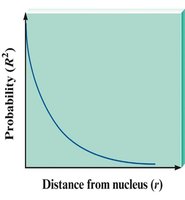
Probability distribution: gives the likelihood of finding an electron at a specific location.
Schrödinger equation:
Probability and Radial Distribution
Probability distribution: Shows how likely it is to find an electron at a certain distance from the nucleus.
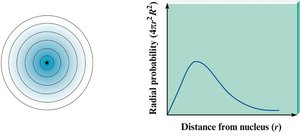
Radial distribution: Considers the probability at different radii.
Quantum Numbers and Orbitals
Quantum Numbers
Quantum numbers describe the properties of atomic orbitals and the electrons in them. They are essential for understanding electron configurations and chemical behavior.
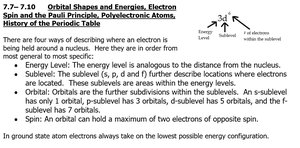
Principal quantum number (n): Indicates energy level.
Angular momentum quantum number (l): Indicates sublevel (s, p, d, f).
Magnetic quantum number (ml): Indicates orbital orientation.
Spin quantum number (ms): Indicates electron spin direction.

Electron Configurations and the Periodic Table
Electron Configurations
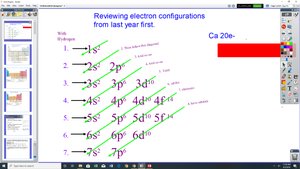
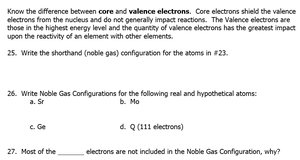
Electrons fill atomic orbitals in a specific order, known as the Aufbau principle. This order is reflected in the structure of the periodic table.
Aufbau principle: Electrons occupy the lowest energy orbitals first.
Pauli exclusion principle: No two electrons in an atom can have the same set of quantum numbers.
Hund's rule: Electrons fill degenerate orbitals singly before pairing.
Orbital Shapes and Energies
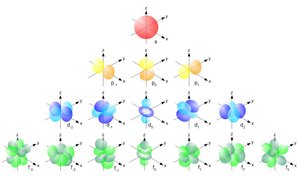
Orbitals have distinct shapes and energies, which influence chemical bonding and reactivity.
s-orbital: Spherical shape
p-orbital: Dumbbell shape
d- and f-orbitals: More complex shapes
Periodic Table and Periodic Trends
Periodic Table Organization
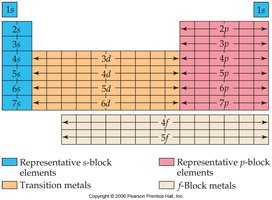
The periodic table is organized by increasing atomic number, reflecting electron configurations and chemical properties.
Groups: Columns with similar properties
Periods: Rows indicating energy levels
Blocks: s, p, d, f blocks correspond to orbital filling
Core vs. Valence Electrons
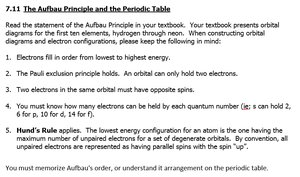
Core electrons are those in inner shells, while valence electrons are in the outermost shell and are most involved in chemical reactions.
Core electrons: Shield valence electrons from the nucleus
Valence electrons: Determine chemical reactivity
Photoelectron Spectroscopy (PES)
PES Principles
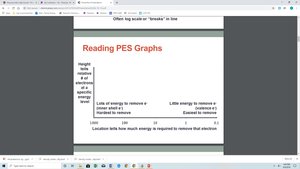
Photoelectron spectroscopy uses high-energy radiation to eject electrons from atoms, allowing measurement of electron binding energies and providing insight into atomic structure.
Electrons closer to the nucleus: Harder to remove
Valence electrons: Easiest to remove
PES output: Shows peaks corresponding to different electron energy levels

Periodic Trends
Atomic Radius
Atomic radius is the distance from the nucleus to the outermost electron. It varies predictably across the periodic table.
Across a period: Atomic radius decreases due to increased effective nuclear charge.
Down a group: Atomic radius increases due to additional energy levels.
Ionization Energy
Ionization energy is the energy required to remove an electron from a gaseous atom or ion. It reflects the strength of electron binding.
First ionization energy: Energy to remove the first electron
Second and third ionization energies: Energy to remove subsequent electrons, usually much higher
Trend: Increases across a period, decreases down a group
Additional info:
These notes cover foundational concepts in atomic structure, quantum mechanics, electron configurations, and periodic trends, all directly relevant to GOB Chemistry.
Sample calculations and questions are included to reinforce understanding and application of key formulas.
