 Back
Atoms and Elements: Structure, Properties, and Periodic Trends
Study Guide - Smart Notes
 Tailored notes based on your materials, expanded with key definitions, examples, and context.
Atoms and Elements
Elements and Their Symbols
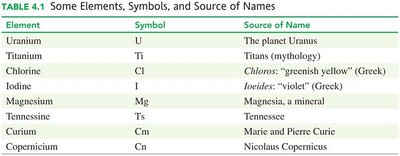
All matter is composed of elements, which are pure substances consisting of only one type of atom. There are currently 118 known elements, with most found naturally on Earth. Elements are named after scientists, planets, mythological figures, minerals, and places. Each element is represented by a unique chemical symbol, usually derived from its English, Latin, or Greek name.
Element: A substance that cannot be broken down into simpler substances by chemical means.
Chemical Symbol: One or two letters representing an element (e.g., C for Carbon, Na for Sodium).
Source of Names: Elements are named for various sources, such as Uranium (planet Uranus), Titanium (Titans, mythology), and Curium (Marie and Pierre Curie).
The Periodic Table
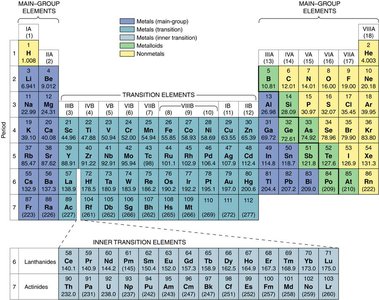
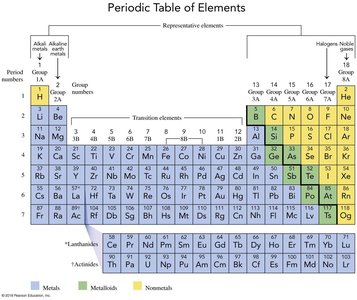
The Periodic Table organizes elements based on increasing atomic number and similarities in chemical properties. Dmitri Mendeleev and Lothar Meyer first arranged elements in rows of increasing atomic mass, but today the table is organized by atomic number. Elements are grouped into periods (rows) and groups (columns), with each group sharing similar properties.
Period: Horizontal row in the periodic table.
Group (Family): Vertical column in the periodic table.
Group Numbering: Groups are numbered 1–18, with main-group elements (A groups) and transition elements (B groups).
Special Groups: Alkali metals (1A), alkaline earth metals (2A), halogens (7A), noble gases (8A), inner transition elements (lanthanides and actinides).
Elements Essential for Human Health
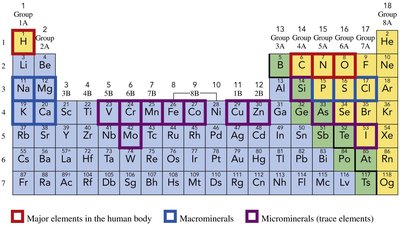
Certain elements are essential for human health, classified as major elements, macrominerals, and microminerals (trace elements). Their functions and typical amounts in the human body are important for biological processes.
Classification of Elements: Metals, Nonmetals, Metalloids
Elements are classified based on their physical and chemical properties:
Metals: Located to the left of the 'steps' in the periodic table. Shiny, good conductors, ductile, malleable, high melting points, tend to lose electrons.
Nonmetals: Located to the right of the 'steps' plus hydrogen. Poor conductors, not ductile or malleable, exist as solids, liquids, or gases, low melting points, tend to gain electrons.
Metalloids: Elements that touch the 'steps' (except Al). Have properties intermediate between metals and nonmetals.
The Structure of the Atom
Historical Development of Atomic Theory
Ancient Greek philosophers debated whether matter was composed of indivisible particles (atoms) or was infinitely divisible. John Dalton's Atomic Theory (1808) provided a scientific foundation for understanding atoms:
All matter is made up of tiny, indivisible particles called atoms.
Atoms of a particular element have identical properties and differ from atoms of other elements.
Compounds are formed by the combination of two or more different types of atoms in fixed ratios.
Chemical reactions involve the rearrangement of atoms; atoms are neither created nor destroyed.
Discovery of Subatomic Particles
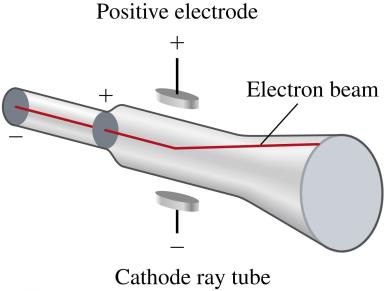
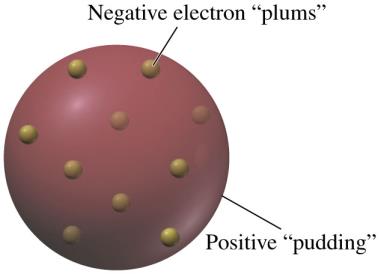
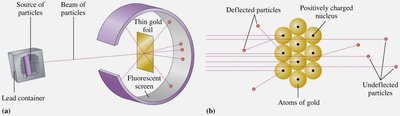
Atoms are composed of three subatomic particles: protons, neutrons, and electrons. J.J. Thomson's cathode ray experiment led to the discovery of electrons, and his 'plum-pudding' model proposed electrons embedded in a positive charge. Rutherford's gold foil experiment revealed the existence of a dense, positively charged nucleus.
Structure of the Atom
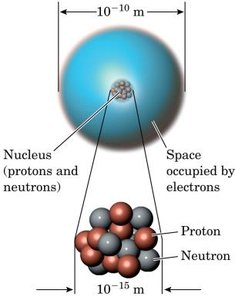
The atom consists of a dense nucleus containing protons and neutrons, surrounded by electrons in a cloud. Most of the atom's mass is concentrated in the nucleus, while most of its volume is empty space.
Proton: Charge +1, mass ≈ 1 amu, located in nucleus.
Neutron: Charge 0, mass ≈ 1 amu, located in nucleus.
Electron: Charge -1, mass ≈ 0.00055 amu, located outside nucleus.

Atomic Number, Mass Number, and Isotopes
Atomic Number and Mass Number
The atomic number (Z) is the number of protons in an atom and defines the element. The mass number (A) is the sum of protons and neutrons. Atoms are neutral, so the number of electrons equals the number of protons.
Atomic Number (Z):
Mass Number (A):
Isotopes and Atomic Mass
Isotopes are atoms of the same element with different numbers of neutrons. The atomic mass listed in the periodic table is a weighted average of the masses of all naturally occurring isotopes.
Example: Nitrogen-14 (7 protons, 7 neutrons), Nitrogen-15 (7 protons, 8 neutrons).
Atomic Mass Calculation:
Electron Energy Levels and Atomic Spectra
Electromagnetic Spectrum
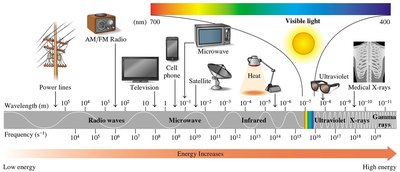
Electromagnetic radiation consists of energy particles called photons that travel as waves. The distance between wave peaks is called wavelength. All forms of electromagnetic radiation travel at the speed of light, with high-energy radiation having short wavelengths and low-energy radiation having long wavelengths.
Atomic Spectra and Electron Energy Levels
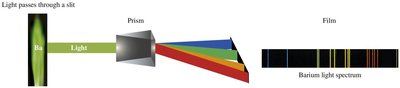
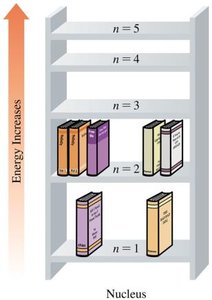
When elements are heated, they emit light that, when passed through a prism, produces an atomic spectrum—a unique pattern for each element. Niels Bohr proposed that electrons occupy specific energy levels (orbits) around the nucleus, and these levels are quantized.
Principal Quantum Number (n): Indicates the energy level; n ranges from 1 to 7.
Electrons in the same energy level have the same value of n.
The lower the value of n, the lower the energy and the closer the electron is to the nucleus.
Changes in Electron Energy Levels
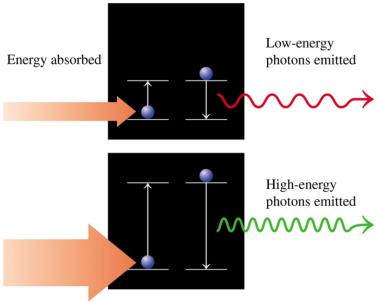
Electrons can absorb energy and move to higher energy levels (excited state). When they return to their original energy level, they release energy as photons.
Electron Arrangements and Valence Electrons
Electron Arrangements for the First 20 Elements
The electron arrangement describes the number of electrons in each energy level for an atom. The maximum number of electrons in each energy level increases with n.
Energy level 1: max 2 electrons
Energy level 2: max 8 electrons
Energy level 3: max 18 electrons
Valence Electrons and Lewis Symbols
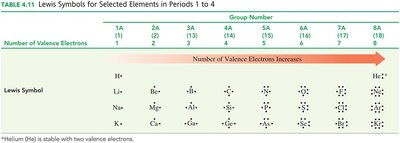
Valence electrons are electrons in the outermost energy level and are responsible for chemical bonding. The number of valence electrons for main-group elements is given by the group number. Lewis symbols (dot structures) represent valence electrons around the element's symbol.
Periodic Properties of Elements
Atomic Size
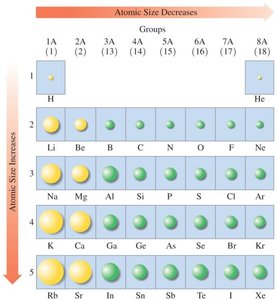
Atomic size increases down a group as new energy levels are added, and decreases across a period due to increasing nuclear charge pulling electrons closer.
Ionization Energy
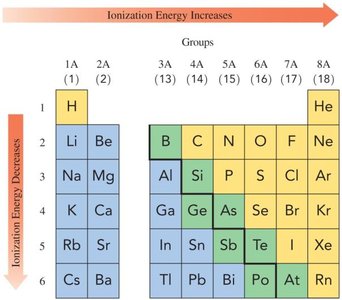
Ionization energy is the energy required to remove an electron from an atom in its gaseous state. It decreases down a group (valence electrons farther from nucleus) and increases across a period (greater attraction between protons and electrons).
Metallic Character
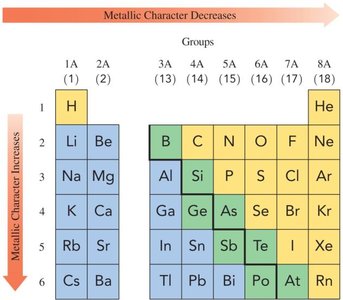
Metallic character refers to an element's tendency to lose electrons. It increases down a group and decreases across a period.
Summary of Key Concepts
Understand the structure and organization of the periodic table.
Know the classification and properties of metals, nonmetals, and metalloids.
Recall Dalton's Atomic Theory and the significance of Thomson's and Rutherford's experiments.
Identify the three subatomic particles and their properties.
Distinguish between atomic number, mass number, and isotopes.
Write electron arrangements and determine valence electrons for main-group elements.
Draw Lewis symbols for elements.
Describe periodic trends: atomic size, ionization energy, and metallic character.
