 Back
Atoms and Radioactivity: Structure, Isotopes, and Nuclear Chemistry
Study Guide - Smart Notes
 Tailored notes based on your materials, expanded with key definitions, examples, and context.
Atoms and the Periodic Table
Structure of the Atom
The atom is the smallest particle of an element that retains its chemical properties. Atoms are composed of a dense, positively charged nucleus containing protons and neutrons, surrounded by a cloud of negatively charged electrons. The nucleus is extremely small compared to the overall size of the atom, but it contains nearly all the atom's mass.
Proton (p+): Positively charged particle, mass ≈ 1 amu.
Neutron (n0): Neutral particle, mass ≈ 1 amu.
Electron (e-): Negatively charged particle, mass ≈ 0.00055 amu (often considered negligible in basic calculations).
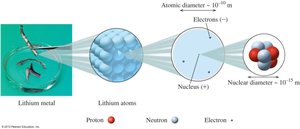
Atomic number (Z): Number of protons in the nucleus; defines the element. Mass number (A): Total number of protons and neutrons in the nucleus. Atomic mass: Weighted average of the masses of all naturally occurring isotopes of an element (in amu).
For example, carbon has an atomic number of 6 (6 protons) and a typical mass number of 12 (6 protons + 6 neutrons).
The Periodic Table
The periodic table organizes elements by increasing atomic number and similar chemical properties. Each element's box provides its symbol, atomic number, and atomic mass.
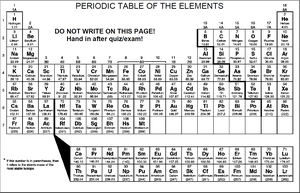
Example: Sodium (Na) has atomic number 11, atomic mass ≈ 22.99 amu.
Isotopes
Isotopes are atoms of the same element with the same number of protons but different numbers of neutrons, resulting in different mass numbers. The atomic mass listed on the periodic table is a weighted average based on the natural abundance of each isotope.
Example: Carbon has three main isotopes: 12C (99%), 13C (1%), 14C (<1%).
Calculating neutrons: Number of neutrons = Mass number – Atomic number.
Nuclear Chemistry and Radioactivity
Radioactivity and Nuclear Radiation
Radioactivity is the spontaneous emission of energy or particles from the nucleus of an unstable atom. Elements that emit radiation are called radioactive. The process by which unstable isotopes become stable by emitting radiation is called radioactive decay. Radioisotopes are isotopes that emit radiation.
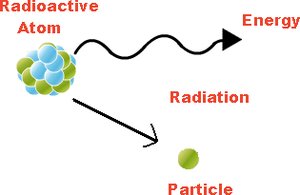
Types of Nuclear Radiation
There are several types of radiation emitted during radioactive decay, each with distinct properties:
Emission | Symbol | Charge |
|---|---|---|
Alpha | or | 2+ |
Beta | or | 1– |
Gamma | 0 | |
Positron | 1+ | |
Neutron | 0 |
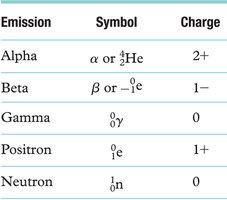
Alpha particle: Helium nucleus (2 protons, 2 neutrons), 2+ charge.
Beta particle: Electron emitted from the nucleus, 1– charge.
Gamma ray: High-energy electromagnetic radiation, no charge or mass.
Positron: Particle with same mass as electron but 1+ charge.
Neutron: Neutral particle, mass ≈ 1 amu.
Penetrating Power and Biological Damage
The ability of radiation to penetrate materials and cause biological damage varies by type:
Alpha particles: Least penetrating, stopped by paper or skin, but most damaging if ingested or inhaled.
Beta particles: Penetrate skin, stopped by aluminum.
Gamma rays: Highly penetrating, require lead or concrete for shielding.
Neutrons: Penetrate deeply, require thick concrete for shielding.
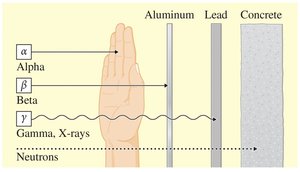
Order of biological damage (most to least): Alpha >> Beta >> Gamma >> Neutron.
Applications of Radioisotopes
Brachytherapy
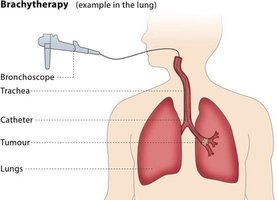
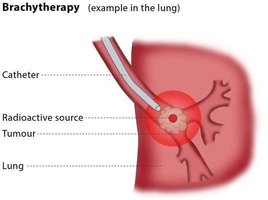
Brachytherapy is a medical treatment that involves placing a radioactive source directly into or near a tumor. This allows for high doses of radiation to be delivered locally, minimizing damage to surrounding healthy tissue.
Radiosurgery
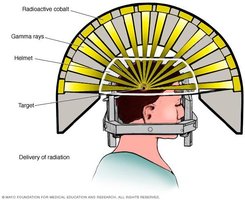
Radiosurgery uses focused beams of radiation (often from cobalt-60) to treat tumors or other abnormalities in the body, especially in the brain. The radioactive decay of cobalt-60 releases both beta and gamma particles, which are directed precisely at the target tissue.
Nuclear Equations and Decay
Writing Nuclear Equations
Nuclear equations represent the transformation of one nucleus into another during radioactive decay. The general form is:
Alpha decay:
Beta decay:
Positron emission:
Gamma emission:
Quantifying Radioactivity
Radioactivity is measured in units such as the Curie (Ci) and the Becquerel (Bq):
1 Ci = Bq
1 Bq = 1 radioactive emission per second
Quantification is essential in medical applications to ensure safe and effective dosing.
Half-Life
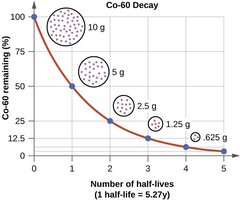
The half-life of a radioactive isotope is the time required for half of the atoms in a sample to decay. After each half-life, only 50% of the original radioactive atoms remain. The process continues exponentially:
After 1 half-life: 50% remains
After 2 half-lives: 25% remains
After 3 half-lives: 12.5% remains
Half-life equation:
Where: = amount remaining = initial amount = elapsed time = half-life
Example: If 10.0 g of phosphorus-32 (half-life = 10 days) is administered, after 35 days:
g remains.
Practice Problems
Write the name and symbol of the elements with atomic numbers 13 (Aluminum, Al), 19 (Potassium, K), and 16 (Sulfur, S).
If an oxygen atom has 9 neutrons, its mass number is 17 (8 protons + 9 neutrons).
Write balanced nuclear equations for alpha decay of thorium-225 and beta decay of cesium-137.
Additional info: These concepts are foundational for understanding atomic structure, isotopes, and the basics of nuclear chemistry, which are essential for GOB Chemistry students.
