 Back
Atoms and Radioactivity: Structured Study Notes for GOB Chemistry
Study Guide - Smart Notes
 Tailored notes based on your materials, expanded with key definitions, examples, and context.
Atoms and Radioactivity
Atoms and Their Components
Atoms are the fundamental units of matter, composed of three main subatomic particles: protons, neutrons, and electrons. Understanding their arrangement and properties is essential for grasping chemical behavior.
Proton: Positively charged particle located in the nucleus; defines the atomic number.
Neutron: Neutral particle also found in the nucleus; contributes to atomic mass.
Electron: Negatively charged particle found in the electron cloud surrounding the nucleus; responsible for chemical bonding.
Atomic Structure: Protons and neutrons cluster in the nucleus, while electrons occupy the surrounding electron cloud.
Atomic Mass Unit (amu): Standard unit for atomic mass; 1 amu is defined as one-twelfth the mass of a carbon-12 atom.
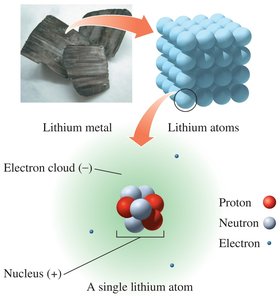
Example: Most of an atom's mass is in the nucleus; electrons are much lighter and contribute negligibly to mass.
Atomic Number and Mass Number
The atomic number and mass number are key identifiers for elements and their isotopes. These numbers help determine the composition of an atom.
Atomic Number (Z): Number of protons in the nucleus; unique to each element.
Mass Number (A): Sum of protons and neutrons in the nucleus.
Symbolic Notation: Atoms are represented as where X is the element symbol, A is mass number, and Z is atomic number.
Neutral Atoms: Number of electrons equals number of protons.
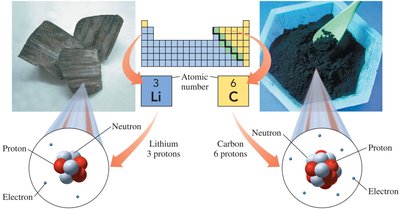

Example: For fluorine with mass number 19 and atomic number 9: 9 protons, 9 electrons, 10 neutrons; symbolic notation .
Isotopes and Atomic Mass
Isotopes are atoms of the same element with different numbers of neutrons, resulting in different mass numbers. Atomic mass is the weighted average of all naturally occurring isotopes.
Isotope: Atoms of the same element with different mass numbers due to varying neutron counts.
Atomic Mass: Weighted average of the masses of all isotopes of an element, as found on the periodic table.
Notation: Isotopes can be written as symbolic notation or with the mass number after the element name (e.g., carbon-12).
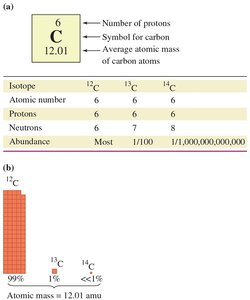
Example: Chlorine has two isotopes: chlorine-35 and chlorine-37. The atomic mass (35.45 amu) indicates chlorine-35 is more abundant.
Radioactivity and Radioisotopes
Radioactivity is the spontaneous emission of energy from unstable atomic nuclei. Radioisotopes are isotopes that emit radiation as they decay to become stable.
Radioactivity: Energy emitted from the nucleus of unstable atoms.
Radioisotope: Isotope that undergoes radioactive decay, emitting radiation.
Forms of Radiation: Alpha (α), beta (β), gamma (γ), positron, and neutron emissions.
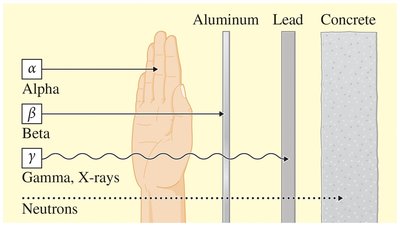
Penetrating Power: Different types of radiation penetrate materials to varying degrees.
Emission | Symbol | Charge |
|---|---|---|
Alpha | 2+ | |
Beta | 1- | |
Gamma | 0 | |
Positron | 1+ | |
Neutron | 0 |
Biological Effects: Ionizing radiation can damage living cells, potentially causing cancer or other health issues.
Nuclear Equations and Radioactive Decay
Nuclear equations represent the transformation of nuclei during radioactive decay. The sum of atomic and mass numbers must be equal on both sides of the equation.
Alpha Decay: Loss of an alpha particle () decreases mass and atomic number.
Beta Decay: Emission of a beta particle () increases atomic number by one.
Gamma Decay: Emission of gamma rays () does not change atomic or mass number.
Positron Emission: Emission of a positron () decreases atomic number by one.
Example: Americium-241 alpha decay:
Example: Manganese-56 beta decay:
Radiation Units and Half-Lives
Radioactivity is measured in units such as curie (Ci) and becquerel (Bq). The half-life is the time required for half of a radioactive sample to decay.
Curie (Ci): Measures disintegrations per second.
Becquerel (Bq): SI unit for radioactivity.
Half-Life: Time for half the atoms in a sample to decay; varies by isotope.
Effective Half-Life: Shortened by biological elimination in medical contexts.
Radioisotope | Symbol | Physical Half-Life | Effective Half-Life |
|---|---|---|---|
Fluorine-18 | 18F | 110 min | 85 min |
Technetium-99m | 99mTc | 6.0 hr | 4.8 hr |
Iodine-131 | 131I | 8 days | 7.6 days |
Half-Life Calculation: where n = number of half-lives elapsed.
Example: 100 mg of iodine-131 (half-life 8 days) after 32 days: 4 half-lives, 6.25 mg remains.
Medical Applications for Radioisotopes
Radioisotopes are used in medicine for both diagnosis and treatment. Tracers with short half-lives are used for imaging, while higher doses can treat diseased tissues.
Diagnostic Use: Tracers like technetium-99m help visualize blood flow and detect abnormalities.
Therapeutic Use: Radioisotopes such as iodine-131 are used to destroy cancerous tissues.
PET Scans: Use positron-emitting isotopes (e.g., fluorine-18) to detect functional abnormalities in organs.
Brachytherapy: Radioactive seeds are implanted in tumors for targeted treatment.
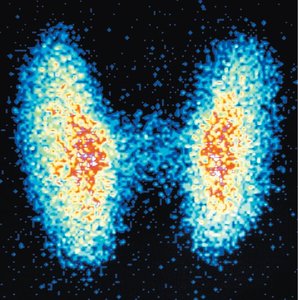
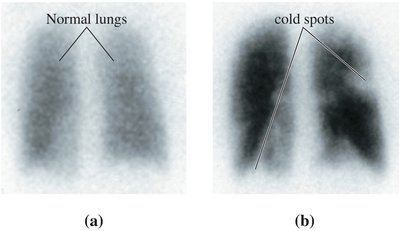
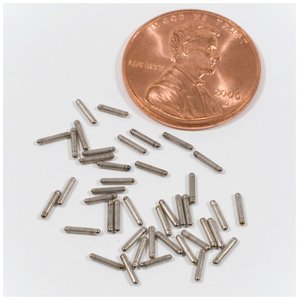
Example: PET scans use fluorine-18, which emits positrons that interact with electrons to produce detectable gamma rays.
Summary Table: Types of Ionizing Radiation
Type | Penetration | Shielding |
|---|---|---|
Alpha (α) | Stops at skin | Paper, clothing |
Beta (β) | Stops at skin layer | Plastic, aluminum, gloves |
Gamma (γ) | Fully penetrates body | Lead, concrete |
Neutron (n) | Fully penetrates body | Concrete, water |
