 Back
Atoms and the Periodic Table: Structured Study Notes for GOB Chemistry
Study Guide - Smart Notes
 Tailored notes based on your materials, expanded with key definitions, examples, and context.
Atoms and the Periodic Table
Atomic Theory and the Structure of Atoms
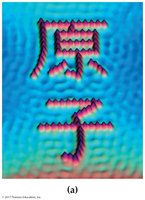
The concept of the atom is fundamental to chemistry. Atoms are the smallest units of matter that retain the identity of an element. Modern atomic theory is based on several key assumptions:
All matter is composed of atoms.
Atoms of a given element are unique and differ from those of other elements.
Chemical compounds consist of atoms combined in specific ratios. Only whole atoms combine, not fractions.
Chemical reactions rearrange atoms but do not change the atoms themselves.
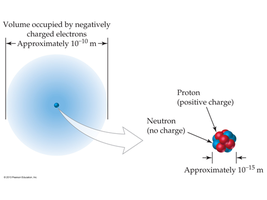
Atoms are composed of three main subatomic particles:
Protons: Positively charged, found in the nucleus.
Neutrons: Neutral, found in the nucleus, similar mass to protons.
Electrons: Negatively charged, much lighter than protons, found outside the nucleus.


Elements and Atomic Number
Each element is defined by its atomic number (Z), which is the number of protons in its nucleus. Atoms are electrically neutral, so the number of electrons equals the number of protons.
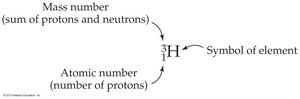
Atomic Number (Z): Number of protons in the nucleus.
Mass Number (A): Total number of protons and neutrons.
Relationship:

Isotopes and Atomic Weight
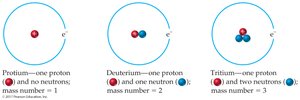
Atoms of the same element can have different numbers of neutrons, resulting in isotopes. Isotopes have identical atomic numbers but different mass numbers.
Isotope: Atoms of the same element with different numbers of neutrons.
Example: Hydrogen has three isotopes—protium, deuterium, and tritium.
A nuclear symbol represents a specific isotope, showing mass number (A) as a superscript and atomic number (Z) as a subscript before the element symbol.
The atomic mass of an element is the weighted average mass of its naturally occurring isotopes, measured in atomic mass units (amu):
The Periodic Table
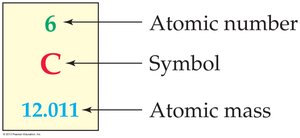
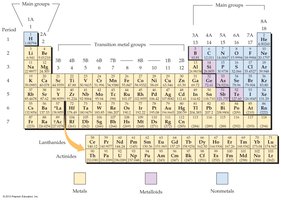
The periodic table organizes elements by increasing atomic number. Each box contains the element's symbol, atomic number, and atomic mass.
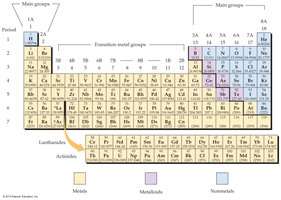
Elements are classified as metals, nonmetals, or metalloids based on their properties.

Rows and Columns
Periods: Horizontal rows (7 total).
Groups: Vertical columns (18 total). Elements in the same group have similar chemical properties.
Group Categories
Main Groups: 1A, 2A, 3A–8A
Transition Metals: 1B–8B
Inner Transition Metals: Lanthanides and Actinides
Characteristics of Different Groups
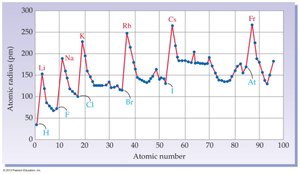
Elements in the same group exhibit periodicity in properties such as atomic size and melting point.
Group 1A: Alkali Metals
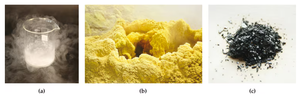
Shiny, soft, highly reactive metals with low melting points.
React with water to form alkaline products.
Never found in nature in pure form due to high reactivity.
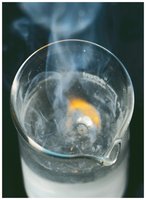
Group 2A: Alkaline Earth Metals
Lustrous, silvery metals with higher melting points than alkali metals.
Less reactive to water, react with oxygen.
Not found in nature in pure form.
Group 7A: Halogens
Colorful, corrosive nonmetals.
Found in nature only in combination with other elements.
Group 8A: Noble Gases
Colorless, inert gases with very low chemical reactivity.
Helium, neon, and argon do not combine with other elements.
Electronic Structure of Atoms
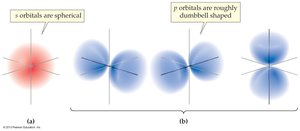
The arrangement of electrons in atoms determines their properties and reactivity. The quantum mechanical model describes electrons as having both particle-like and wave-like properties, grouped into shells, subshells, and orbitals.

Shells, Subshells, and Orbitals
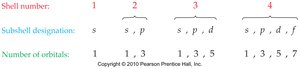
Shells: Layers around the nucleus, labeled by number (1, 2, 3, ...).
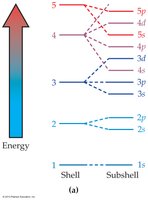
Subshells: Types are s, p, d, f; energy increases from s to f.
Orbitals: Regions where electrons are likely found; s = 1, p = 3, d = 5, f = 7 orbitals per subshell.
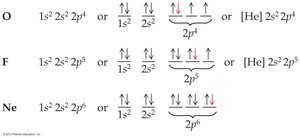
Electron Configurations
Electron configuration describes the arrangement of electrons in an atom. Electrons fill the lowest energy orbitals first, and each orbital can hold two electrons of opposite spin.
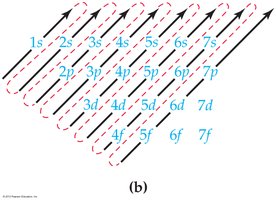
Rules for Orbital Filling
Electrons occupy the lowest energy orbitals first.
Each orbital holds two electrons of opposite spin.
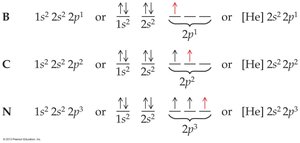
Orbitals of the same energy are half-filled before pairing.
Electron Configuration Representation
Write the subshell symbol with a superscript for the number of electrons.
Example: Lithium (Li): 1s22s1
Condensed Electron Configurations
Use noble gas notation for shorthand, e.g., [Ne] for neon's configuration.

Electron Configurations and the Periodic Table
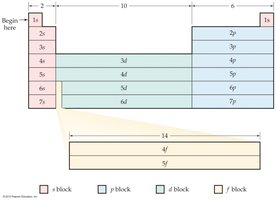
The electron configuration of an atom determines its placement and reactivity on the periodic table. The table is divided into blocks based on the subshell filled last:
s-block: Groups 1A and 2A
p-block: Groups 3A–8A
d-block: Transition metals
f-block: Inner transition metals
Valence Shell and Valence Electrons
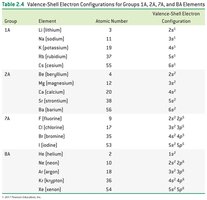
Valence shell: Outermost shell of an atom. Valence electrons: Electrons in the outermost shell, crucial for chemical properties and bonding.
Electron-Dot Symbols
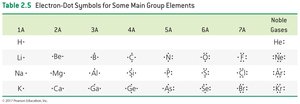
Electron-dot symbols visually represent the number of valence electrons around an element's symbol. Atoms in the same group have similar electron-dot symbols.
Atoms and Light
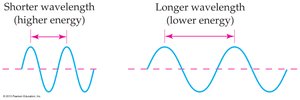
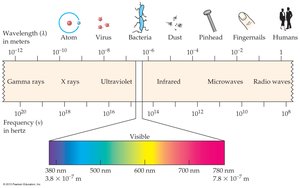
Light is a form of energy. The energy of light is inversely related to its wavelength: shorter wavelengths have higher energy. When atoms absorb energy, electrons are excited to higher energy states and release energy as they return to the ground state, sometimes emitting visible light.
Summary Table: Subatomic Particles
Particle | Charge | Location | Relative Mass |
|---|---|---|---|
Proton | +1 | Nucleus | 1 |
Neutron | 0 | Nucleus | 1 |
Electron | -1 | Outside nucleus | 1/1836 |
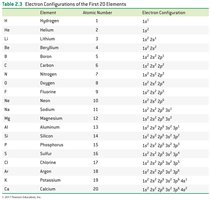
Summary Table: Electron Configurations of First 20 Elements
Element | Atomic Number | Electron Configuration |
|---|---|---|
H | 1 | 1s1 |
He | 2 | 1s2 |
Li | 3 | 1s22s1 |
Be | 4 | 1s22s2 |
B | 5 | 1s22s22p1 |
C | 6 | 1s22s22p2 |
N | 7 | 1s22s22p3 |
O | 8 | 1s22s22p4 |
F | 9 | 1s22s22p5 |
Ne | 10 | 1s22s22p6 |
Na | 11 | 1s22s22p63s1 |
Mg | 12 | 1s22s22p63s2 |
Al | 13 | 1s22s22p63s23p1 |
Si | 14 | 1s22s22p63s23p2 |
P | 15 | 1s22s22p63s23p3 |
S | 16 | 1s22s22p63s23p4 |
Cl | 17 | 1s22s22p63s23p5 |
Ar | 18 | 1s22s22p63s23p6 |
K | 19 | 1s22s22p63s23p64s1 |
Ca | 20 | 1s22s22p63s23p64s2 |
Summary Table: Electron-Dot Symbols for Main Group Elements
Group | 1A | 2A | 3A | 4A | 5A | 6A | 7A | Noble Gases |
|---|---|---|---|---|---|---|---|---|
H | • | |||||||
Li | • | |||||||
Be | •• | |||||||
B | ••• | |||||||
C | •••• | |||||||
N | ••••• | |||||||
O | •••••• | |||||||
F | ••••••• | |||||||
Ne | •••••••• |
Additional info: These notes expand on the original slides and textbook excerpts, providing definitions, examples, and tables for clarity and completeness. All images included are directly relevant to the adjacent content and reinforce key concepts.
