 Back
Atoms, Elements, and Chemical Bonding: Study Notes for GOB Chemistry
Study Guide - Smart Notes
 Tailored notes based on your materials, expanded with key definitions, examples, and context.
Atoms and Elements
Structure of Atoms
Atoms are the fundamental units of matter, composed of three main subatomic particles: protons, neutrons, and electrons. Each plays a distinct role in determining the properties and behavior of the atom.
Protons: Positively charged particles found in the nucleus; determine the atomic number and identity of the element.
Neutrons: Neutral particles found in the nucleus; contribute to atomic mass and isotope formation.
Electrons: Negatively charged particles found in electron shells around the nucleus; responsible for chemical bonding.
Atoms are electrically neutral because the number of protons equals the number of electrons.
Periodic Table Block
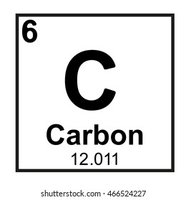
The periodic table provides key information about each element, including its atomic number, symbol, name, and atomic mass.
Atomic Number: Number of protons in the nucleus.
Atomic Mass: Sum of protons and neutrons (measured in daltons).
Essential and Trace Elements
Life requires a variety of elements, classified as essential or trace based on their abundance and necessity.
Essential Elements: Carbon, Oxygen, Hydrogen, Nitrogen (~96%); Calcium, Phosphorus, Potassium, Sulfur, Sodium, Chlorine, Magnesium (~4%).
Trace Elements: Required in minute amounts (<0.01%).
Isotopes
Isotopes are atoms of the same element with different numbers of neutrons. Some isotopes are stable, while others are radioactive and decay over time.
Example: Carbon-12 (6 protons, 6 neutrons), Carbon-14 (6 protons, 8 neutrons).
Radioactive Isotopes: Used in medicine and radiometric dating.
Electron Behavior and Configuration
Energy Levels and Electron Shells
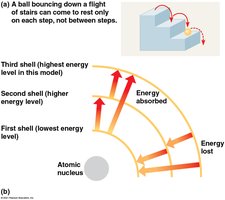
Electrons occupy specific energy levels or shells around the nucleus. The further an electron is from the nucleus, the higher its potential energy.
First shell: Lowest energy, holds up to 2 electrons.
Second shell: Higher energy, holds up to 8 electrons.
Valence electrons: Electrons in the outermost shell; determine chemical reactivity.
Electron Orbitals
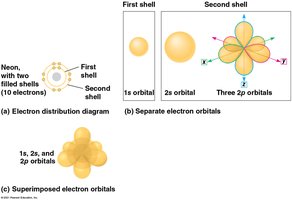
Electron shells are composed of orbitals, which are three-dimensional regions where electrons are likely to be found. Each orbital can hold up to 2 electrons.
s orbitals: Spherical, hold 2 electrons.
p orbitals: Dumbbell-shaped, hold 6 electrons (three p orbitals per shell).
d orbitals: Hold up to 10 electrons (not present in the first two shells).
Electron Configuration
Electron configuration describes the arrangement of electrons in an atom's orbitals. It is written using the notation for each orbital and the number of electrons in superscript.
Example: Helium: 1s2; Neon: 1s2 2s2 2p6; Carbon: 1s2 2s2 2p2
Chemical Bonding
Covalent Bonds
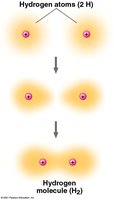
Covalent bonds involve the sharing of valence electrons between atoms. These bonds can be single (one pair of electrons) or double (two pairs of electrons).
Molecule: Two or more atoms held together by covalent bonds.
Bonding capacity: The number of covalent bonds an atom can form, determined by its valence.
Electronegativity and Bond Polarity
Electronegativity is an atom's ability to attract electrons in a covalent bond. Unequal sharing leads to polar covalent bonds, while equal sharing results in nonpolar covalent bonds.
Polar bond: One atom attracts electrons more strongly, creating partial charges.
Nonpolar bond: Electrons are shared equally.
Ionic Bonds
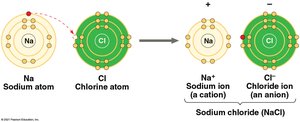
Ionic bonds form when atoms transfer electrons, resulting in charged ions. Cations are positively charged, and anions are negatively charged. Ionic compounds (salts) are formed by the attraction between these ions.
Properties of salts: Often crystalline, not considered molecules, stable when dry, dissociate in water.
Hydrogen Bonds
Hydrogen bonds occur when a hydrogen atom covalently bonded to an electronegative atom is attracted to another electronegative atom. Common partners are oxygen and nitrogen.
Importance: Stabilize structures of proteins and DNA, contribute to water's unique properties.
Van der Waals Interactions
Van der Waals interactions are weak attractions between molecules due to temporary uneven electron distributions. Collectively, these interactions can be significant.
Example: Gecko's toe hairs adhering to surfaces.
Hybridization
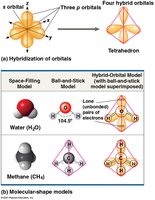
Hybridization is the process by which atomic orbitals mix to form new, hybrid orbitals, influencing molecular shape and function. This is key to understanding the geometry of molecules like methane and water.
Hybrid orbitals: Combine s and p orbitals to form tetrahedral shapes.
Molecular shape: Determines function and reactivity.
Chemical Reactions
Making and Breaking Bonds
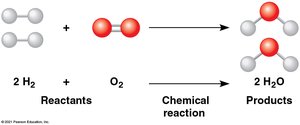
Chemical reactions involve the making and breaking of chemical bonds. Reactants are the starting substances, and products are the resulting substances.
Reversible reactions: Products can revert to reactants; equilibrium is reached when forward and reverse rates are equal.
Example equation:
Half-Life Calculations
The half-life of a radioactive isotope is the time required for half of the sample to decay. This concept is used in radiometric dating and medical diagnostics.
Calculation: If a sample has a half-life of 1 hour, after 4 hours (4 half-lives), the remaining fraction is of the original amount.
Formula:
Intermolecular and Intramolecular Forces
Types of Forces
Forces within and between molecules determine their physical properties and behavior.
Intramolecular forces: Forces within a molecule (covalent, ionic bonds).
Intermolecular forces: Forces between molecules (hydrogen bonds, Van der Waals forces).
Properties of Salts
Salts, or ionic compounds, have distinct properties due to their ionic bonds.
Crystalline structure
Stable when dry
Dissociate easily in water
Summary Table: Types of Chemical Bonds
Bond Type | Strength | Example | Key Feature |
|---|---|---|---|
Covalent | Strong | H2, O2 | Electron sharing |
Ionic | Strong (dry), Weak (in water) | NaCl | Electron transfer |
Hydrogen | Weak | Water (H2O) | Attraction between H and electronegative atom |
Van der Waals | Very weak | Gecko adhesion | Temporary charge fluctuations |
