 Back
Atoms, Elements, and Ionic & Molecular Compounds: Study Notes for GOB Chemistry
Study Guide - Smart Notes
 Tailored notes based on your materials, expanded with key definitions, examples, and context.
Atoms and Elements
Elements and Chemical Symbols
Elements are pure substances that cannot be broken down into simpler substances by chemical means. Each element is represented by a unique chemical symbol, which is a one- or two-letter abbreviation derived from its English or Latin name. The first letter is always capitalized, and if there is a second letter, it is lowercase.
One-letter symbols: Examples include C for carbon, N for nitrogen, H for hydrogen.
Two-letter symbols: Examples include Co for cobalt, Ne for neon, He for helium.
Distinguishing symbols: Co (cobalt) is different from CO (carbon monoxide, a compound of carbon and oxygen).
Example: The symbol for aluminum is Al.
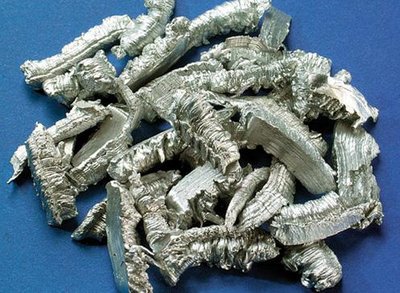
Learning Check: Practice writing symbols and names for elements to reinforce recognition and spelling.
The Periodic Table
The periodic table organizes all known elements into groups (vertical columns) and periods (horizontal rows) based on their atomic number and recurring chemical properties. Elements in the same group have similar chemical behaviors.
Groups: Numbered 1A to 8A (or 1 to 18). Elements in a group share similar properties.
Periods: Numbered 1 to 7. Elements in the same period have the same number of electron shells.
Classification: Elements are classified as metals, nonmetals, or metalloids.
Metals: Good conductors of heat and electricity, typically solid at room temperature.
Nonmetals: Poor conductors, can be gases, liquids, or brittle solids.
Metalloids: Have properties intermediate between metals and nonmetals.
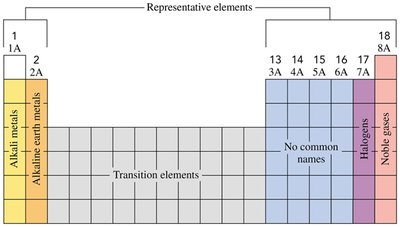
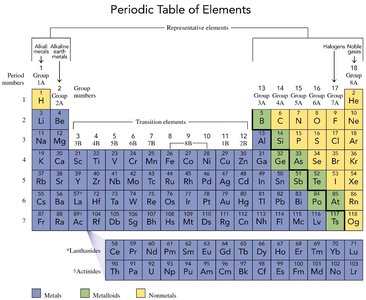
Application: The periodic table is essential for predicting element properties and understanding chemical reactivity.
Elements Essential to Health
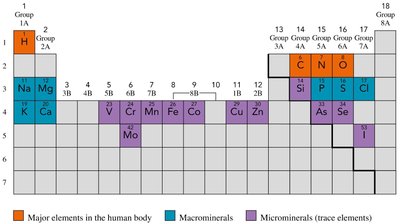
Certain elements are essential for human health and are classified as major elements, macrominerals, or microminerals (trace elements) based on the required amounts in the body.
Major elements: H, C, N, O, Na, Mg, K, Ca, P, S, Cl
Macrominerals: Needed in moderate amounts (e.g., Ca, P, K, S, Na, Cl, Mg)
Microminerals: Needed in trace amounts (e.g., Fe, Zn, Cu, I, Se, Mo, Cr, Mn, Co, V)
Ionic and Molecular Compounds
Ions: Transfer of Electrons
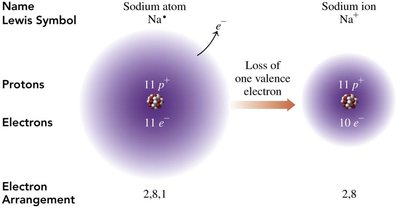
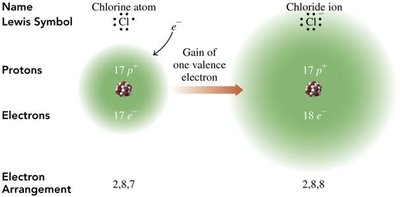
Atoms can gain or lose electrons to form ions. Metals tend to lose electrons and form positively charged ions (cations), while nonmetals tend to gain electrons and form negatively charged ions (anions). The transfer of electrons leads to the formation of ionic bonds due to the electrostatic attraction between oppositely charged ions.
Cation: A positively charged ion (e.g., Na+).
Anion: A negatively charged ion (e.g., Cl−).
Ionic bond: The strong attraction between cations and anions.
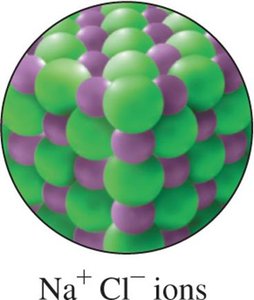
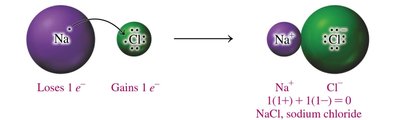
Example: Sodium (Na) loses one electron to become Na+; chlorine (Cl) gains one electron to become Cl−.
Ionic Charges from Group Numbers
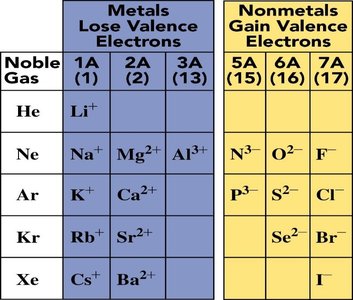
The charge of ions formed by representative elements can often be predicted from their group number on the periodic table.
Group 1A (1): +1 charge (e.g., Na+)
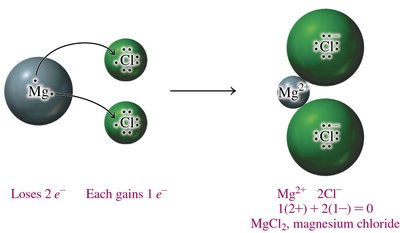
Group 2A (2): +2 charge (e.g., Mg2+)
Group 3A (13): +3 charge (e.g., Al3+)
Group 5A (15): −3 charge (e.g., N3−)
Group 6A (16): −2 charge (e.g., O2−)
Group 7A (17): −1 charge (e.g., Cl−)
Ionic Compounds
Ionic compounds are composed of positive and negative ions held together by ionic bonds. They are typically solid at room temperature and have high melting points. The chemical formula of an ionic compound reflects the lowest whole-number ratio of ions that results in a neutral compound (total positive charge equals total negative charge).
Formula writing: The sum of the charges in the formula must be zero.
Example: For NaCl, one Na+ and one Cl− combine to form a neutral compound.
Example: For MgCl2, one Mg2+ and two Cl− ions combine to balance the charges.
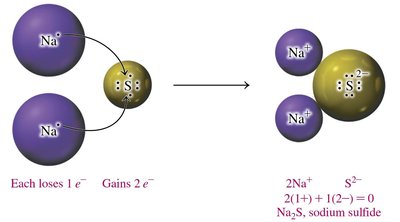
Example: For Na2S, two Na+ and one S2− combine to form a neutral compound.
Naming and Writing Ionic Formulas
The name of an ionic compound consists of the name of the metal (cation) followed by the name of the nonmetal (anion) with its ending changed to "-ide." For compounds containing polyatomic ions, the name of the polyatomic ion is used without changing its ending.
Example: KI is potassium iodide; MgBr2 is magnesium bromide; Al2O3 is aluminum oxide.
Compound | Metal Ion | Nonmetal Ion | Name |
|---|---|---|---|
KI | K+ | I− | Potassium iodide |
MgBr2 | Mg2+ | Br− | Magnesium bromide |
Al2O3 | Al3+ | O2− | Aluminum oxide |
Metals with Variable Charges
Some metals (mainly transition metals) can form more than one type of positive ion. The charge is specified using Roman numerals in parentheses after the metal's name.
Element | Possible Ions | Name of Ion |
|---|---|---|
Iron | Fe2+, Fe3+ | Iron(II), Iron(III) |
Copper | Cu+, Cu2+ | Copper(I), Copper(II) |
Tin | Sn2+, Sn4+ | Tin(II), Tin(IV) |
Lead | Pb2+, Pb4+ | Lead(II), Lead(IV) |
Manganese | Mn2+, Mn3+ | Manganese(II), Manganese(III) |
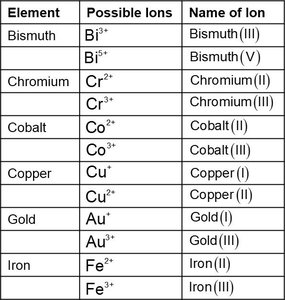
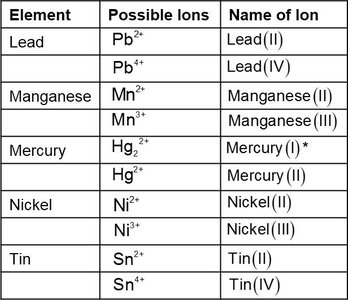
Example: MnF2 is manganese(II) fluoride because the two F− ions (−2 total) balance one Mn2+ ion (+2).
Polyatomic Ions
Polyatomic ions are ions composed of two or more atoms covalently bonded, carrying an overall charge. Many polyatomic ions contain oxygen and are called oxyanions. Their names often end in "-ate" or "-ite," with "-ate" indicating more oxygen atoms than "-ite." Some exceptions include cyanide (CN−) and hydroxide (OH−).
Examples: SO42− (sulfate), NO3− (nitrate), CO32− (carbonate), PO43− (phosphate)
Hydrogen addition: Adding H+ to a polyatomic ion increases its charge by +1 and adds "hydrogen" or "bi-" to the name (e.g., HCO3− is hydrogen carbonate or bicarbonate).
Halogen oxyanions: ClO4− (perchlorate), ClO3− (chlorate), ClO2− (chlorite), ClO− (hypochlorite)

Naming compounds with polyatomic ions: Name the metal (or positive ion) first, then the polyatomic ion. No prefixes are used.
Molecular Compounds: Sharing Electrons
Molecular (covalent) compounds are formed when two or more nonmetal atoms share electrons to achieve stability. The names of molecular compounds use prefixes to indicate the number of each type of atom present.
Common prefixes: mono- (1), di- (2), tri- (3), tetra- (4), penta- (5), hexa- (6), hepta- (7), octa- (8)
Examples: CO2 (carbon dioxide), CS2 (carbon disulfide), N2O (dinitrogen oxide), NO (nitrogen oxide)
Writing formulas: Use the prefixes in the name to determine the subscripts in the formula.
Distinguishing ionic and molecular compounds: If the first element is a metal or the polyatomic ion NH4+, the compound is ionic. If the first element is a nonmetal, the compound is molecular.
Example: K2O is ionic (potassium oxide); N2O is molecular (dinitrogen oxide).
Summary Table: Key Differences Between Ionic and Molecular Compounds
Property | Ionic Compounds | Molecular Compounds |
|---|---|---|
Constituent Particles | Cations and anions | Atoms (usually nonmetals) |
Bond Type | Ionic (electron transfer) | Covalent (electron sharing) |
Physical State | Usually solid | Solid, liquid, or gas |
Melting Point | High | Low to moderate |
Naming | No prefixes; use -ide for anions | Prefixes indicate number of atoms |
Practice Problems
Write the correct chemical symbols for: iodine (I), iron (Fe), magnesium (Mg), zinc (Zn), lithium (Li).
Give the names for: P (phosphorus), Ar (argon), Mn (manganese), Be (beryllium), K (potassium).
Write the formula for sodium phosphate: Na3PO4.
Write the formula for diphosphorus pentoxide: P2O5.
Write the name for CO: carbon monoxide; N2O: dinitrogen oxide; PF3: phosphorus trifluoride; CCl4: carbon tetrachloride.
