 Back
Atoms: Structure, Models, and Atomic Orbitals – GOB Chemistry Study Notes
Study Guide - Smart Notes
 Tailored notes based on your materials, expanded with key definitions, examples, and context.
Atoms and Atomic Theory
Introduction to Atoms
Atoms are the fundamental building blocks of matter. Understanding their structure and properties is essential for studying chemistry and biochemistry. The atomic theory provides a framework for explaining the chemical behavior of matter.
Atom: The smallest and simplest particle of an element that retains its chemical properties.
Atomic Theory: A set of principles that describe the nature and behavior of atoms.
Key Postulates of Atomic Theory
All matter is composed of atoms.
The atoms of a given element differ from the atoms of all other elements.
Chemical compounds consist of atoms combined in specific ratios; only whole atoms can combine.
Chemical reactions change only the way atoms are bonded together in compounds; the chemical identities of atoms remain unchanged.
Structure of the Atom
Subatomic Particles
Atoms are composed of three main subatomic particles:
Protons: Positively charged particles (+1 charge), located in the nucleus.
Neutrons: Electrically neutral particles (0 charge), similar in mass to protons, also in the nucleus.
Electrons: Negatively charged particles (-1 charge), much lighter than protons and neutrons, move rapidly in the space surrounding the nucleus.
The nucleus contains nearly all the mass of the atom but occupies a very small volume. Electrons occupy most of the atom's volume but contribute little to its mass.
Electric Charge and Atomic Structure
Electric charge (q or Q): A property of matter that causes it to experience a force in an electromagnetic field.
Protons (+1) and electrons (-1) have equal but opposite charges; neutrons have no charge.
Like charges repel, unlike charges attract. Atoms and molecules are held together by the attraction between protons and electrons.
Electrons are held near the nucleus due to attraction to protons, but repel each other, causing them to occupy a large volume.
Evolution of Atomic Models
Development of Atomic Models
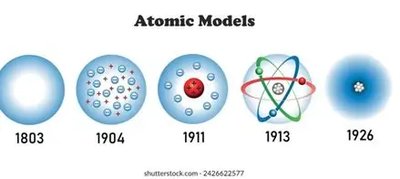
Atomic models have evolved over time as scientific understanding has advanced. Each model reflects the knowledge and experimental evidence available at the time.
1803 (Dalton Model): Atoms are indivisible, solid spheres.
1904 (Thomson Model): "Plum pudding" model; electrons embedded in a positively charged sphere.
1911 (Rutherford Model): Dense, positively charged nucleus with electrons orbiting around it.
1913 (Bohr Model): Electrons move in fixed orbits with quantized energies around the nucleus.
1926 (Quantum Mechanical Model): Electrons exist in probabilistic orbitals, described by quantum mechanics.
Units for Atomic and Molecular Dimensions
Appropriate Units for Atomic Scale
Angstrom (Å): $1\ \text{Å} = 10^{-10}\ \text{m}$; used for bond lengths and atomic dimensions.
Nanometer (nm): $1\ \text{nm} = 10^{-9}\ \text{m}$; used for wavelengths of light, sizes of viruses, and large biomolecules.
These units are essential for describing the sizes of atoms, molecules, and biological structures.
Atomic Mass and the Atomic Mass Unit (amu)
Relative Atomic Mass
Atomic masses are measured relative to the mass of a carbon-12 atom (6 protons, 6 neutrons).
Atomic Mass Unit (amu): $1\ \text{amu} = 1.660539 \times 10^{-24}\ \text{g}$
The amu is also called the Dalton (Da) in honor of John Dalton.
Biochemists often use kilodaltons (kDa): $1\ \text{kDa} = 1000\ \text{Da}$
Atomic Orbitals
Nature and Shapes of Atomic Orbitals
Atomic orbitals describe the regions in an atom where electrons are most likely to be found. The shapes and energies of these orbitals are determined by quantum mechanics.
s orbitals: Spherical in shape, centered around the nucleus.
p orbitals: Dumbbell-shaped, oriented along the x, y, and z axes.
Other orbitals (d, f) have more complex shapes, but are less relevant for introductory GOB chemistry.
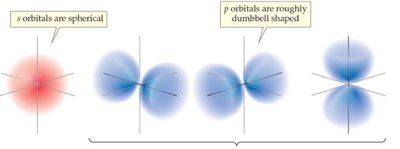
Electrons in atoms occupy these orbitals according to the principles of quantum mechanics, which differ from classical (Newtonian) mechanics. In this course, atoms can often be visualized as spherical, with a dense nucleus and a surrounding electron cloud.
Electron Density and Probability
Electrons exhibit both particle and wave-like behavior.
Electron density refers to the probability of finding an electron in a particular region of space.
Areas of higher electron density indicate a greater likelihood of locating an electron there.
