 Back
Basic Concepts of Chemical Bonding: Ionic, Covalent, and Metallic Bonds
Study Guide - Smart Notes
 Tailored notes based on your materials, expanded with key definitions, examples, and context.
Basic Concepts of Chemical Bonding
Introduction to Chemical Bonds
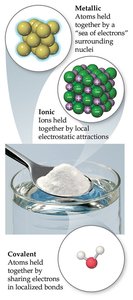
Chemical bonding is the foundation of molecular structure and properties. Atoms combine to form compounds through different types of bonds, each with distinct characteristics and implications for chemical behavior.
Ionic Bonds: Formed by the electrostatic attraction between oppositely charged ions, typically between metals and nonmetals.
Covalent Bonds: Involve the sharing of electron pairs between atoms, usually nonmetals.
Metallic Bonds: Characterized by a 'sea of electrons' that are delocalized among a lattice of metal atoms.
Ionic Bonding
Formation of Ionic Bonds
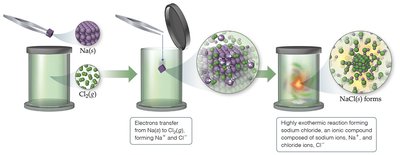
Ionic bonding occurs when one atom donates an electron to another, resulting in the formation of positive and negative ions. This process is highly exothermic and leads to the creation of crystalline solids with high melting points.
Electron Transfer: Metals (low ionization energy) lose electrons; nonmetals (high electron affinity) gain electrons.
Example: Sodium reacts with chlorine to form sodium chloride (NaCl).

Properties of Ionic Substances
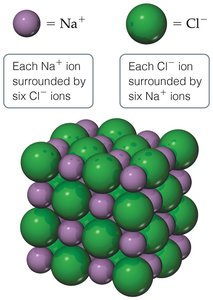
Ionic compounds exhibit well-defined three-dimensional structures due to the strong electrostatic forces between ions.
Brittle and crystalline
High melting points
Cleave along smooth planes
Lattice Energy
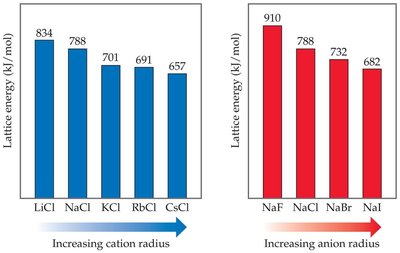
Lattice energy is the energy required to completely separate one mole of a solid ionic compound into its gaseous ions. It is a measure of the strength of the ionic bonds in a crystal lattice.
Lattice energy increases with increasing ionic charge and decreasing ionic radius.
Where U is lattice energy, Q1 and Q2 are the charges, r is the distance between ions, and k is a proportionality constant.
Covalent Bonding
Formation of Covalent Bonds
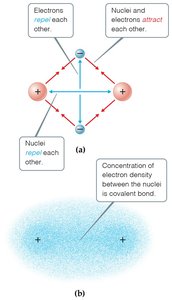
Covalent bonds are formed when two atoms share one or more pairs of electrons. The shared electrons allow each atom to attain the electron configuration of a noble gas (octet rule).
Electrostatic attractions between electrons and nuclei must outweigh repulsions for a stable bond to form.
Lewis Structures
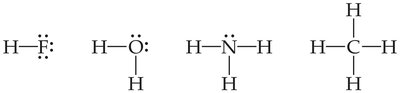
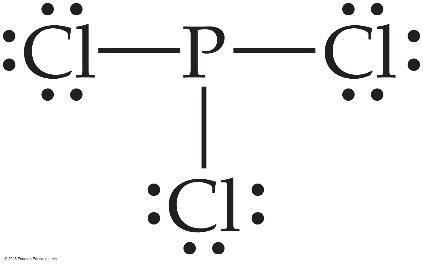
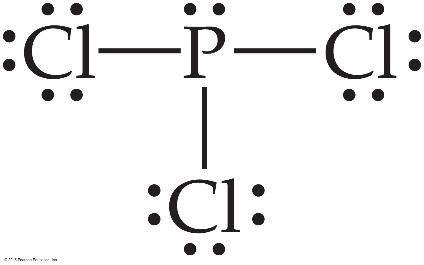
Lewis structures are diagrams that represent the arrangement of valence electrons among atoms in a molecule. They help visualize bonding pairs and lone pairs of electrons.
Each dot represents a valence electron.
Lines represent shared pairs (bonds).

Number of Bonds for Nonmetals
The number of bonds an atom forms is typically equal to the number of electrons needed to complete its octet.
Group number indicates the number of valence electrons.
Examples: H forms 1 bond, O forms 2, N forms 3, C forms 4.
Single, Double, and Triple Bonds
Atoms can share one, two, or three pairs of electrons, resulting in single, double, or triple bonds, respectively.
Single bond: 1 pair shared (e.g., H–H)
Double bond: 2 pairs shared (e.g., O=O)
Triple bond: 3 pairs shared (e.g., N≡N)

Bond Polarity and Electronegativity
Polarity of Bonds
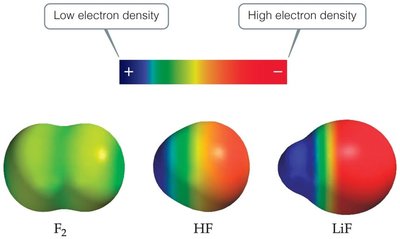
Bond polarity describes the distribution of electron density between two atoms in a bond. It depends on the difference in electronegativity between the atoms.
Nonpolar Covalent Bond: Electrons are shared equally (e.g., F2).
Polar Covalent Bond: Electrons are shared unequally, resulting in partial charges (e.g., HF).
Determining Bond Type
The type of bond (ionic or covalent) can often be predicted based on the elements involved and their properties.
Metal + Nonmetal: Usually ionic
Nonmetal + Nonmetal: Usually covalent
Electronegativity difference can help predict bond type, but exceptions exist.
Writing Lewis Structures
Steps for Drawing Lewis Structures
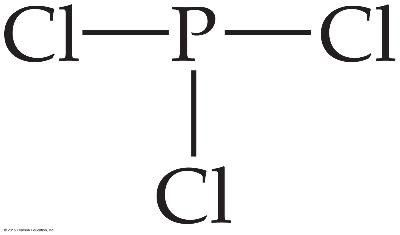
Sum the valence electrons from all atoms, adjusting for charge.
Write the symbols for the atoms, connect with single bonds.
Complete the octets around atoms bonded to the central atom.
Place any remaining electrons on the central atom.
If the central atom lacks an octet, form multiple bonds as needed.

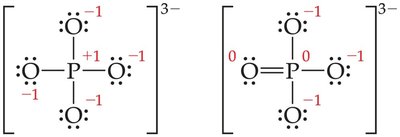
Formal Charge
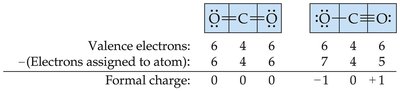
Formal charge helps determine the most stable Lewis structure. It is calculated as:
The best Lewis structure minimizes formal charges and places negative charges on the most electronegative atoms.

Resonance Structures
Resonance in Molecules
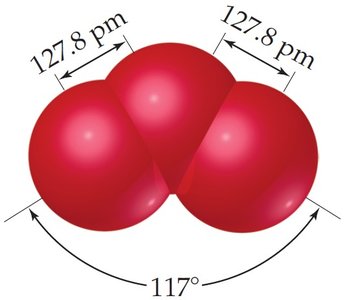
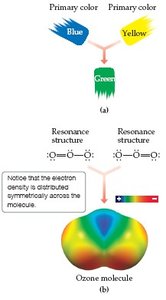
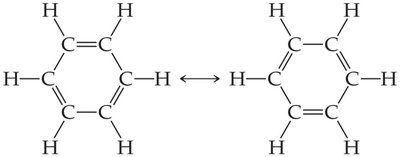
Some molecules cannot be adequately represented by a single Lewis structure. Resonance structures are used to depict delocalized electrons within a molecule.
Resonance structures are drawn with double-headed arrows between them.
The actual structure is a hybrid of all resonance forms.

Exceptions to the Octet Rule
Types of Exceptions
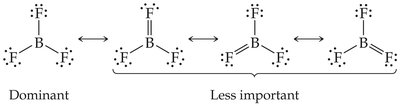
Not all molecules follow the octet rule. Exceptions include:
Molecules with an odd number of electrons (free radicals)
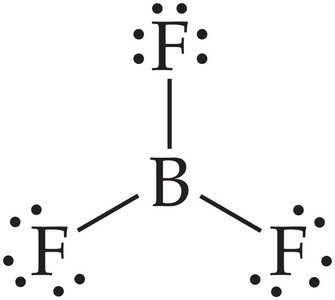
Molecules with fewer than eight electrons (e.g., BF3)
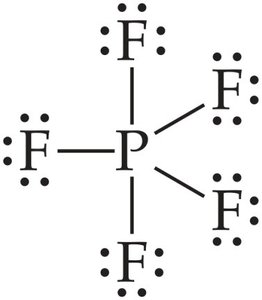
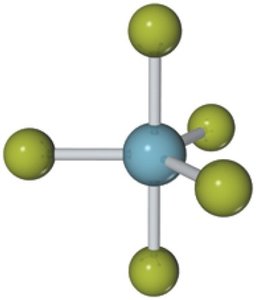
Molecules with more than eight electrons (expanded octet, e.g., PF5)

Summary Table: Types of Chemical Bonds
Bond Type | Formation | Example | Properties |
|---|---|---|---|
Ionic | Electron transfer (metal + nonmetal) | NaCl | High melting point, crystalline, brittle |
Covalent | Electron sharing (nonmetal + nonmetal) | H2O | Lower melting point, discrete molecules |
Metallic | Delocalized electrons (metal atoms) | Fe, Cu | Conductive, malleable, ductile |
