 Back
BackBuffers: Maintaining pH in Acid-Base Equilibrium
Study Guide - Smart Notes
 Tailored notes based on your materials, expanded with key definitions, examples, and context.
Acids and Bases and Equilibrium
Introduction to Buffers
Buffers are essential solutions in chemistry and biology that help maintain a stable pH when small amounts of acids or bases are added. This property is crucial for many chemical and biological processes, especially in maintaining the proper function of cells and blood in living organisms.
What is a Buffer?
Definition: A buffer solution is a mixture that resists changes in pH when small quantities of an acid or a base are added.
Components: Buffers typically consist of a weak acid and its conjugate base (often provided as a salt), or a weak base and its conjugate acid.
Example: A common buffer is acetic acid (HC2H3O2) and sodium acetate (NaC2H3O2).
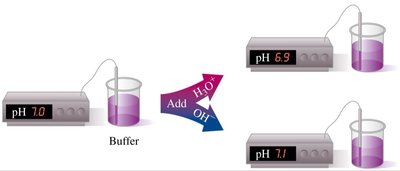
How Buffers Work
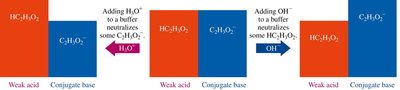
Buffers function by neutralizing added acids (H3O+) or bases (OH−), thus minimizing changes in pH. In the body, buffers absorb H3O+ or OH− from metabolic processes to maintain a pH close to 7.4, which is vital for oxygen uptake and cellular activities.
Weak Acid Neutralizes Base: The weak acid component reacts with added OH− to form water and its conjugate base.
Conjugate Base Neutralizes Acid: The conjugate base reacts with added H3O+ to form the weak acid and water.
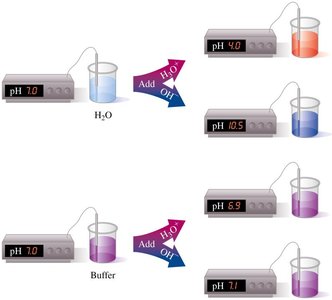
Components of a Buffer
A buffer solution contains a weak acid and a salt of its conjugate base in roughly equal concentrations. For example:
Weak Acid: HC2H3O2 (acetic acid)
Conjugate Base: C2H3O2− (acetate ion, provided by sodium acetate)
The salt dissociates in water to provide a higher concentration of the conjugate base than the weak acid alone could supply.
Buffer Reactions
When a base (OH−) is added:
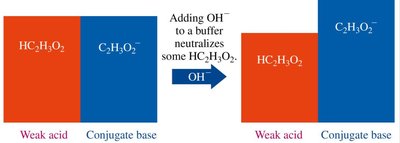
When an acid (H3O+) is added:
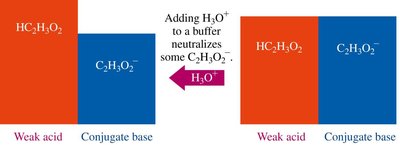
Summary of Buffer Action
Buffers work because the weak acid neutralizes added bases, and the conjugate base neutralizes added acids. The pH remains nearly constant as long as the amounts of acid or base added are small compared to the buffer components.
Identifying Buffer Solutions
To form a buffer, you need a weak acid and a salt of its conjugate base (or a weak base and a salt of its conjugate acid). For example:
Buffer: H2CO3 and NaHCO3 (weak acid and its salt)
Buffer: HC2H3O2 and KC2H3O2 (weak acid and its salt)
Not a buffer: HCl and KCl (strong acid and its salt)
Not a buffer: H3PO4 and NaCl (weak acid and unrelated salt)
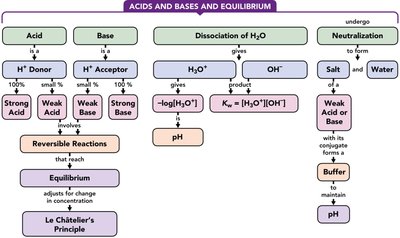
Concept Map: Acids, Bases, and Equilibrium
The following concept map summarizes the relationships among acids, bases, equilibrium, and buffers:
Key Equations
pH Calculation:
Ion Product of Water:
Summary Table: Buffer Components and Their Functions
Component | Function | Example |
|---|---|---|
Weak Acid | Neutralizes added base (OH−) | HC2H3O2 |
Conjugate Base | Neutralizes added acid (H3O+) | C2H3O2− |
