 Back
BackCarbohydrate Structure and Isomerism Study Guide
Study Guide - Smart Notes
 Tailored notes based on your materials, expanded with key definitions, examples, and context.
Q12. The structures of galactose (left) and glucose (right) are shown below. How are the two monosaccharides related?
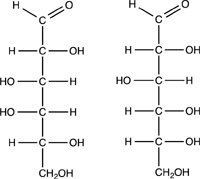
Background
Topic: Carbohydrate Isomerism
This question tests your understanding of the relationships between monosaccharides, specifically how structural differences define isomers, stereoisomers, and other types of carbohydrate relationships.
Key Terms:
Monosaccharide: The simplest form of carbohydrates, consisting of a single sugar unit.
Stereoisomers: Molecules with the same molecular formula and sequence of bonded atoms, but differ in the three-dimensional orientation of their atoms.
Structural isomers: Molecules with the same molecular formula but different connectivity of atoms.
Anomers: Isomers of monosaccharides that differ only in the configuration around the anomeric carbon.
Enantiomers: Stereoisomers that are non-superimposable mirror images of each other.
Step-by-Step Guidance
Examine the structures of galactose and glucose. Both are hexoses (six-carbon sugars) and have the same molecular formula.
Compare the arrangement of the hydroxyl groups (-OH) on each carbon. Look for differences in the orientation of these groups between the two molecules.
Identify which carbons have different configurations. For galactose and glucose, focus on the fourth carbon (C4) to see if the -OH group is on the left or right in the Fischer projection.
Recall the definitions of structural isomers, stereoisomers, enantiomers, and anomers. Determine which term best describes the relationship based on the differences you observe.
Try solving on your own before revealing the answer!
Final Answer: Stereoisomers
Galactose and glucose are stereoisomers because they differ in the configuration at one chiral center (C4), but have the same connectivity and molecular formula.
This means they are not mirror images (not enantiomers), nor are they structural isomers or anomers.
