 Back
Carbohydrates, Lipids, Proteins, and Alcohol: GOB Chemistry Study Notes
Study Guide - Smart Notes
 Tailored notes based on your materials, expanded with key definitions, examples, and context.
Carbohydrates
Complex Carbohydrates vs. Simple Carbohydrates
Carbohydrates are classified based on the number of sugar units they contain. Simple carbohydrates consist of one or two sugar units, while complex carbohydrates are composed of longer chains of sugar units.
Simple carbohydrates: Glucose, fructose, sucrose, lactose. Digested quickly.
Complex carbohydrates: Starch, glycogen, fiber. Digestion depends on the type; fiber is not fully digestible by humans.
Example: Table sugar (sucrose) is a simple carbohydrate; bread (starch) is a complex carbohydrate.
Soluble vs. Insoluble Fiber
Dietary fiber is a type of complex carbohydrate and is categorized as soluble or insoluble based on its interaction with water.
Soluble fiber: Dissolves in water, forms a gel, lowers blood cholesterol, slows glucose absorption. Examples: oats, beans, apples, oranges.
Insoluble fiber: Does not dissolve in water, adds bulk to stool, prevents constipation. Examples: wheat bran, whole grains, vegetables.
Example: Apple flesh contains soluble fiber; apple skin contains insoluble fiber.
Nutritive vs. Nonnutritive Sweeteners
Sweeteners are classified by their caloric content.
Nutritive sweeteners: Provide energy (calories). Examples: table sugar, honey.
Nonnutritive sweeteners: Provide little or no energy. Examples: sucralose, saccharin.
Recommended Sugar and Fiber Intake
Dietary guidelines recommend specific daily intakes for fiber and added sugar.
Age Group | Women | Men |
|---|---|---|
Before age 50 | 25 g/day | 38 g/day |
After age 50 | 21 g/day | 30 g/day |
General recommendation: 14 grams of fiber per 1,000 calories. Added sugar: Women 24 g (6 tsp), Men 36 g (9 tsp) per day.
Carbohydrate Digestive Enzymes
Enzymes break down carbohydrates into absorbable units.
Enzyme | What it breaks down |
|---|---|
Salivary amylase | Starch |
Pancreatic amylase | Starch |
Maltase | Maltose |
Sucrase | Sucrose |
Lactase | Lactose |
Example: Lactase deficiency leads to lactose intolerance.
Primary vs. Secondary Lactose Intolerance
Lactose intolerance results from insufficient lactase enzyme production.
Primary: Natural decrease in lactase with age.
Secondary: Intestinal damage or illness reduces lactase production.
Type 1 vs. Type 2 Diabetes
Diabetes is a disorder of blood glucose regulation.
Type 1 | Type 2 |
|---|---|
Little or no insulin produced; requires insulin treatment. | Insulin resistance; managed by lifestyle, medication, or insulin. |
Glycemic Index (GI)
The glycemic index measures how quickly carbohydrate-containing foods raise blood glucose compared to a reference food.
High GI: Rapid increase in blood glucose.
Low GI: Slower increase.
Lipids
Triglycerides vs. Phospholipids
Lipids are a diverse group of biomolecules, including triglycerides and phospholipids.
Triglycerides: One glycerol molecule attached to three fatty acids. Main form of fat storage and energy in the body.
Phospholipids: Glycerol backbone, two fatty acid tails, and a phosphate-containing head. Major component of cell membranes; amphipathic (hydrophilic head, hydrophobic tails).
Example: Triglycerides are found in adipose tissue; phospholipids form the lipid bilayer of cell membranes.
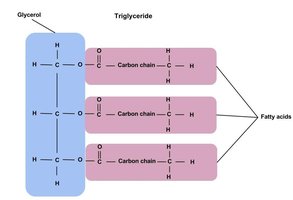
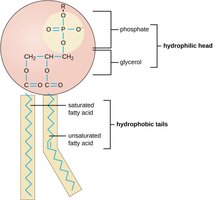
Which Fatty Acid Has a Straight Chain?
Fatty acids differ in their structure based on the presence and type of double bonds.
Saturated fatty acids: No double bonds; straight chains, pack tightly.
Cis unsaturated fatty acids: Double bonds cause bends.
Trans fatty acids: Trans double bond; straighter than cis, but not as straight as saturated.
Eicosanoids
Eicosanoids are signaling molecules derived from fatty acids. They regulate inflammation, blood clotting, and blood vessel function.
Essential Fatty Acids
Essential fatty acids must be obtained from the diet because the body cannot synthesize them.
Linoleic acid (omega-6)
Alpha-linolenic acid (omega-3)
Recommended Fat and Saturated Fat Intake
Dietary guidelines distinguish between total fat and saturated fat. It is important to limit saturated fat intake for cardiovascular health.
LDL vs. HDL Cholesterol
Cholesterol is transported in the blood by lipoproteins.
LDL (Low-density lipoprotein) | HDL (High-density lipoprotein) |
|---|---|
"Bad" cholesterol; carries cholesterol to tissues, can contribute to plaque buildup. | "Good" cholesterol; carries cholesterol away from tissues to the liver. |
R Component in Biomolecules
The R group in fatty acids refers to the hydrocarbon chain. In amino acids, the R group is the variable side chain that determines the amino acid's properties.
Proteins
Essential and Nonessential Amino Acids
There are 20 amino acids; 9 are essential and must be obtained from food, while 11 are nonessential and can be synthesized by the body.
Essential amino acids: Cannot be synthesized; must be consumed.
Nonessential amino acids: Can be synthesized by the body.
Example: Lysine is essential; alanine is nonessential.
Nutritional Concerns of a Vegetarian Diet
Vegetarian diets may lack certain nutrients if not properly planned.
High-biological-value protein
Riboflavin
Vitamin D
Vitamin B12
Calcium
Iron
Zinc
Additional info: Complementary protein sources and fortified foods can prevent deficiencies.
Protein Sources in North America
About 70% of protein in the North American diet comes from meat, poultry, fish, milk, cheese, legumes, and nuts. Not all of this is animal protein.
Functions of Protein in the Body
Proteins serve many vital functions:
Body structures (collagen, actin, myosin)
Fluid balance (albumin)
Acid-base balance (buffers)
Hormones
Enzymes
Neurotransmitters
Immune function (antibodies)
Transport (hemoglobin, nutrient carriers)
Glucose and energy (4 kcal/g)
Protein-Energy Malnutrition
Two main types:
Marasmus | Kwashiorkor |
|---|---|
Develops slowly; severe deficiency of energy, protein, micronutrients. | Develops rapidly; severe protein deficiency, often with infection or disease. |
Alcohol
Caloric Density of Alcohol
Alcohol provides 7 kcal per gram, higher than protein (4 kcal/g).
Alcohol Metabolism Pathways
Alcohol is metabolized by three main pathways:
Alcohol dehydrogenase (ADH) pathway
Microsomal ethanol-oxidizing system (MEOS)
Catalase pathway
Alcohol is absorbed without digestion; 20% in the stomach, most in the small intestine. Food slows absorption.
Moderate Alcohol Intake
Definitions for moderate intake:
Women: 1 standard drink/day
Men: 2 standard drinks/day
One standard drink: 14 g alcohol (beer: 12 oz, wine: 5 oz, liquor: 1.5 oz)
Amino Acids for Alcoholics
Alcohol abuse can cause protein-energy malnutrition and vitamin/mineral deficiencies. No specific amino acid is identified in the slides.
