 Back
BackCarboxylic Acids and Esters: Structure, Properties, and Nomenclature
Study Guide - Smart Notes
 Tailored notes based on your materials, expanded with key definitions, examples, and context.
Carboxylic Acids and Esters
Introduction
Carboxylic acids and esters are important classes of organic compounds with significant roles in biological systems, industry, and daily life. This chapter explores their structures, nomenclature, properties, and reactions, providing foundational knowledge for further study in organic and biological chemistry.
Carboxylic Acids
Structure and Functional Group
Carboxylic acids contain a carboxyl group (-COOH), which consists of a carbonyl group (C=O) bonded to a hydroxyl group (-OH). This functional group imparts unique chemical properties to carboxylic acids.
General formula: R-COOH, where R is a hydrocarbon group.
The carboxyl group is always at the end of the carbon chain.
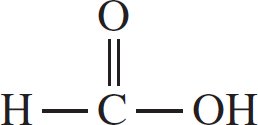
Nomenclature of Carboxylic Acids
Carboxylic acids are named using both IUPAC and common naming systems.
IUPAC Naming: Replace the -e ending of the parent alkane with -oic acid (e.g., methane → methanoic acid).
Number the carbon chain starting from the carboxyl carbon (always carbon 1).
For aromatic acids, such as benzoic acid, substituent positions are indicated using ortho (1,2-), meta (1,3-), and para (1,4-) prefixes.
Common Names: Use prefixes such as form-, acet-, propion-, and butyr- (e.g., acetic acid for ethanoic acid).
Greek letters (α, β, γ, etc.) are used to indicate positions of substituents relative to the carboxyl group.
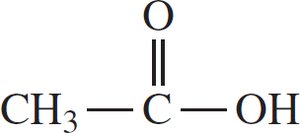
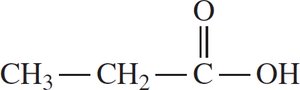
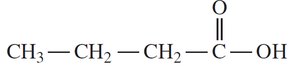


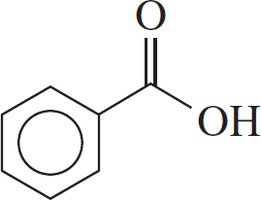
Examples of Carboxylic Acids
Methanoic acid (formic acid): Found in ant stings.
Ethanoic acid (acetic acid): Responsible for the sour taste of vinegar.
Benzoic acid: Used as a food preservative.
Alpha Hydroxy Acids (AHAs)
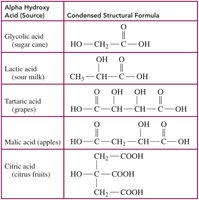
Alpha hydroxy acids are naturally occurring carboxylic acids with a hydroxyl group on the carbon adjacent to the carboxyl group. They are found in fruits, milk, and sugar cane, and are used in dermatology for skin treatments.
Alpha Hydroxy Acid (Source) | Condensed Structural Formula |
|---|---|
Glycolic acid (sugar cane) | HOCH2COOH |
Lactic acid (sour milk) | CH3CH(OH)COOH |
Tartaric acid (grapes) | HOOCCH(OH)CH(OH)COOH |
Malic acid (apples) | HOOCCH2CH(OH)COOH |
Citric acid (citrus fruits) | HOOCCH2C(OH)(COOH)CH2COOH |
Preparation of Carboxylic Acids
Carboxylic acids can be synthesized by the oxidation of primary alcohols or aldehydes.
Oxidation sequence: Primary alcohol → Aldehyde → Carboxylic acid
Example: Ethanol in wine oxidizes to acetaldehyde, then to acetic acid (vinegar).
Physical Properties of Carboxylic Acids
Polarity: Carboxylic acids are strongly polar due to both the carbonyl and hydroxyl groups.
Boiling Points: Higher than alcohols, ketones, and aldehydes of similar molar mass due to hydrogen bonding and dimer formation.
Solubility: Carboxylic acids with 1–5 carbons are very soluble in water; solubility decreases with increasing chain length.
Acidity and Reactions
Weak acids: Carboxylic acids partially dissociate in water to form carboxylate ions and hydronium ions.
Neutralization: React with strong bases (e.g., NaOH, KOH) to form carboxylate salts, which are ionic, solid at room temperature, and usually water-soluble.
Carboxylic Acids in Health and Industry
Preservatives: Sodium propionate and sodium benzoate are used to inhibit microbial growth in foods.
Metabolism: Carboxylate ions participate in metabolic pathways such as the citric acid cycle (Krebs cycle).
Esters
Structure and Synthesis
Esters are organic compounds derived from carboxylic acids and alcohols. They are characterized by the functional group -COOR, where R is an alkyl group.
General formula: R-COOR'
Synthesis (Esterification): Carboxylic acid + Alcohol \( \xrightarrow{H^+,\ \text{heat}} \) Ester + Water
This is an equilibrium reaction, often driven to completion by using excess alcohol or removing water.
Nomenclature of Esters
The name consists of two parts: the alkyl group from the alcohol and the carboxylate name from the acid (e.g., ethyl acetate).
IUPAC: Alkyl + (acid name with -ic acid replaced by -ate).
Common names are frequently used for simple esters.
Properties of Esters
Boiling Points: Higher than alkanes and ethers, but lower than alcohols and carboxylic acids of similar mass (due to lack of hydrogen bonding between ester molecules).
Solubility: Esters with 2–5 carbons are soluble in water; solubility decreases with increasing chain length.
Odor and Flavor: Many esters are responsible for the pleasant aromas and flavors of fruits and flowers.
Hydrolysis of Esters
Acid Hydrolysis: Ester + Water \( \xrightarrow{H^+,\ \text{heat}} \) Carboxylic acid + Alcohol (reverse of esterification).
Base Hydrolysis (Saponification): Ester + Strong base \( \xrightarrow{\text{heat}} \) Carboxylate salt + Alcohol.
Applications of Esters
Solvents: Ethyl acetate is used in nail polish, plastics, and lacquers.
Pharmaceuticals: Aspirin (acetylsalicylic acid) is an ester of salicylic acid and acetic acid.
Plastics: Polyesters such as Dacron and PETE are made from ester monomers.
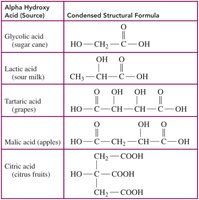
Summary Table: Alpha Hydroxy Acids
Alpha Hydroxy Acid (Source) | Condensed Structural Formula |
|---|---|
Glycolic acid (sugar cane) | HOCH2COOH |
Lactic acid (sour milk) | CH3CH(OH)COOH |
Tartaric acid (grapes) | HOOCCH(OH)CH(OH)COOH |
Malic acid (apples) | HOOCCH2CH(OH)COOH |
Citric acid (citrus fruits) | HOOCCH2C(OH)(COOH)CH2COOH |
Key Equations
General structure of a carboxylic acid:
General structure of an ester:
Esterification reaction:
Acid hydrolysis of an ester:
Base hydrolysis (saponification):
Conclusion
Understanding the structure, nomenclature, properties, and reactions of carboxylic acids and esters is essential for further study in organic and biological chemistry. These compounds are not only fundamental to metabolic pathways but also have widespread applications in industry, health, and everyday life.
