 Back
Carboxylic Acids and Their Derivatives: Properties and Names
Study Guide - Smart Notes
 Tailored notes based on your materials, expanded with key definitions, examples, and context.
Carboxylic Acids and Their Derivatives
Properties and Names
Carboxylic acids are organic compounds containing a carboxyl group (-COOH). Their derivatives include esters, amides, and acid anhydrides, which share structural similarities and chemical properties. Understanding their nomenclature, physical properties, and reactions is essential in organic chemistry.
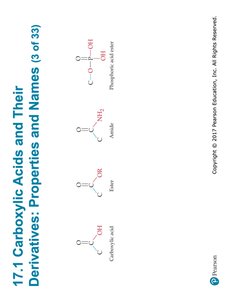
Carboxylic acid: A compound with a carboxyl group bonded to an -OH group. General formula: RCOOH.
Esters: Have an -OR group bonded to the carbonyl carbon.
Amides: Have an -NH2, -NHR, or -NR2 group bonded to the carbonyl carbon.
Acid anhydrides: Formed when two carboxylic acids join together by eliminating a molecule of water.
Physical Properties
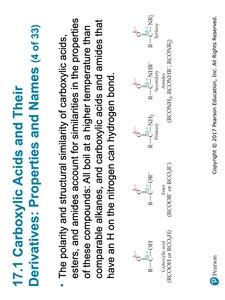
The polarity and structural similarity of carboxylic acids, esters, and amides account for similarities in their properties. All boil at higher temperatures than comparable alkanes. Carboxylic acids and amides that have an H on the nitrogen can hydrogen bond.
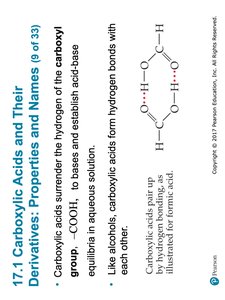
Carboxylic acids surrender the hydrogen of the carboxyl group (-COOH), establishing acid-base equilibrium in aqueous solution.
Carboxylic acids form hydrogen bonds with each other, similar to alcohols.
Naming Carboxylic Acids and Derivatives
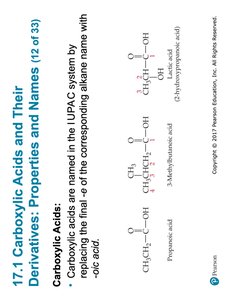
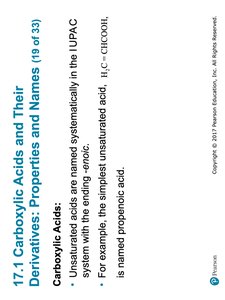
Carboxylic acids are named in the IUPAC system by replacing the final -e of the corresponding alkane name with -oic acid. Common names are often used for many carboxylic acids.
Greek letters (α, β, γ, etc.) are used to identify carbons attached to the -COOH group in the common system.
In IUPAC nomenclature, the carboxyl group has the highest priority when naming compounds with multiple functional groups.
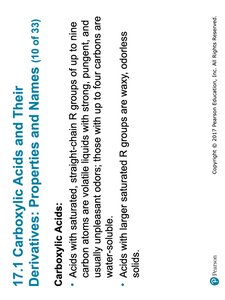
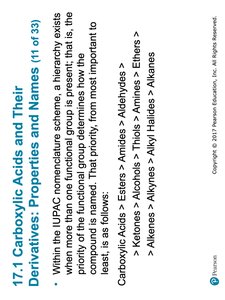
Table: Some Common Carboxylic Acids
Common Name | Structure |
|---|---|
Formic | HCOOH |
Acetic | CH3COOH |
Propionic | CH3CH2COOH |
Butyric | CH3CH2CH2COOH |
Valeric | CH3(CH2)3COOH |
Caproic | CH3(CH2)4COOH |
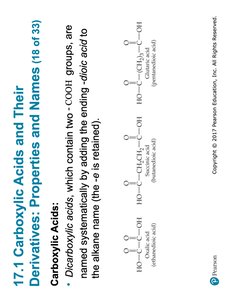
Succinic | HOOCCH2CH2COOH |
Glutaric | HOOC(CH2)3COOH |
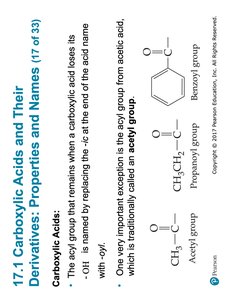
Acyl Groups
The portion of the carboxylic acid that does not change during a carboxy-group substitution reaction is known as an acyl group. In biochemistry, carboxy-group substitution reactions are often called acyl transfer reactions.
Worked Example: Naming Carboxylic Acids
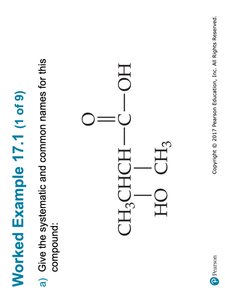
Given the compound:
Identify the longest chain containing the -COOH group and number it starting with the carboxyl-group carbon.
The parent compound is butanoic acid (4-carbon acid). There is a methyl group on carbon 2 and a hydroxy group on carbon 3.
The IUPAC name is 3-hydroxy-2-methylbutanoic acid.
The common name is β-hydroxy-α-methylbutyric acid.
Summary Table: Functional Group Priority
Priority (Highest to Lowest) |
|---|
Carboxylic Acids |
Esters |
Amides |
Aldehydes |
Ketones |
Alcohols |
Thiols |
Amines |
Ethers |
Alkenes |
Alkynes |
Alkyl Halides |
Alkanes |
Key Equations
General formula for carboxylic acid:
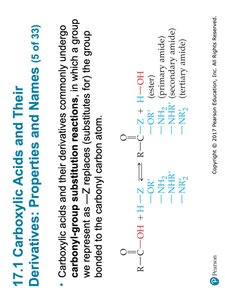
Carboxy-group substitution reaction:
Additional info:
Carboxylic acids with saturated, straight-chain R groups of up to nine carbon atoms are volatile liquids with strong, pungent, and usually unpleasant odors. Those with up to four carbons are water-soluble.
Carboxylic acids and their derivatives commonly undergo carboxy-group substitution reactions, in which a group represented as Z replaces the group bonded to the carbonyl carbon atom.
