 Back
BackCarboxylic Acids, Esters, Amines, and Amides: Structure, Properties, and Nomenclature
Study Guide - Smart Notes
 Tailored notes based on your materials, expanded with key definitions, examples, and context.
Carboxylic Acids
Structure and Functional Groups
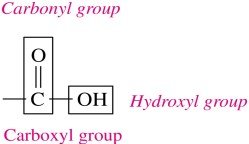
Carboxylic acids are organic compounds containing a carboxyl group (–COOH), which is composed of a carbonyl group (C=O) and a hydroxyl group (–OH) attached to the same carbon atom. This functional group is responsible for the characteristic properties of carboxylic acids.
Carboxyl group: The combination of a carbonyl and a hydroxyl group on the same carbon atom.
General formula: R–COOH, where R is a hydrocarbon group.
Nomenclature of Carboxylic Acids
Carboxylic acids are named by replacing the -e ending of the parent alkane with -oic acid in IUPAC nomenclature. The carboxyl carbon is always carbon 1.
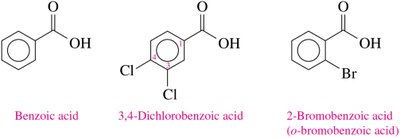
For aromatic carboxylic acids, such as benzoic acid, substituents are indicated by prefixes (ortho-, meta-, para-) or by numbering the ring.
Examples: Methanoic acid (formic acid), Ethanoic acid (acetic acid), Benzoic acid.
Carboxylic Acids in Everyday Life
Carboxylic acids and their salts are widely used as preservatives and flavor enhancers in food products, such as soups and instant noodles.
Sodium propionate is a common preservative in bakery items.

Physical Properties of Carboxylic Acids
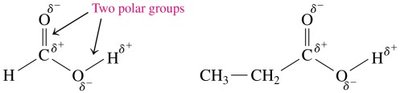
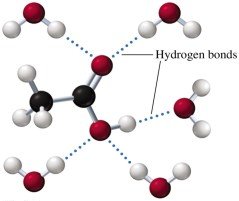
Carboxylic acids are strongly polar due to the presence of both a carbonyl and a hydroxyl group, which allows them to form hydrogen bonds.
They have higher boiling points than similar alcohols, aldehydes, and ketones.
Carboxylic acids with 1–5 carbon atoms are very soluble in water due to hydrogen bonding.
Solubility decreases as the hydrocarbon chain length increases.
Acidity of Carboxylic Acids
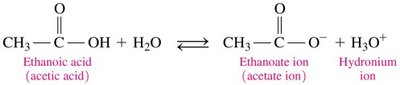
Carboxylic acids are weak acids that partially dissociate in water to produce carboxylate ions and hydronium ions.
The negative charge on the carboxylate ion is stabilized by resonance between the two oxygen atoms.
General dissociation equation:
Esters
Structure and Synthesis of Esters
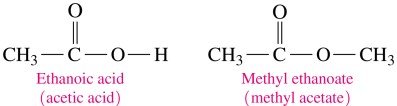
Esters are organic compounds derived from carboxylic acids and alcohols. They are characterized by the functional group –COOR.
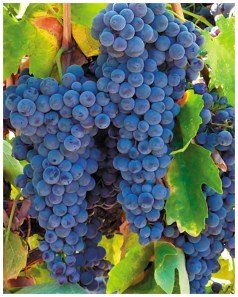
Esters are commonly found in fats, oils, and as components responsible for the aroma and flavor of many fruits.
They are synthesized via esterification, a reaction between a carboxylic acid and an alcohol in the presence of an acid catalyst and heat.
This reaction is an equilibrium process:

Naming Esters
The name of an ester consists of two parts:
The alkyl group from the alcohol (first word).
The carboxylate name from the acid (second word, replacing -ic acid with -ate).
Example: Methyl ethanoate (from methanol and ethanoic acid).
Esters in Nature and Industry
Many esters are responsible for the pleasant aromas and flavors of fruits and flowers. Small esters are volatile and soluble in water, making them detectable by smell and taste.
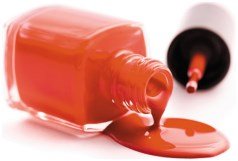
Esters are also used as solvents in products like nail polish remover (ethyl acetate).

Amines
Structure and Classification of Amines
Amines are derivatives of ammonia (NH3) in which one or more hydrogen atoms are replaced by alkyl or aromatic groups.
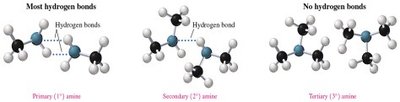
Primary (1°) amine: One carbon group attached to nitrogen.
Secondary (2°) amine: Two carbon groups attached to nitrogen.
Tertiary (3°) amine: Three carbon groups attached to nitrogen.
Naming Amines
The -e ending of the parent alkane is replaced with -amine.
For amines with substituents on nitrogen, the prefix N- is used for each alkyl group attached to the nitrogen atom.
Properties of Amines
Amines contain polar N–H bonds, allowing primary and secondary amines to form hydrogen bonds with each other and with water. Tertiary amines can only form hydrogen bonds with water.
Hydrogen bonds in amines are weaker than those in alcohols due to the lower electronegativity of nitrogen compared to oxygen.
Amides
Structure and Preparation of Amides
Amides are derivatives of carboxylic acids in which the hydroxyl group is replaced by an amino group (–NH2, –NHR, or –NR2).
Amides are produced by the reaction of a carboxylic acid with ammonia or a primary/secondary amine, releasing water (amidation or condensation reaction).
Naming Amides
Replace -oic acid (IUPAC) or -ic acid (common) with -amide.
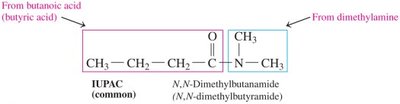
Alkyl groups attached to the nitrogen are named with the prefix N- followed by the alkyl name.
Example: N,N-Dimethylbutanamide (from butanoic acid and dimethylamine).
Applications of Amides
Amides are found in many pharmaceuticals, such as acetaminophen (Tylenol), which acts as a pain and fever reducer. 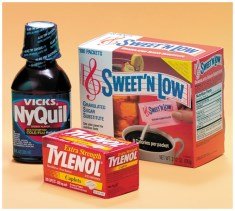 *Additional info: The notes above include expanded academic context and examples to ensure completeness and clarity for exam preparation.*
