 Back
Carboxylic Acids: Structure, Naming, Properties, and Biological Relevance
Study Guide - Smart Notes
 Tailored notes based on your materials, expanded with key definitions, examples, and context.
Carboxylic Acids and Esters
Carboxylic Acids: Structure and Functional Group
Carboxylic acids are organic compounds containing a carboxyl group (–COOH), which consists of a carbonyl group (C=O) bonded to a hydroxyl group (–OH). This functional group imparts unique chemical properties to carboxylic acids, including acidity and the ability to form hydrogen bonds.

Naming Carboxylic Acids
Carboxylic acids are named using both IUPAC and common naming conventions. The IUPAC system replaces the -e ending of the parent alkane with -oic acid. The carboxyl carbon is always numbered as carbon 1. For aromatic carboxylic acids, substituent positions are indicated using ortho, meta, and para prefixes.
IUPAC Naming: Methanoic acid (formic acid), Ethanoic acid (acetic acid), Propanoic acid (propionic acid).
Common Naming: Uses prefixes such as form-, acet-, propion-, butyr-.
Greek Letters: Used to designate carbons adjacent to the carboxyl group (α, β, γ, etc.).
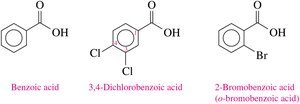
Examples of Carboxylic Acids
Carboxylic acids are found in everyday life and biological systems. For example, methanoic acid (formic acid) is present in ant stings, and ethanoic acid (acetic acid) gives vinegar its sour taste.
Methanoic acid: HCOOH
Ethanoic acid: CH3COOH
Propanoic acid: CH3CH2COOH
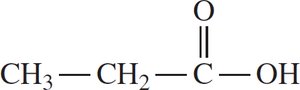
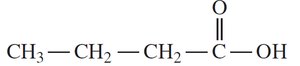

Preparation of Carboxylic Acids
Carboxylic acids can be synthesized by the oxidation of primary alcohols or aldehydes. For example, ethanol in wine is oxidized to acetaldehyde and then to acetic acid, which is the main component of vinegar.
Oxidation Reaction: Primary alcohol → Aldehyde → Carboxylic acid
Alpha Hydroxy Acids (AHAs) in Health
Alpha hydroxy acids are naturally occurring carboxylic acids with a hydroxyl group on the carbon adjacent to the carboxyl group (the alpha carbon). AHAs are used in skin care products for exfoliation and treatment of acne scars, pigmentation, and age spots.
Sources: Fruits, milk, sugar cane
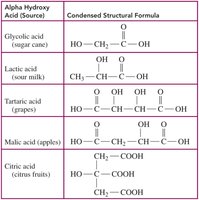
Examples: Glycolic acid (sugar cane), Lactic acid (milk), Tartaric acid (grapes), Malic acid (apples), Citric acid (citrus fruits)
Alpha Hydroxy Acid (Source) | Condensed Structural Formula |
|---|---|
Glycolic acid (sugar cane) | HO–CH2–COOH |
Lactic acid (sour milk) | CH3–CH(OH)–COOH |
Tartaric acid (grapes) | HOOC–CH(OH)–CH(OH)–COOH |
Malic acid (apples) | HOOC–CH2–CH(OH)–COOH |
Citric acid (citrus fruits) | HOOC–CH2–C(OH)(COOH)–CH2–COOH |
Properties of Carboxylic Acids
Polarity and Hydrogen Bonding
Carboxylic acids are strongly polar due to the presence of both a hydroxyl and a carbonyl group. This allows them to form multiple hydrogen bonds, resulting in higher boiling points compared to alcohols, ketones, and aldehydes of similar molar mass.
Hydrogen Bonding: Leads to formation of dimers, effectively doubling the molecular mass and increasing boiling point.
Boiling Point Comparison: Alkane < Alcohol < Carboxylic Acid
Solubility in Water
Carboxylic acids with one to five carbon atoms are very soluble in water due to their ability to form hydrogen bonds with water molecules. Solubility decreases as the carbon chain length increases.
Acidity and Dissociation
Carboxylic acids are weak acids that dissociate in water to produce carboxylate ions and hydronium ions. The negative charge on the carboxylate ion is stabilized by resonance between the two oxygen atoms.
General Dissociation Equation:
Neutralization of Carboxylic Acids
Carboxylic acids react with strong bases (such as NaOH or KOH) to form carboxylate salts. The carboxylate ion is named by replacing the -ic acid ending with -ate.
Example Reaction:
Properties of Carboxylate Salts: Ionic compounds, solids at room temperature, high melting points, usually soluble in water.
Carboxylic Acids as Preservatives and Flavor Enhancers
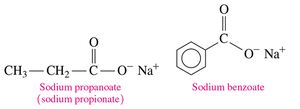
Carboxylate salts such as sodium propionate and sodium benzoate are used as preservatives in food to inhibit spoilage by microorganisms. Monosodium glutamate (MSG) is used as a flavor enhancer.
Carboxylic Acids in Biological Metabolism
Role in Cellular Metabolism
At physiological pH, carboxylic acids exist as carboxylate ions, which participate in metabolic pathways such as the citric acid cycle (Krebs cycle) and glycolysis.
Glycolysis: Glucose is broken down into pyruvate (the carboxylate salt of pyruvic acid).
Anaerobic Conditions: Pyruvate is reduced to lactic acid or lactate ion.
Citric Acid Cycle: Di- and tri-carboxylates are oxidized and decarboxylated to produce energy for cells.
Example: Succinic acid is in equilibrium with its carboxylate ion, succinate, which is involved in the citric acid cycle.
Additional info: The citric acid cycle is a central metabolic pathway that generates energy through the oxidation of acetyl-CoA derived from carbohydrates, fats, and proteins.
