 Back
BackCh.8 Gases: Properties, Laws, and Applications
Study Guide - Smart Notes
 Tailored notes based on your materials, expanded with key definitions, examples, and context.
Gases: Properties and Behavior
Introduction to Gases
Gases are one of the fundamental states of matter, characterized by their ability to expand and fill any container. The study of gases involves understanding their physical properties, the laws that govern their behavior, and their applications in both laboratory and real-world contexts.
Pressure and Its Units
Definition of Pressure
Pressure is defined as the force exerted per unit area by gas molecules as they collide with the walls of their container. The SI unit for pressure is the pascal (Pa), named after Blaise Pascal.
Formula:
Force (F) is measured in newtons (N).
Area (A) is measured in square meters (m2).
Other common units of pressure include:
Atmosphere (atm)
Millimeters of mercury (mmHg)
Torr
Bar
Pounds per square inch (psi)
These units can be converted using standard conversion factors.
Kinetic Molecular Theory (KMT)
Postulates of Kinetic Molecular Theory
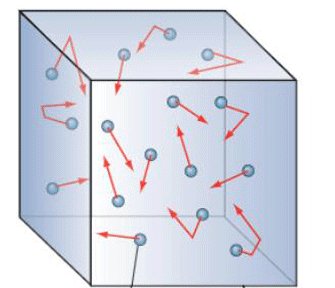
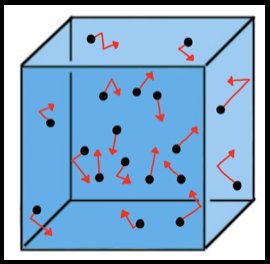
The Kinetic Molecular Theory explains the behavior of ideal gases based on the motion of their particles. An ideal gas is a hypothetical gas that perfectly follows these postulates:
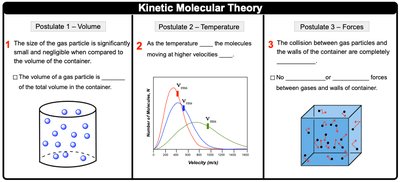
Gas particles are in constant, random motion and move in straight lines until they collide with each other or the container walls.
The volume of individual gas particles is negligible compared to the total volume of the container.
Collisions between gas particles and with the container walls are perfectly elastic (no energy is lost).
There are no significant attractive or repulsive forces between gas particles.
The average kinetic energy of gas particles is directly proportional to the absolute temperature (in Kelvin).
Example: At high temperatures, the attractive forces between molecules become negligible, making gases behave more ideally.
Chemistry Gas Laws
Overview of Gas Laws
The behavior of gases is described by several fundamental laws that relate pressure (P), volume (V), temperature (T), and amount (n) of gas. These laws are derived from experimental observations and the Kinetic Molecular Theory.
Boyle’s Law
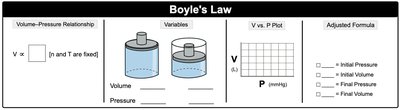
Boyle’s Law states that the volume of a gas is inversely proportional to its pressure at constant temperature and amount of gas (n and T fixed).
Mathematical form:
If volume increases, pressure decreases, and vice versa.
Gay-Lussac’s Law (Amonton’s Law)
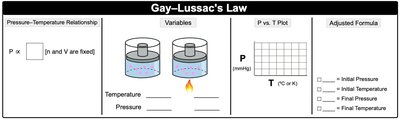
Gay-Lussac’s Law states that the pressure of a gas is directly proportional to its absolute temperature at constant volume and amount of gas (n and V fixed).
Mathematical form:
Temperature must be in Kelvin.
Avogadro’s Law
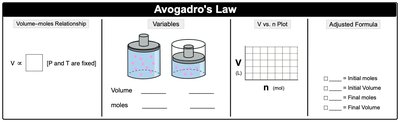
Avogadro’s Law states that the volume of a gas is directly proportional to the number of moles of gas at constant pressure and temperature (P and T fixed).
Mathematical form:
Charles’s Law
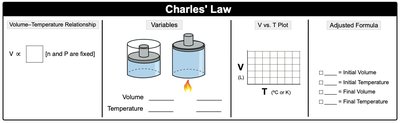
Charles’s Law states that the volume of a gas is directly proportional to its absolute temperature at constant pressure and amount of gas (n and P fixed).
Mathematical form:
Temperature must be in Kelvin.
Combined Gas Law
The Combined Gas Law combines Boyle’s, Charles’s, and Gay-Lussac’s Laws to relate pressure, volume, and temperature for a fixed amount of gas:
Mathematical form:
This law is useful when more than one variable changes.
The Ideal Gas Law
Ideal Gas Law Formula
The Ideal Gas Law relates the four variables of pressure, volume, temperature, and amount of gas:
Formula:
P = Pressure (atm or Pa)
V = Volume (L or m3)
n = Moles of gas
R = Gas constant (0.08206 L·atm/mol·K or 8.314 J/mol·K)
T = Temperature (K)
Use the appropriate value of R based on the units of pressure and volume.
Derivations and Applications
By rearranging the Ideal Gas Law, you can solve for any one variable if the others are known. The law can also be used to derive other relationships, such as the molar mass of a gas or the density of a gas under specific conditions.
Standard Temperature and Pressure (STP)
Definition and Molar Volume
Standard Temperature and Pressure (STP) is defined as 0°C (273.15 K) and 1 atm pressure. At STP, one mole of an ideal gas occupies 22.4 L.
Conversion factor: 1 mol gas = 22.4 L at STP
Dalton’s Law of Partial Pressures
Partial Pressure in Gas Mixtures
Dalton’s Law states that the total pressure of a mixture of non-reacting gases is equal to the sum of the partial pressures of each individual gas:
Formula:
The partial pressure of a gas can be calculated using its mole fraction or fractional composition.
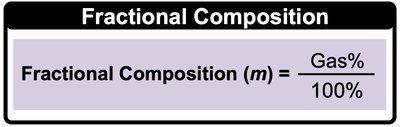
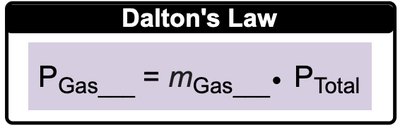
Fractional Composition (m):
Partial Pressure:
Summary Table: Gas Laws and Their Relationships
Law | Variables Related | Mathematical Form | Relationship |
|---|---|---|---|
Boyle's Law | P, V (n, T constant) | Inverse | |
Charles's Law | V, T (n, P constant) | Direct | |
Gay-Lussac's Law | P, T (n, V constant) | Direct | |
Avogadro's Law | V, n (P, T constant) | Direct | |
Combined Gas Law | P, V, T (n constant) | Mixed | |
Ideal Gas Law | P, V, n, T | All variables |
Additional info: The above notes include expanded explanations, definitions, and examples to ensure completeness and academic quality for exam preparation.
