 Back
Chapter 1: Chemistry Basics – Matter and Measurement (GOB Chemistry Study Notes)
Study Guide - Smart Notes
 Tailored notes based on your materials, expanded with key definitions, examples, and context.
Chemistry Basics: Matter and Measurement
Introduction to Chemistry
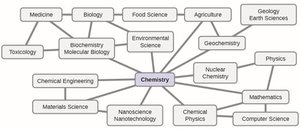
Chemistry is the study of matter and its changes. It is considered the central science because it connects and overlaps with many other scientific disciplines, such as biology, physics, medicine, and environmental science. Chemistry seeks to understand the composition, structure, properties, and reactions of matter.
Matter: Anything that has mass and occupies space.
Science: A process of asking questions, finding principles, and developing theories that are testable and subject to change as new information is discovered.
Why Chemistry Matters
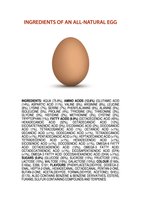
Chemistry is present in everything we interact with daily, from the air we breathe to the food we eat. The term "chemical-free" is a misconception, as all substances, including water and air, are chemicals. Chemistry helps us understand the difference between natural and synthetic substances and their roles in our lives.
1.1 Classifying Matter: Pure Substance or Mixture
Types of Matter
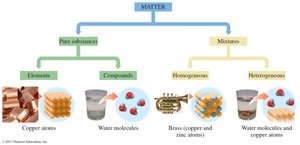
Matter can be classified based on its composition and properties:
Pure Substances: Have a consistent composition and distinct properties. They cannot be separated by physical means and are represented by a single chemical formula.
Mixtures: Contain more than one component, and their properties can vary. They can be separated by physical means and contain more than one chemical formula.
Subclassification
Elements: Pure substances that cannot be broken down by chemical means. Represented by one capital letter (sometimes with a second lowercase letter).
Compounds: Pure substances composed of two or more elements in fixed ratios. Can be separated by chemical means.
Homogeneous Mixtures: Uniform composition throughout (e.g., saline solution).
Heterogeneous Mixtures: Distinct and discernible parts (e.g., a frosted doughnut).
1.2 Elements, Compounds, and the Periodic Table
The Periodic Table
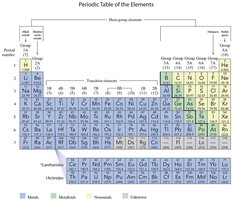
The periodic table organizes elements by increasing atomic number and similar chemical properties. Each element is represented by a chemical symbol (1-3 letters, first capitalized). Groups (columns) and periods (rows) help classify elements further:
Groups: Vertical columns (e.g., Alkali metals, Halogens, Noble gases).
Periods: Horizontal rows.
Metals: Left side; Nonmetals: Right side; Metalloids: Staircase region.
Chemical Formulas
Compounds are represented by chemical formulas that indicate the elements present and the number of atoms of each. Subscripts show the number of atoms; if no subscript, assume one. Parentheses are used to indicate groups of atoms multiplied by a subscript outside the parentheses.
Example: (water) has 2 hydrogen and 1 oxygen atom.
Example: has 1 palladium, 2 sulfur, and 8 oxygen atoms.
1.3 How Matter Changes
Physical vs. Chemical Changes
Matter can undergo two main types of changes:
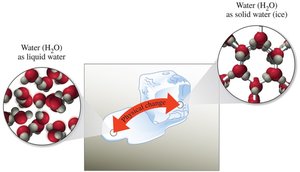
Physical Changes: Alter the form but not the identity of a substance (e.g., melting, boiling, dissolving). Usually reversible.
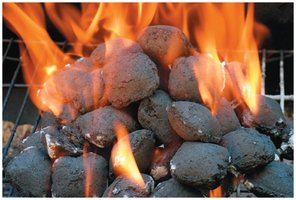
Chemical Changes: Result in the formation of new substances with different identities (e.g., burning, rusting). Usually irreversible.
Chemical Equations
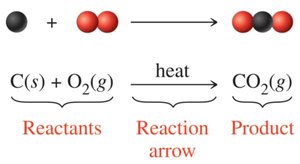
Chemical equations represent chemical reactions, showing reactants (starting materials) and products (ending materials). The reaction arrow indicates the direction of the reaction. States of matter are indicated as (s), (l), (g), or (aq).
Coefficients: Indicate the number of molecules.
Subscripts: Indicate the number of atoms in a molecule.
Balancing Chemical Equations
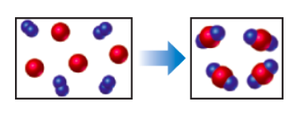
The law of conservation of mass requires that the number and type of atoms on both sides of a chemical equation be equal. Balance equations by adjusting coefficients, not subscripts.
Steps:
Write a chemical inventory for each side.
Balance one element at a time using coefficients.
Check your work and ensure the lowest whole-number coefficients.
1.4 Math Counts
Units and Measurement Systems
Units provide context for measurements. The SI (International System of Units) is the standard in science, with the metric system as its foundation. Common units include meter (m) for length, liter (L) for volume, and gram (g) for mass.
Prefix Multipliers
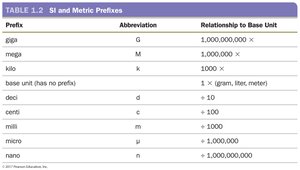
Prefix multipliers are used to express very large or small quantities conveniently. They are applied to base units by powers of ten.
Prefix | Abbreviation | Relationship to Base Unit |
|---|---|---|
giga | G | 1,000,000,000 × |
mega | M | 1,000,000 × |
kilo | k | 1,000 × |
deci | d | 1/10 |
centi | c | 1/100 |
milli | m | 1/1,000 |
micro | μ | 1/1,000,000 |
nano | n | 1/1,000,000,000 |
Scientific Notation
Scientific notation expresses very large or small numbers as a coefficient (between 1 and 10) multiplied by a power of ten. This makes calculations and comparisons easier.
General form:
Example: kg = kg
P
Dimensional Analysis (Unit Conversions)
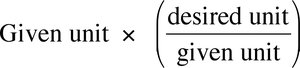
Dimensional analysis is a systematic approach to converting between units using conversion factors. Equivalent units are related by an equal sign, and conversion factors are written as fractions to cancel units.
General formula:
Significant Figures (Sig Figs)
Significant figures reflect the precision of a measurement. All nonzero digits are significant; zeros may or may not be, depending on their position. The last digit in a measurement is always uncertain.
Exact numbers: Have infinite significant figures (e.g., defined conversions, counted values).
Measured numbers: Have a limited number of significant figures.
Rules for Calculations with Significant Figures
Addition/Subtraction: Result should have the same number of decimal places as the measurement with the fewest decimal places.
Multiplication/Division: Result should have the same number of significant figures as the measurement with the fewest significant figures.
1.5 Matter: The “Stuff” of Chemistry
Mass and Volume
Mass: The amount of material in an object. Common unit: gram (g); SI unit: kilogram (kg).
Volume: The amount of space occupied by matter. Common unit: milliliter (mL); SI unit: liter (L). 1 mL = 1 cm3.
Density and Specific Gravity
Density is the ratio of mass to volume, and is a characteristic property of a substance.
Formula:
Specific Gravity: The ratio of the density of a sample to the density of water (unitless).
Temperature Scales
Celsius (°C): Water freezes at 0°C, boils at 100°C.
Kelvin (K): Absolute zero is 0 K; no negative values.
Fahrenheit (°F): Water freezes at 32°F, boils at 212°F.
Energy and Specific Heat
Energy: The capacity to do work or supply heat. SI unit: joule (J); 1 calorie (cal) = 4.184 J.
Specific Heat (c): The amount of heat required to raise the temperature of 1 g of a substance by 1°C.
Formula:
1.6 Measuring Matter
Accuracy and Precision
Accuracy: How close a measurement is to the true value.
Precision: How close repeated measurements are to each other.
Applications in Health and Medicine
SI and metric units are used in health care, but familiarity with U.S. customary units is also necessary.
Dosages, concentrations, and drip rates are calculated using dimensional analysis and conversion factors.
Percentages are used to express concentrations and dosages (e.g., percent active ingredient, percent of adult dose).
