 Back
Chapter 1: Chemistry Basics—Matter and Measurement (GOB Chemistry Study Notes)
Study Guide - Smart Notes
 Tailored notes based on your materials, expanded with key definitions, examples, and context.
Chapter 1: Chemistry Basics—Matter and Measurement
1.1 Classifying Matter: Pure Substance or Mixture
Matter is anything that occupies space and has mass. Understanding the classification of matter is fundamental in chemistry, as it helps distinguish between different types of substances and their properties.
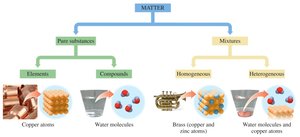
Pure Substances: Matter composed of only one type of substance, represented by a single chemical formula or symbol. Pure substances are further classified as elements (made of one type of atom) and compounds (made of two or more elements chemically combined).
Mixtures: Combinations of two or more substances that can be separated by physical means. Mixtures are classified as homogeneous (uniform composition throughout) or heterogeneous (composition varies throughout).
Element: The simplest form of matter, consisting of only one type of atom.
Compound: A pure substance formed from two or more elements joined chemically in fixed ratios.
Homogeneous Mixture: Also called a solution; composition is uniform throughout (e.g., salt water).
Heterogeneous Mixture: Composition is not uniform; different parts can be seen (e.g., salad).
Example: Brass is a homogeneous mixture of copper and zinc atoms; water and copper atoms form a heterogeneous mixture.
1.2 Elements, Compounds, and the Periodic Table
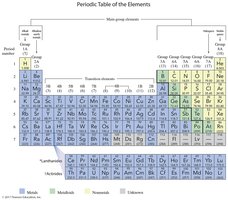
The periodic table organizes all known elements based on their properties. It is a central tool in chemistry for understanding the relationships between elements.
Periodic Table: A chart listing all elements, each represented by a chemical symbol (one or two letters).
Groups: Vertical columns containing elements with similar chemical behaviors. Main-group elements are labeled with 'A', transition elements with 'B', and columns are numbered 1–18 (IUPAC system).
Periods: Horizontal rows numbered 1–7. Sections of periods 6 and 7 are set apart at the bottom.
Metals, Nonmetals, Metalloids: The staircase line separates metals (left) from nonmetals (right); elements bordering the line (except Al) are metalloids.
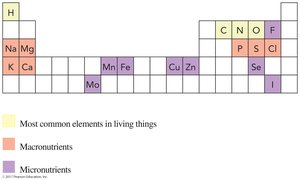
Essential Elements for Health: Carbon, hydrogen, oxygen, and nitrogen are most abundant in biological molecules. Macronutrients (needed >100 mg/day) include Na, Mg, K, Ca, Cl. Micronutrients (needed <100 mg/day) include I, F, Fe, Zn, etc.
Chemical Formula: Shows the elements and the number of atoms in a compound (e.g., for water).
Example: Table salt () is composed of one sodium and one chlorine atom.
1.3 How Matter Changes
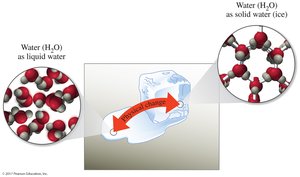
Matter can undergo physical or chemical changes. Physical changes alter the form but not the identity, while chemical changes result in new substances.
Physical Change: Change in state (solid, liquid, gas) or appearance without altering chemical identity (e.g., melting ice).
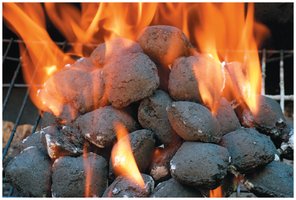
Chemical Change: Change in chemical identity; a chemical reaction forms new substances (e.g., burning charcoal).
Chemical Equation: Represents a chemical reaction, showing reactants and products. Physical states are indicated: (s)olid, (l)iquid, (g)as, (aq)ueous.
Balancing Chemical Equations: The number of atoms must be equal on both sides, illustrating the law of conservation of mass. Coefficients are used to balance equations.
Steps to Balance:
Examine the equation for balance.
Balance one element at a time using coefficients.
Check for smallest possible set of coefficients.
1.4 Math Counts
Mathematical concepts are essential for measuring and analyzing chemical quantities. The metric system (SI) is used for standardization.
SI Units: Mass (kilogram, kg), volume (liter, L), length (meter, m).
Prefixes: Modify units by powers of 10 (e.g., milli-, centi-, kilo-).
Conversion Factors: Used to convert between units (e.g., ).
Dimensional Analysis: Method for converting units using conversion factors.
Significant Figures: Digits known with certainty plus one estimated digit; all nonzero digits are significant. Zeros may or may not be significant depending on their position.
Exact Numbers: Defined values or counted items with infinite significant figures.
Rules for Calculations:
Addition/Subtraction: Match least decimal places.
Multiplication/Division: Match least significant digits.
Rounding: Drop digits based on value; round only at the end of multi-step calculations.
Scientific Notation: , where is the coefficient (1 ≤ C < 10), is the exponent.
Percent: Part per hundred; convert fractions or decimals to percent by multiplying by 100.
1.5 Matter: The “Stuff” of Chemistry
Measurement of matter involves mass, volume, density, temperature, and energy. These properties are fundamental for understanding chemical and physical processes.
Mass: Amount of material in an object, measured in grams (g).
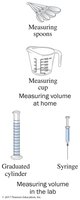
Volume: Space occupied by matter, measured in milliliters (mL) or cubic centimeters (cm3); 1 mL = 1 cm3.
Example: Measuring volume at home (measuring cup, spoons) and in the lab (graduated cylinder, syringe).
Density: Ratio of mass to volume; . Density of water is 1.00 g/mL.
Example: Objects with different densities float or sink in water.
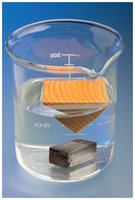
Specific Gravity: Ratio of sample density to water density; unitless.
Temperature: Measured in Fahrenheit (°F), Celsius (°C), or Kelvin (K). Kelvin is the SI unit.
Conversion:
Example: Comparing temperature scales for boiling and freezing points of water.
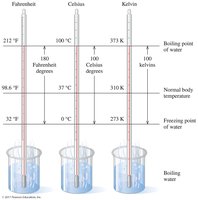
Body Temperature: Normal is 98.6 °F (37.0 °C). Hyperthermia (>40.0 °C), hypothermia (<35 °C).
Energy: Capacity to do work or supply heat. Potential energy is stored; kinetic energy is motion. SI unit is joule (J); calorie is energy to raise 1 g water by 1 °C.
Heat and Specific Heat: Heat flows from warmer to colder bodies. Specific heat is the energy needed to raise 1 g of a substance by 1 °C.
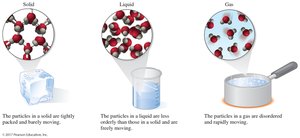
States of Matter: Solid, liquid, gas. Solids have definite shape and volume; liquids have definite volume but variable shape; gases have neither definite shape nor volume.
Example: Particle arrangement and movement in solids, liquids, and gases.
1.6 Measuring Matter
Accurate and precise measurement is crucial in chemistry and health sciences. Understanding units, conversions, and dosing is essential for safe and effective practice.
Accuracy: Measurements close to the true value.
Precision: Measurements consistent with each other.
Units: SI/metric units are standard; U.S. customary units are also used in health care.
Lab Reports: Results are compared to normal values; units may vary widely.
Dosage Calculations: Use conversion factors to ensure correct units.
Drop Units: IV medications measured in drops per mL (gtt/mL); drop factor depends on tubing diameter.
Percents in Health: Used for active ingredient, dosing, and nutrition labeling (%DV).
Summary Table: Classification of Matter
Type | Definition | Example |
|---|---|---|
Element | Pure substance, one type of atom | Copper (Cu) |
Compound | Pure substance, two or more elements chemically combined | Water (H2O) |
Homogeneous Mixture | Uniform composition throughout | Brass (Cu and Zn) |
Heterogeneous Mixture | Composition varies throughout | Salad, water and copper atoms |
Summary Table: SI Units and Conversions
Quantity | SI Unit | Common Conversion |
|---|---|---|
Mass | kilogram (kg), gram (g) | 1 kg = 1000 g |
Volume | liter (L), milliliter (mL) | 1 L = 1000 mL |
Length | meter (m) | 1 m = 100 cm |
Temperature | Kelvin (K), Celsius (°C), Fahrenheit (°F) | K = C + 273; F = 1.8 × C + 32 |
Additional info: Academic context was added to clarify definitions, provide examples, and expand on brief points for completeness and exam preparation.
