 Back
BackChapter 1: Chemistry in Our Lives – Study Notes
Study Guide - Smart Notes
 Tailored notes based on your materials, expanded with key definitions, examples, and context.
Chapter 1: Chemistry in Our Lives
Introduction to Chemistry
Chemistry is the scientific study of matter, including its composition, structure, properties, and the changes it undergoes during reactions. Chemistry is present in everyday activities such as cooking, cleaning, and even starting a car. All substances around us, including toothpaste, soaps, food, and water, are made up of chemicals.
Matter: Anything that has mass and occupies space.
Chemical: A substance with a definite composition and set of properties, found everywhere in daily life.
Examples: Toothpaste, fruit, milk, breakfast cereal, and water are all chemicals. Sunlight is not a chemical, as it is energy, not matter.
The Scientific Method
The scientific method is a systematic approach used by scientists to explore observations, answer questions, and solve problems. It involves making observations, forming hypotheses, conducting experiments, and drawing conclusions. This process is iterative and may require revising hypotheses based on experimental results.
Observation: Gathering information and asking questions about phenomena.
Hypothesis: A proposed explanation or answer to a question, based on observations.
Experiment: A controlled procedure to test the hypothesis and establish relationships between variables.
Conclusion: A statement based on experimental results; if results are consistent, the hypothesis is supported.
Law: A statement that describes consistent observations but does not explain them (e.g., Law of Gravity).
Theory: An explanation developed from multiple experiments supporting a hypothesis.
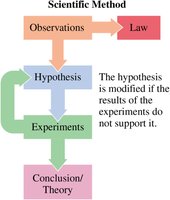
Example: If you sneeze when visiting homes with cats, you might hypothesize you are allergic to cats. Testing this by visiting other homes with cats and observing the same reaction supports your hypothesis.
Studying and Learning Chemistry
Success in chemistry requires effective study habits, connecting new information to prior knowledge, and practicing retrieval for exams. Storing information in long-term memory is essential for mastering chemistry concepts.
Active Learning: Engage with material by asking questions, self-testing, and solving example problems.
Study Strategies: Study regularly, make a plan, and relate new concepts to familiar ideas.
Avoid Passive Review: Simply rereading notes or textbooks is less effective than active engagement.
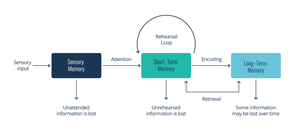
Additional info: The rehearsal loop and encoding are key for transferring information from short-term to long-term memory.
Key Math Skills for Chemistry
Basic math skills are essential for success in chemistry. These include understanding place values, working with positive and negative numbers, calculating percentages, solving equations, and interpreting graphs.
Identifying Place Values
Place value refers to the position of a digit in a number, which determines its value (e.g., ones, tens, hundreds, tenths, hundredths).
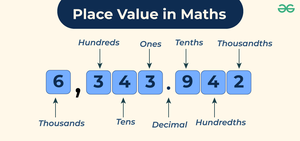
Operations with Positive and Negative Numbers
Multiplication/Division: The product or quotient of two numbers with the same sign is positive; with different signs, it is negative.
Addition: Add numbers with the same sign; for different signs, subtract the smaller from the larger and use the sign of the larger number.
Subtraction: Subtracting a negative is the same as adding a positive.
Calculating Percentages
Percentages express a part per hundred. The formula is:
Example: If a bullet weighs 15.1 g and contains 13.9 g of lead, the percentage of lead is .
Solving Equations
Solving equations involves finding the value of a variable that makes the equation true. Common methods include balancing both sides or using function machines.
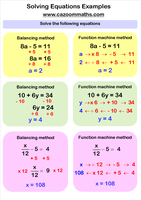
Interpreting Graphs
Graphs visually represent relationships between variables. The x-axis (horizontal) typically shows the independent variable, while the y-axis (vertical) shows the dependent variable. A straight line indicates a direct relationship.
Example: A graph of balloon volume versus temperature shows that as temperature increases, so does volume.
Calculating an Average (Mean)
The average is calculated by summing all data points and dividing by the number of points:
Writing Numbers in Scientific Notation
Scientific notation is a way to express very large or very small numbers using a coefficient and a power of ten:
Example: 64,000 is written as ; 0.021 is .
Converting: Move the decimal point to create a coefficient between 1 and 10, adjusting the exponent accordingly.
